Band 4.5 IELTS Writing Task 1 Model Answer
Overall Band Score: 4.5 · Cambridge IELTS 18 · 2026-11-28
IELTS Writing Task 1 question
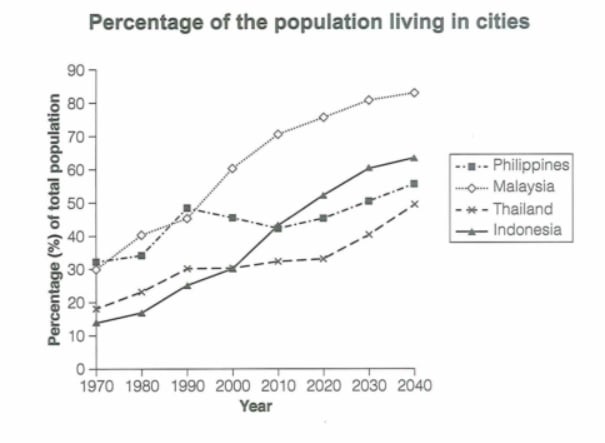
The graph below gives information about the percentage of the population in four Asian countries living in cities from 1970 to 2020, with predictions for 2030 and 2040. Summarize the information by selecting and reporting the main features and make comparisons where relevant.
Student answer (Band 4.5)
The graph provides information about the percentage of the four Asian countries (Philippines, Malasysia, Thailand, Indonesia) living in cities from 1970 to 2020, with predictions for 2030 and 2040.
Overall, all the four countries rose slightly at the beginning with Malaysia having the largest percentage 80 then Indonesia, Philippines and Thailand.
Malayisia rose dramatically from 30 to 80 the same way as Indonesia their population grew steadily between 15 and 60 on the other hand Philippines the population declined gradually between 1990 and 2010 then it climbed sharply in addition Thailand rose considerably to 30 then it remain stable from 1990 to 2010 after than it
AI examiner evaluation
| Criterion | Band |
|---|---|
| Task Achievement / Task Response | 4.0 |
| Coherence and Cohesion | 4.5 |
| Lexical Resource | 5.0 |
| Grammatical Range and Accuracy | 4.5 |
| Overall | 4.5 |
Task Achievement / Task Response: Band 4.0
You identify the chart’s subject and mention relevant trends, including Malaysia’s rise, Indonesia’s growth, and the Philippines’ decline between 1990 and 2010. However, the response is incomplete and addresses the task only minimally: it stops mid-sentence at “after than it,” gives no finished account of Thailand’s later trend, and lacks a clear, accurate overview of the full period. Some figures are also misleading: Malaysia reaches about 84%, not 80%, by 2040, while Indonesia rises to about 64%, not 60%. The response contains 93 words, below the required 150, which limits the detail and comparisons you can provide. Complete the report and select the main trends and end-point comparisons accurately.
Coherence and Cohesion: Band 4.5
There is a basic attempt to organise the response, beginning with an introduction and then moving to an overall statement and country trends. The country names and time references give the reader some sense of the topic. However, the ideas are crowded into one unfinished paragraph, and the final clause breaks off, so the report has no complete progression or conclusion. Linking is also difficult to follow in the long sequence “on the other hand … in addition,” where several countries’ trends are joined without clear sentence boundaries. Use separate paragraphs for the overview and key details, and organise comparisons into complete sentences. A small number of accurate links, such as “whereas” or “by contrast,” would make relationships clearer.
Lexical Resource: Band 5.0
You use some relevant vocabulary for describing trends, including “declined gradually,” “climbed sharply,” “rose dramatically,” and “remain stable.” These choices show an attempt to describe changes rather than simply list figures. However, the range is limited and several phrases are imprecise or repetitive: “the population grew” does not clearly describe the percentage living in cities, and “rose considerably to 30” gives little sense of the trend’s scale. There are also noticeable spelling errors in country names, including “Malasysia” and “Malayisia,” which reduce accuracy. Use precise terms such as “urban population share” and check the spelling of all labels. Vary trend language while keeping it appropriate to the data.
Grammatical Range and Accuracy: Band 4.5
The response attempts to combine ideas using clauses, for example, “Malaysia … the same way as Indonesia,” and includes past-tense trend descriptions. However, sentence structures are limited and several are incomplete or difficult to parse. “Overall, all the four countries rose slightly at the beginning with Malaysia having the largest percentage 80” lacks clear grammatical relationships, while the final “after than it” is unfinished. There are also problems with agreement and tense, as in “it remain stable,” and punctuation is insufficient in the long run-on sequence of trends. Practise writing complete sentences with a clear subject and verb, and use past tense for historical data and future forms for predictions.
See this exact question answered at other band scores. The same prompt compared across bands.
Browse more IELTS Writing model answers or get your own writing scored by the same AI examiner.