Band 5.0 IELTS Writing Task 1 Model Answer
Overall Band Score: 5.0 · Cambridge IELTS 18 · 2026-11-28
IELTS Writing Task 1 question
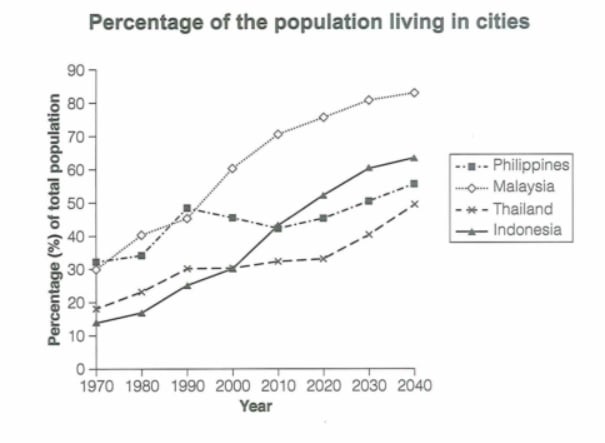
The graph below gives information about the percentage of the population in four Asian countries living in cities from 1970 to 2020, with predictions for 2030 and 2040. Summarize the information by selecting and reporting the main features and make comparisons where relevant.
Student answer (Band 5.0)
The graph illustrates information about percentage of the population in four asian countriesliving in cities from 1970 to 2020, with prediction for 2030 and 2040.
Overall, it is noticeable that there are several percenatges of population living in cities. The highest ratio of population is of malaysia which is 30% in 1970 but gradually increasing to 85% in 2040. The lowest percenatge is of thailand which is 20% in 1970 and steadily increase to 45% in 2040.
It is evident that the percentage of population in indonesia is 10 to 60%, in thailand 20 to 45%, population in malaysia is 30 to 85% and in philippines 30 to 55%. This ratio is the time from 1970 to 2040.
A closer look reveals that there ia large difference between the percentage of malaysia and indonesia. In malaysia the percentage is started from 30% while in indonesia the starting percentage is only 10%
AI examiner evaluation
| Criterion | Band |
|---|---|
| Task Achievement / Task Response | 5.0 |
| Coherence and Cohesion | 5.5 |
| Lexical Resource | 5.0 |
| Grammatical Range and Accuracy | 5.0 |
| Overall | 5.0 |
Task Achievement / Task Response: Band 5.0
You identify the overall upward movement and include approximate starting and ending figures for all four countries, which gives the reader a basic account of the period. However, the response only partially selects and reports the graph’s main features. The overview calls Thailand the lowest throughout, although Indonesia starts lower, and it misses the important changes in ranking: the Philippines peaks around 1990 before falling, while Indonesia rises sharply and overtakes the Philippines by 2020. The statement that Malaysia reaches 85% is a little high compared with the chart’s approximate 84%, but the larger issue is the limited comparison and the inaccurate description of Thailand’s position. Develop the overview around these contrasting trends and support it with key dates and figures.
Coherence and Cohesion: Band 5.5
The response has a recognisable structure, with an introduction, an overview and two detail paragraphs. Basic linking phrases such as “Overall,” “It is evident” and “A closer look reveals” help signal stages of the report. However, the progression is limited: the third paragraph largely repeats the country ranges already given in the overview, and the final paragraph adds only one comparison before stopping. Some references are unclear, particularly “This ratio is the time from 1970 to 2040,” which does not clearly explain what is being compared. Group the countries by meaningful trends—for example, Malaysia’s sustained rise and Indonesia’s rapid growth—and use comparisons to connect the details rather than repeating them.
Lexical Resource: Band 5.0
You use relevant task vocabulary, including “percentage,” “population,” “gradually increasing” and “difference,” so the topic is generally understandable. However, the range is limited and several word choices or forms are inaccurate or repetitive. “Several percentages of population” does not express a clear overall trend, while “highest ratio” and “lowest percentage” are less precise than describing the highest and lowest urban shares. There are also noticeable spelling and form errors, such as “percenatges,” “asian” and “ia,” which reduce polish. Aim for accurate, varied language for trends and comparisons, such as “rose steadily,” “fluctuated,” “overtook” and “accounted for,” and check spelling and country-name capitalization.
Grammatical Range and Accuracy: Band 5.0
The response communicates its basic meaning through mostly simple sentence patterns, and it attempts some longer constructions, such as “A closer look reveals that…” However, the range is limited, and errors occur frequently enough to make several sentences awkward. Examples include “the percentage … is started from 30%,” where the verb construction is faulty, and “the lowest percentage is of Thailand … and steadily increase,” which has an incorrect structure and subject–verb agreement. Articles and prepositions are also often missing or awkward, as in “about percentage of the population” and “in four asian countriesliving.” Practise forming accurate comparisons and trend sentences, and check verb tense and agreement; for example, “Malaysia’s figure rose from 30% to about 84%.”
See this exact question answered at other band scores. The same prompt compared across bands.
Browse more IELTS Writing model answers or get your own writing scored by the same AI examiner.