Band 4.5 IELTS Writing Task 1 Model Answer
Overall Band Score: 4.5 · Cambridge IELTS 18 · 2026-11-28
IELTS Writing Task 1 question
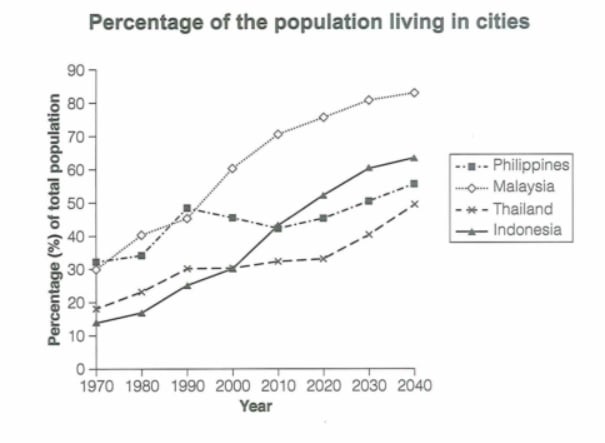
The graph below gives information about the percentage of the population in four Asian countries living in cities from 1970 to 2020, with predictions for 2030 and 2040. Summarize the information by selecting and reporting the main features and make comparisons where relevant.
Student answer (Band 4.5)
First of all I will talk about Philippiness. The people who lives in Philippines, In 1970 only 30% of people were living in cities. But in 1990 it grow up it to 50% of people were living in city. Than it comes down and around 45% of people were livin in in city and from 2000 to 2020 it geow again and reach it 40%.And in the future it will geow more with predication. In Malaysia in 1970 aroun 30% of people were living in cities and in 1980 it grow up to 45% . Which shows a huge change and with the passage of time it grows and in 2010 it reach to 70% which is very massive change and may be the ruler area is changing in to cities. With the passage of time in 2030 to 2040 around 80% or above people will be living in cities. Now in Thiland in Indonesia aroun 20% of people were living in cities. Then in 2000 it reach to 25% and the Indonesia grow more than Thailand to cities . Because with predicatin in 2030 to 2040 Indonesia will move 50% and and Thailand will move only 40%
AI examiner evaluation
| Criterion | Band |
|---|---|
| Task Achievement / Task Response | 4.5 |
| Coherence and Cohesion | 4.0 |
| Lexical Resource | 5.0 |
| Grammatical Range and Accuracy | 5.0 |
| Overall | 4.5 |
Task Achievement / Task Response: Band 4.5
You identify the four countries and make some relevant comparisons, including Malaysia’s strong rise and Indonesia’s projected lead over Thailand. However, the account is incomplete and several key figures or trends are inaccurate. For the Philippines, you say the figure reaches 40% by 2020, whereas it is about 45.5%; you also describe growth from 2000 to 2020, although it first falls and then recovers. The Thailand and Indonesia figures are confused: both are around 30.5% in 2000, not 25%, and Indonesia is already at about 52% in 2020. There is no clear overview of the main patterns, such as Malaysia becoming the most urbanised and Indonesia’s marked acceleration. Select the major trends accurately and summarise them before giving details.
Coherence and Cohesion: Band 4.0
The response follows a country-by-country order, which gives it a basic organising principle, and time references such as “in 1970” and “in 2010” help readers follow some changes. However, the ideas are not arranged into clear paragraphs or a consistent overview-and-details structure. The opening, “First of all I will talk about Philippiness,” is conversational rather than a focused introduction, and the final section abruptly combines Thailand and Indonesia, making their separate trends difficult to track. Linking phrases such as “with the passage of time” are repeated without clarifying the relationships between figures. Group the information into an introduction, an overview, and logically organised detail paragraphs, and use comparisons to connect the countries.
Lexical Resource: Band 5.0
You use some relevant vocabulary for describing change, including “comes down,” “grows,” “huge change,” and “in the future.” This shows an attempt to report trends, but the range is limited and several expressions are repetitive or imprecise. Phrases such as “move 50%,” “grow up,” and “the ruler area is changing in to cities” do not describe urbanisation naturally and may make the intended meaning unclear. Spelling errors, including “Philippiness,” “Thiland,” “aroun,” and “predicatin,” also reduce accuracy. Build a more precise set of chart-reporting expressions, for example “rise to,” “decline,” “remain stable,” and “be projected to reach,” and check spelling and collocations.
Grammatical Range and Accuracy: Band 5.0
You attempt to connect ideas with clauses using “but,” “which,” and “with the passage of time,” and the reader can understand the general topic. However, sentence structures are limited, and errors occur frequently, especially in verb forms, agreement, and sentence boundaries. For example, “The people who lives” has incorrect subject–verb agreement, while “in 1990 it grow up it to 50% of people were living” combines clauses without a workable structure. The sentence beginning “And in the future” is also joined awkwardly to the preceding idea, with missing spaces and punctuation. Practise forming complete sentences with a clear subject and verb, and use past forms for historical data and “is projected to” for forecasts.
See this exact question answered at other band scores. The same prompt compared across bands.
Browse more IELTS Writing model answers or get your own writing scored by the same AI examiner.