Band 4.0 IELTS Writing Task 1 Model Answer
Overall Band Score: 4.0 · Cambridge IELTS 18 · 2026-11-28
IELTS Writing Task 1 question
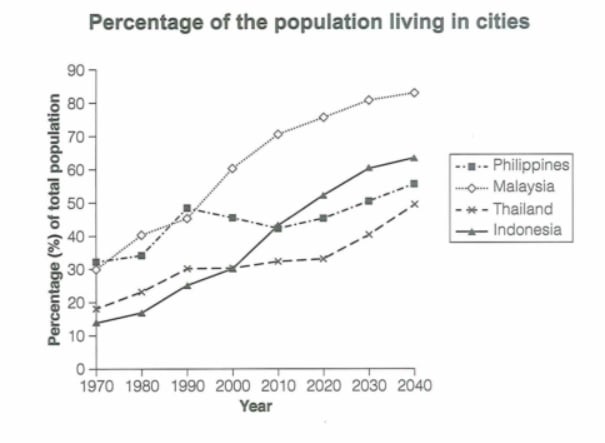
The graph below gives information about the percentage of the population in four Asian countries living in cities from 1970 to 2020, with predictions for 2030 and 2040. Summarize the information by selecting and reporting the main features and make comparisons where relevant.
Student answer (Band 4.0)
in 1970 in the country of philippines the ratio pf popullation were in a very less amount some people were living there they were caring about there places and about their environment so becouse of that the ratio of pullution were also also less but after some time this ratio move to more popullation means some other people came to that couontry with the passage of time the popullation value reach to 20% and then that ratio reach to 50% and the percentage of people reach to a high level after sometime after that if we talk about malaysia so they provide some opportunities to the people of other countries becouse of that tthe ratio of popullation are increasing in malaysia but if we look to the thailand so here are too less ratio of the popullation becouse thay do not provide opportunities like other countries but indonesia have the high ratio of popullation as compare to the others
AI examiner evaluation
| Criterion | Band |
|---|---|
| Task Achievement / Task Response | 3.5 |
| Coherence and Cohesion | 3.5 |
| Lexical Resource | 4.5 |
| Grammatical Range and Accuracy | 4.5 |
| Overall | 4.0 |
Task Achievement / Task Response: Band 3.5
The response makes some attempt to discuss the countries and changes over time, but it does not provide a clear, accurate summary of the graph’s main features. It says the Philippines rose to 20% and then 50%, although the figure was already about 32% in 1970, peaked near 48% in 1990, and is projected to reach about 56% in 2040. The claim that Indonesia has the highest proportion “as compare to the others” is also inaccurate: Malaysia is highest from 2000 onward and is projected to reach about 84%. There is no clear overview of the overall trends or useful, accurate comparisons. Focus on the data shown and report the major rises, fluctuations, and country rankings without inventing explanations about migration or opportunities.
Coherence and Cohesion: Band 3.5
There is a basic attempt to move from the Philippines to Malaysia, Thailand, and Indonesia, and phrases such as “after some time” and “if we talk about” signal transitions. However, the response is presented as one long, loosely connected sequence, with no clear overview or grouping of related trends. Repeated references to “ratio” and “population” do not establish a logical progression, and the reader has difficulty distinguishing the countries’ actual comparisons. Organise the report into clear paragraphs: an introduction and overview, followed by a paragraph comparing the higher figures and another covering the lower or changing trends. Use precise links such as “by contrast” and “while” to show relationships between data.
Lexical Resource: Band 4.5
The response uses a small set of relevant terms, including “ratio,” “percentage,” “population,” and “increasing,” so the general subject is identifiable. However, vocabulary is repetitive and often imprecise: “ratio of population” is not a natural way to describe the chart’s measure, and “very less amount” and “high level” do not communicate specific data clearly. Numerous spelling errors, including “popullation,” “becouse,” and “thay,” also reduce accuracy. The explanations about people caring for the environment and countries providing opportunities use vocabulary that is not supported by the graph. Build a more suitable range for describing trends, such as “proportion,” “urban population,” “rose,” “declined,” and “was projected to reach.”
Grammatical Range and Accuracy: Band 4.5
The response attempts to connect ideas in longer sentences using “but,” “so,” and “because of that,” showing some ability to form more than simple statements. However, sentence boundaries and punctuation are poorly controlled, and many clauses run together, as in the opening sentence beginning “in 1970 in the country of philippines.” There are also recurring problems with agreement and verb forms, such as “the ratio … were” and “this ratio move,” as well as unclear tense choices when describing past data and projections. These errors make relationships between ideas harder to follow. Use shorter, complete sentences, check subject–verb agreement, and use past forms for historical figures and future or projected forms for estimates.
See this exact question answered at other band scores. The same prompt compared across bands.
Browse more IELTS Writing model answers or get your own writing scored by the same AI examiner.