Band 5.5 IELTS Writing Task 1 Model Answer
Overall Band Score: 5.5 · Cambridge IELTS 18 · 2026-11-28
IELTS Writing Task 1 question
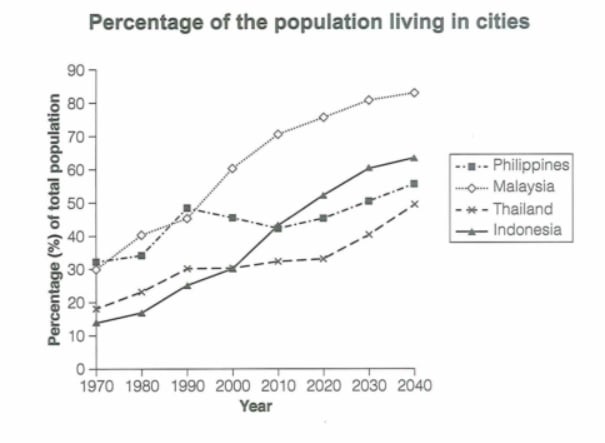
The graph below gives information about the percentage of the population in four Asian countries living in cities from 1970 to 2020, with predictions for 2030 and 2040. Summarize the information by selecting and reporting the main features and make comparisons where relevant.
Student answer (Band 5.5)
This graph illustrates the number of people living in cities across 4 differnet countries in Asia.
Generally the graph tells us the trend of living in city is increased over he last 3 decades in which the Malaysia stands at the top while predicting the future in 2040.
There are 4 countries presented in wich the Indonesia is at the lowest rate 15 percent in 1970 but looking at the future prediction Indonesia will cross the Thialand and Malaysia upto 60 percent, so that clearifies people will move to the cities in future.
On the other hand looking at the Thialnad that is gradually increasing in the graph shows that the trend to move to the cities will be increasing from 20 percent to the 40 percent.Phillipines shows a rapid increse in the year 1990 moved from 30 percent but after that the graduall fall shows the population moves back to th countryside and the graph stops at 50 percent in 2040.
On the top there is Malaysia which will move from 30 percent to the 80 percent in 2040.
AI examiner evaluation
| Criterion | Band |
|---|---|
| Task Achievement / Task Response | 5.5 |
| Coherence and Cohesion | 5.5 |
| Lexical Resource | 5.0 |
| Grammatical Range and Accuracy | 5.0 |
| Overall | 5.5 |
Task Achievement / Task Response: Band 5.5
You identify the overall upward movement in urban populations and note that Malaysia is highest, while the Philippines rises to a peak before declining and then recovering. These are relevant features. However, the overview is unclear about the period covered, and several comparisons are inaccurate or incomplete: Indonesia does not overtake Malaysia by 2040; it reaches about 64%, while Malaysia remains highest at roughly 84%. The Philippines ends at about 56%, not 50%, and Thailand rises to around 50%. The response also gives little detail about the countries’ relative positions across the period. Select the main turning points and end values accurately, and make the overview a clear summary of the key contrasts.
Coherence and Cohesion: Band 5.5
The response has a basic sequence: an introduction, a general statement, and comments on the individual countries. This gives the reader some sense of how the information is organised. However, the progression is not consistently clear, and several ideas are crowded into long sentences, particularly the discussion of Indonesia and the Philippines. Linking phrases such as “On the other hand” do not always show a clear contrast, while “On the top” is an imprecise transition. Grouping countries by their trends or relative levels, then using one focused paragraph for each group, would make comparisons easier to follow. Clearer sentence boundaries and references would also improve cohesion.
Lexical Resource: Band 5.0
You use some relevant topic vocabulary, including “trend,” “prediction,” “gradually increasing,” and “rapid increase,” so the reader can understand the general subject. However, the range is limited and several word choices or collocations are inaccurate, such as “the trend of living in city,” “cross the Thailand and Malaysia,” and “the graph stops at 50 percent.” Spelling errors, including “differnet,” “Thialand,” and “Phillipines,” are noticeable and sometimes make reading less smooth. Aim for precise terms such as “urban population,” “percentage,” and “rise to,” and check country names carefully. Avoid describing the graph as if it stops; report the figure at the final year instead.
Grammatical Range and Accuracy: Band 5.0
The response attempts longer sentences and uses some time references, but the range of sentence structures is limited and complex sentences are often faulty. For example, “Generally the graph tells us the trend of living in city is increased” has an incorrect verb pattern, while “the Malaysia stands at the top while predicting the future in 2040” does not form a clear grammatical relationship. Articles and prepositions are also inconsistent, as in “in wich the Indonesia is at the lowest rate.” These errors sometimes make the intended meaning difficult to follow. Use straightforward, complete sentences first, with accurate subject–verb patterns, and then add subordinate clauses only when their relationships are clear.
See this exact question answered at other band scores. The same prompt compared across bands.
Browse more IELTS Writing model answers or get your own writing scored by the same AI examiner.