Band 4.5 IELTS Writing Task 1 Model Answer
Overall Band Score: 4.5 · Cambridge IELTS 18 · 2026-11-28
IELTS Writing Task 1 question
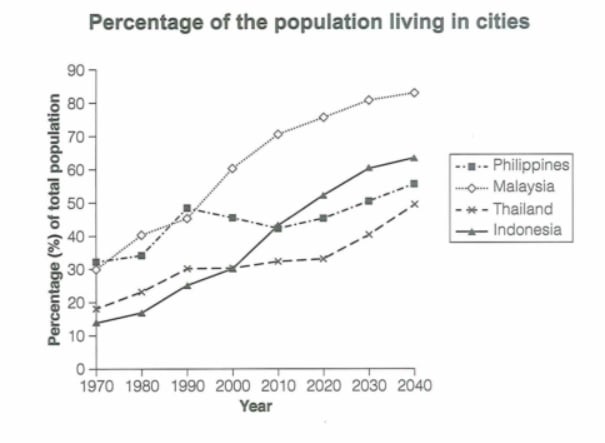
The graph below gives information about the percentage of the population in four Asian countries living in cities from 1970 to 2020, with predictions for 2030 and 2040. Summarize the information by selecting and reporting the main features and make comparisons where relevant.
Student answer (Band 4.5)
the graph show the information about the percentage of the population in four asian countries such as,philippines,Malaysia,Thailand and indonesia living in cities from 1970 to 2020,with predicts for 2030 and 2040.
Overall, The line gragh illustrate the percentage of the population of malaysia increased dramatically while the the the percentage of the population of philippines is start from the 30% to 48%,after that it will be declined to 40% in 2010,and again it will rose to 52%. And the percentage of the population of indonesia begin to 11% to 60% it will be gradully increased.
The percentage of the population of the four countries the malaysia and indonesia all the time increased, the percenatge of the population of malaysia in 1970 begin with 30% to on its peak round about to 85% in 2040. whlile the indonesia in 1970 start from 12%to 60% to 2040, it will be all the time increased.
And the percentage of the population of phlippines and thailand will be up and down.the population of the thailand in 1970 was start from 32% to 45% in 1990. after that it will decreased,and again to rose high.The the thailand population was also up and down.
AI examiner evaluation
| Criterion | Band |
|---|---|
| Task Achievement / Task Response | 4.5 |
| Coherence and Cohesion | 4.5 |
| Lexical Resource | 4.5 |
| Grammatical Range and Accuracy | 4.5 |
| Overall | 4.5 |
Task Achievement / Task Response: Band 4.5
You identify the four countries and the period covered, and you attempt to describe several broad trends. However, the account only minimally reports the graph’s key features, and some important details are inaccurate or unclear. Malaysia rises from about 30% to roughly 84%, and Indonesia increases steadily from around 14% to 64%; these are broadly captured, though some figures are off. The Philippines does not finish at 52%: it is projected to reach about 56% in 2040. More seriously, Thailand starts at about 18%, not 32%, and rises gradually rather than showing the stated rise to 45% by 1990 followed by a fall. Give a clear overview and compare the countries’ levels and changes accurately.
Coherence and Cohesion: Band 4.5
The response has separate paragraphs and uses basic sequencing expressions such as “Overall,” “after that,” and “in 1970,” so there is an attempt to organise the information. However, the progression is difficult to follow because ideas are repeated and some references are unclear. For example, the Malaysia and Indonesia trends are described in both the overview and the next paragraph, while the final paragraph repeats that Thailand is “up and down” without clarifying its actual pattern. The sentence beginning “The percentage of the population of the four countries…” is also hard to interpret. Organise the report into a concise overview followed by grouped comparisons, and use clear links between each country and its figures.
Lexical Resource: Band 4.5
You use some relevant task vocabulary, including “percentage,” “increased,” “declined,” and “peak,” which helps communicate the general subject. However, the range is basic and repetitive, with “the percentage of the population” repeated many times and “up and down” used imprecisely. Several spelling errors, including “gragh,” “percenatge,” “whlile,” and “phlippines,” reduce accuracy and polish. Some expressions are also awkward, such as “begin with 30%” and “rose high.” Build a more precise set of trend terms and check spelling carefully; for example, distinguish a steady rise from a fluctuation and use natural collocations when describing starting and ending values.
Grammatical Range and Accuracy: Band 4.5
The response attempts to connect ideas in longer sentences, but grammatical control is weak and errors frequently make relationships between trends difficult to understand. Examples include “the percentage … is start,” “it will be declined,” and “it will rose,” where verb forms and tense are incorrect. There are also problems with sentence construction and agreement, as in “the Malaysia and indonesia all the time increased,” and punctuation is often missing or misplaced, creating run-on sentences. The range of structures is very limited, with repeated simple patterns and faulty attempts at complex sentences. Practise accurate past-tense descriptions for 1970–2020 and use “is projected to” for future figures, while separating each comparison into a complete sentence.
See this exact question answered at other band scores. The same prompt compared across bands.
Browse more IELTS Writing model answers or get your own writing scored by the same AI examiner.