Band 6.5 IELTS Writing Task 1 Model Answer
Overall Band Score: 6.5 · Cambridge IELTS 18 · 2026-11-28
IELTS Writing Task 1 question
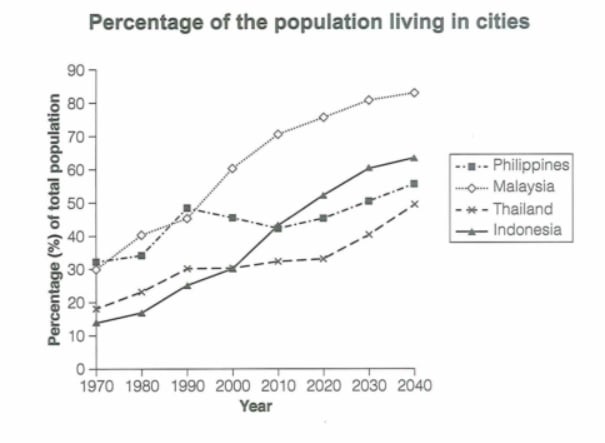
The graph below gives information about the percentage of the population in four Asian countries living in cities from 1970 to 2020, with predictions for 2030 and 2040. Summarize the information by selecting and reporting the main features and make comparisons where relevant.
Student answer (Band 6.5)
The line chart illustrates the proportion of the population of cities in four Asian countries between 1970 and 2020, and making predictions for 2030 and 2040.
Overall, it is evident that population in cities in all four countries had an upward trend. Malaysia and Indonesia increased significantly. However, the number of people is predicted to increase for 2030 and 2040.
In detail, Indonesia accounted for around 12% in 1970 making it the lowest country, but ended up as the second highest in 2020 with more than half of people living in cities. It is expected to grow up around 60%% in 2040. Thailand also had the same upward trend, however it stayed stable at 30% from 2000 to 2010. Thailand city population is predicted to be just under 50% in 2040.
In comparison, Malaysia and the Philippines started around 30% in 1970. The Philippines population had fluctuated throughout the time period, reaching around 45% in 2020. Moreover, the most significant change was the city population of Malaysia which has increased rapidly in the given time period and expected to be 80% in 2040.
AI examiner evaluation
| Criterion | Band |
|---|---|
| Task Achievement / Task Response | 7.0 |
| Coherence and Cohesion | 7.0 |
| Lexical Resource | 6.0 |
| Grammatical Range and Accuracy | 6.0 |
| Overall | 6.5 |
Task Achievement / Task Response: Band 7.0
You provide a clear overview of the broad rise in urbanisation and identify important contrasts, especially Indonesia’s climb to more than half by 2020 and Malaysia’s strong growth. The country-by-country details are generally relevant, and the Philippines’ fluctuation and Thailand’s relative stability are noted. However, some comparisons and figures are imprecise: Indonesia was about 52% in 2020, but its projected figure of around 60% applies to 2030, not 2040, when it is about 64%. The overview also says all four countries had an upward trend without acknowledging the Philippines’ decline after 1990 before its later recovery. More precise comparisons across the final years would make the account more fully developed.
Coherence and Cohesion: Band 7.0
The response is organised into an introduction, an overview and two detail paragraphs, with a generally clear progression from overall trends to country-specific information. Linking expressions such as “Overall,” “In detail” and “In comparison” help signal the structure, and the reader can follow the main comparisons. Some connections are less effective: “However” does not express a clear contrast in the overview, and “Moreover” introduces Malaysia’s growth without a strong relationship to the preceding point about the Philippines. The grouping of Indonesia and Thailand, followed by Malaysia and the Philippines, is workable, but clearer transitions between their trends would strengthen the flow. Keep each comparison explicitly tied to the relevant years.
Lexical Resource: Band 6.0
You use an adequate range of task-related vocabulary, including “proportion,” “fluctuated,” “stable,” “significant change” and “increased rapidly.” These choices communicate the main trends, and the language is varied enough to avoid excessive repetition. Some word choices and collocations are imprecise, however: “population of cities” is less natural than “urban population,” while “grow up around 60%%” is awkward and contains a typographical error. “The number of people” also shifts from the chart’s measure, which is a percentage, and “city population” is repeated where more precise alternatives are available. Aim for accurate collocations and consistent terminology for the share of each country’s population living in cities.
Grammatical Range and Accuracy: Band 6.0
You attempt a mix of simple and complex structures, including the contrast clause “but ended up as the second highest” and the time clause “reaching around 45% in 2020.” Most sentences remain understandable, and errors do not prevent the reader from following the trends. Some grammatical problems persist: the opening phrase “between 1970 and 2020, and making predictions” is not parallel, and “it is expected to grow up around 60%%” lacks a suitable grammatical construction. In “Malaysia … has increased rapidly … and expected to be 80%,” the coordinated verbs do not share a complete structure. There are also tense inconsistencies when describing past data and forecasts. Use parallel verb forms and distinguish past trends from future predictions consistently.
See this exact question answered at other band scores. The same prompt compared across bands.
Browse more IELTS Writing model answers or get your own writing scored by the same AI examiner.