Band 5.0 IELTS Writing Task 1 Model Answer
Overall Band Score: 5.0 · Cambridge IELTS 18 · 2026-11-04
IELTS Writing Task 1 question
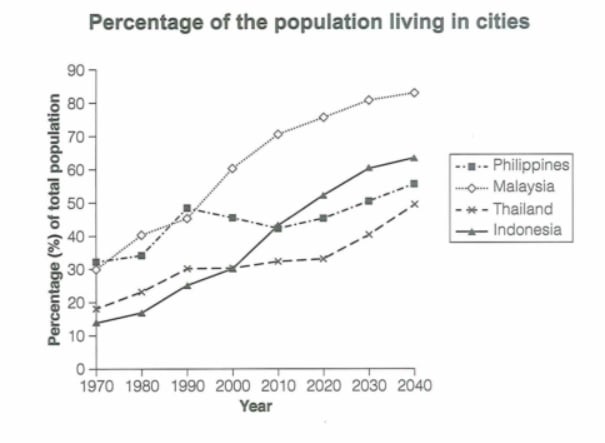
The graph below gives information about the percentage of the population in four Asian countries living in cities from 1970 to 2020, with predictions for 2030 and 2040. Summarize the information by selecting and reporting the main features and make comparisons where relevant.
Student answer (Band 5.0)
The graph compares the proportion of the population for 4 Asian countries from 1970 to 2020 and the predictions for 2030 and 2024.
Overall, the percentage of population for each four countries varies, but they increased throughout the year, even in the prediction for the future. With Malaysia having the highest percentage compared to the three countries.
In the 1970, Indonesia had the lowest population, but it increased significantly through periods of time, and it is predicted to be the second highest population after Malaysia. Thailand, in the other hand, was higher than Indonesia in 1970, but it is predicted that Thailand will be the lowest of them all.
The population in Malaysia in 1970 is 30%, then increased significantly than any other countries, and it is predicted that it will have the highest population of them all. In contras, Philippines was slightly higher than Malaysia in 1970, but compared to Malaysia, it did not increased significantly and it is predicted that it will be the third country with the highest population.
AI examiner evaluation
| Criterion | Band |
|---|---|
| Task Achievement / Task Response | 5.0 |
| Coherence and Cohesion | 5.5 |
| Lexical Resource | 5.0 |
| Grammatical Range and Accuracy | 5.0 |
| Overall | 5.0 |
Task Achievement / Task Response: Band 5.0
You identify several important broad patterns: Malaysia rises strongly and remains the highest, while Indonesia grows substantially and is projected to rank second. However, the overview is not fully accurate: the figures do not increase in every country throughout, since the Philippines falls from about 48% in 1990 to 42.5% in 2010. The opening also gives 2024 rather than 2040, and the response does not report enough key figures to show the scale or timing of the changes. Some comparisons are incorrect: the Philippines was slightly higher than Malaysia in 1970, but it is projected to be second-lowest, not third-highest, in 2040. Select a few accurate figures and describe the main changes more precisely.
Coherence and Cohesion: Band 5.5
The response has a recognisable structure, with an introduction, an overview and separate paragraphs discussing country trends. This helps the reader follow the general topic. However, progression is weakened by repeated claims: Malaysia’s rise and future leading position are stated more than once, while the Philippines comparison is repeated without developing the data. Linking phrases such as “In the other hand” and “In contras” are inaccurate, and the overview’s claim that all four countries increased throughout conflicts with the later description of the Philippines. Organise the body around clear comparisons—for example, the strongest growth, the changing rankings and the more modest trends—and use linking expressions that accurately show contrast or sequence.
Lexical Resource: Band 5.0
You use some relevant task vocabulary, including “proportion,” “predictions,” “increased significantly” and “highest,” so the main subject is generally clear. However, the range is limited and several phrases are imprecise or repetitive, particularly repeated uses of “population” where the graph measures the share of people living in cities. Expressions such as “through periods of time” and “the highest population of them all” are not natural for describing this data, while “in contras” is an inaccurate form. Aim for more precise trend language and vary your comparisons, using terms such as “urbanisation,” “rose,” “declined,” “remained” and “was projected to reach.” This would make the report clearer and more appropriately academic.
Grammatical Range and Accuracy: Band 5.0
You attempt a mixture of simple statements and longer sentences, including clauses with “but” and “while,” and the overall meaning is usually recoverable. However, errors are frequent in basic sentence patterns and verb forms. Examples include “each four countries” instead of “each of the four countries,” “In the 1970” instead of “In 1970,” and “it did not increased,” where the verb should remain in its base form after “did not.” Tense and agreement are also inconsistent in “the population in Malaysia in 1970 is 30%, then increased,” and “it is predicted that it will have.” Practise accurate past-tense descriptions and consistent future projections, as well as articles, prepositions and subject–verb agreement, before adding more complex structures.
See this exact question answered at other band scores. The same prompt compared across bands.
Browse more IELTS Writing model answers or get your own writing scored by the same AI examiner.