Band 5.5 IELTS Writing Task 1 Model Answer
Overall Band Score: 5.5 · Cambridge IELTS 12 · 2026-11-05
IELTS Writing Task 1 question
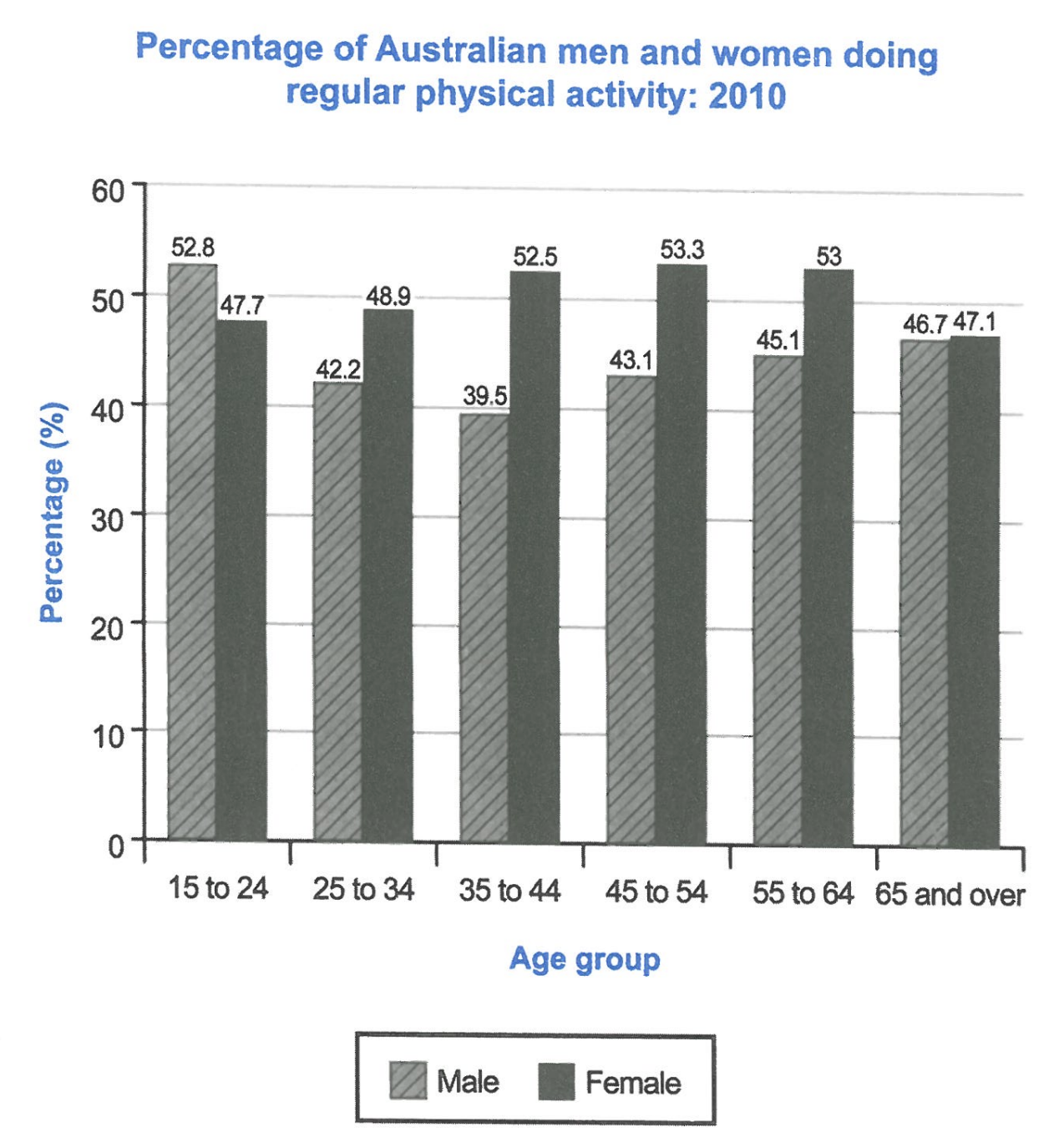
The bar chart below shows the percentage of Australian men and women in different age groups who did regular physical activity in 2010.
Summarise the information by selecting and reporting the main features, and make comparisons where relevant.
Student answer (Band 5.5)
The chart demonstrates the physical activity of men and women from Australia in 2010 shows with through various age groups.
Overall, men in comparision to women are much active in younger ages, but women on the other hand are more active in older ages. And surprisingly, at the age of 65 and above both the genders have almost same level of physical activity.
The three age groups mentioned in the chart 25 to 34, 45 to 54 and 55 to 64 have difference for both genders under 10% but in the other three age groups the percetage varies like 15 to 24 where men are most active with 52.8% and women 47.7%. And the age from 45 to 54 is almost opposite where men are at 43.1% and women are 53.3%. and most interstingly at age 65 and over both the gender stand around 46.7 and 47.1, which is almost same.
In conclusion, It can be said that Austrailian women are more invloved in regular physical activities than men as the numbers are prove that women in all age brackets shows active participation which is not less than 50%.
AI examiner evaluation
| Criterion | Band |
|---|---|
| Task Achievement / Task Response | 5.0 |
| Coherence and Cohesion | 5.5 |
| Lexical Resource | 5.5 |
| Grammatical Range and Accuracy | 5.0 |
| Overall | 5.5 |
Task Achievement / Task Response: Band 5.0
You identify the broad contrast between men’s higher participation among the youngest group and women’s higher rates across most other ages, and you include several accurate figures, such as 52.8% versus 47.7% for ages 15–24 and the near-equal 46.7% and 47.1% among those aged 65 and over. However, the overview is not fully accurate: men are not more active in the younger age groups generally, since women lead at ages 25–34 and 35–44. The conclusion also incorrectly says women’s rates are never below 50%; they are 47.7%, 48.9% and 47.1% in three groups. Select the main pattern more carefully and report the full trend, including the rise and fall in women’s figures and the male low at ages 35–44.
Coherence and Cohesion: Band 5.5
The response has a recognisable paragraph structure, moving from an introduction to an overview, supporting comparisons and a conclusion. This gives the reader some organisation, and phrases such as “Overall” and “In conclusion” signal the stages. However, progression is weakened by repetition: the near-equal figures for the oldest group appear in both the overview and the body, while the final paragraph repeats a broad claim rather than adding a useful summary. Some links are awkward or inaccurate, including “And surprisingly” at the start of a sentence and “And the age from 45 to 54,” which makes the comparison feel disconnected. Group related figures into a clearer sequence and use linking phrases to show contrasts precisely.
Lexical Resource: Band 5.5
You use relevant vocabulary for describing the chart, including “physical activity,” “age groups,” “percentage,” and “active,” so the topic remains understandable. There are also attempts at more descriptive phrasing, such as “almost opposite” and “involved in regular physical activities.” However, several choices are imprecise or unnatural, including “much active,” “the numbers are prove,” and “both the gender stand.” Spelling errors such as “comparision,” “percetage,” “interstingly,” and “Austrailian” are noticeable and reduce control. Aim for accurate collocations and consistent terms for participation rates; avoid conversational emphasis such as “surprisingly” unless it adds a clear analytical point.
Grammatical Range and Accuracy: Band 5.0
The response attempts both simple and longer sentence forms, including comparisons with “where” and a concluding clause beginning “as.” However, complex sentences are often faulty, and errors sometimes make relationships difficult to follow. For example, the opening sentence has an unclear structure (“demonstrates … shows with through”), while “the numbers are prove” has an incorrect verb form. There are also agreement and article problems in “both the gender stand” and “women … shows,” as well as sentence-boundary and capitalization issues after full stops. Build accuracy first with clear subject–verb patterns, then combine clauses using controlled structures such as “whereas” and “while.”
See this exact question answered at other band scores. The same prompt compared across bands.
Browse more IELTS Writing model answers or get your own writing scored by the same AI examiner.