Band 6.0 IELTS Writing Task 1 Model Answer
Overall Band Score: 6.0 · Cambridge IELTS 12 · 2026-11-08
IELTS Writing Task 1 question
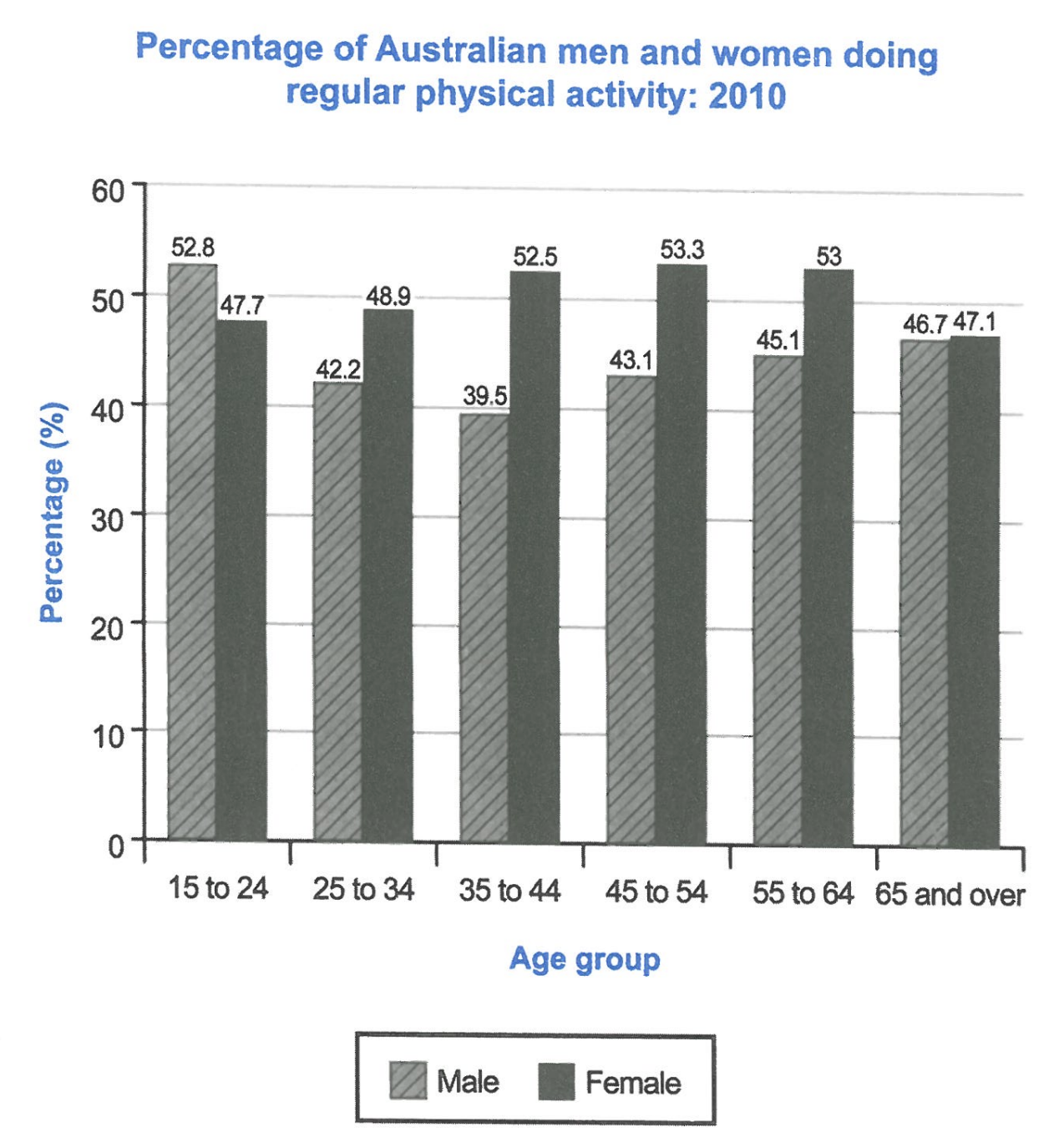
The bar chart below shows the percentage of Australian men and women in different age groups who did regular physical activity in 2010.
Summarise the information by selecting and reporting the main features, and make comparisons where relevant.
Student answer (Band 6.0)
The bar chart illustrates changes in the proportion of Australian men and women doing regular physical activity in 2010. Figures are expressed in percentage.
Overall, female recorded the highest figure for most of the period, while male experienced the lowest rate of doing physical exercise.
Looking first at the male, its figure stood at 52.8% in the age group of 15 to 24, before declining to 42.2% in the age group of 25 to 34 and 39.5% people aged 35 to 44 respectively. It subsequently recovered to 43.1% in the age group of 45 to 54 and 45.1% those between the ages of 55 and 64.
Turning to the female, the figure stood at 47.7% people aged 15 to 24, before rising to 48.9% ,52.5%, 53.3% and 53% in the age group of 25 to 34, 35 to 44, 45 to 54 and 55 to 64 respectively.
The male and female remained the almost same proportion of physical exercise in aged group 65 to over.
AI examiner evaluation
| Criterion | Band |
|---|---|
| Task Achievement / Task Response | 5.5 |
| Coherence and Cohesion | 6.5 |
| Lexical Resource | 5.5 |
| Grammatical Range and Accuracy | 5.5 |
| Overall | 6.0 |
Task Achievement / Task Response: Band 5.5
You identify the chart’s subject and report several accurate figures, including the male decline from 52.8% to 39.5% and the female rise to a peak of 53.3%. However, the overview is too broad and partly misleading: women did not have the highest rate in most age groups, since men led among 15–24-year-olds. The statement that men had the lowest rate also needs qualification; the overall minimum was men aged 35–44. Most importantly, the final age group is not reported with its actual values (46.7% for men and 47.1% for women), and saying the rates were “almost the same” leaves this comparison unsupported. A more precise overview and complete coverage of the key comparisons would strengthen the response.
Coherence and Cohesion: Band 6.5
The response has a clear overall arrangement: an introduction and overview are followed by separate paragraphs for male and female figures. Sequencing within the male paragraph is easy to follow, and phrases such as “Looking first” and “Turning to” help signal the shift. This meets the lower-band expectation of coherent organisation and shows some effective progression. However, the final sentence is detached from the preceding female paragraph and introduces the 65-and-over comparison without giving the figures, so the ending feels incomplete. Some linking is also mechanical, with repeated “in the age group of” constructions. Connect the final comparison to both series and use varied, precise transitions to make the progression more natural.
Lexical Resource: Band 5.5
You use relevant chart vocabulary, including “proportion,” “declining,” “recovered,” and “rising,” and the reader can generally understand the trends you describe. However, the range is limited and several word choices or collocations are noticeably inaccurate. “Female recorded” and “the male” are awkward ways to refer to the groups; “female” and “male” are also used as nouns where “women” and “men” would sound more natural. “The lowest rate of doing physical exercise” is cumbersome, while “in percentage” should be “in percentages” or, more naturally, “as percentages.” Aim for concise, conventional chart language and avoid repeating “age group” in nearly every comparison.
Grammatical Range and Accuracy: Band 5.5
You attempt a mix of sentence forms, including a complex trend sentence with “before” and “subsequently,” and most of the intended meaning remains understandable. However, errors in agreement, articles, and sentence construction are frequent enough to limit accuracy. For example, “female recorded” and “male experienced” do not agree with the plural groups, while “Looking first at the male, its figure” has an unclear pronoun reference. The phrase “39.5% people aged 35 to 44 respectively” is not a complete, well-formed comparison, and “The male and female remained the almost same proportion” contains several structural problems. Practise accurate plural subjects and complete comparison patterns, such as “The figures for men and women were nearly equal.”
See this exact question answered at other band scores. The same prompt compared across bands.
Browse more IELTS Writing model answers or get your own writing scored by the same AI examiner.