Band 5.5 IELTS Writing Task 1 Model Answer
Overall Band Score: 5.5 · Cambridge IELTS 12 · 2026-11-08
IELTS Writing Task 1 question
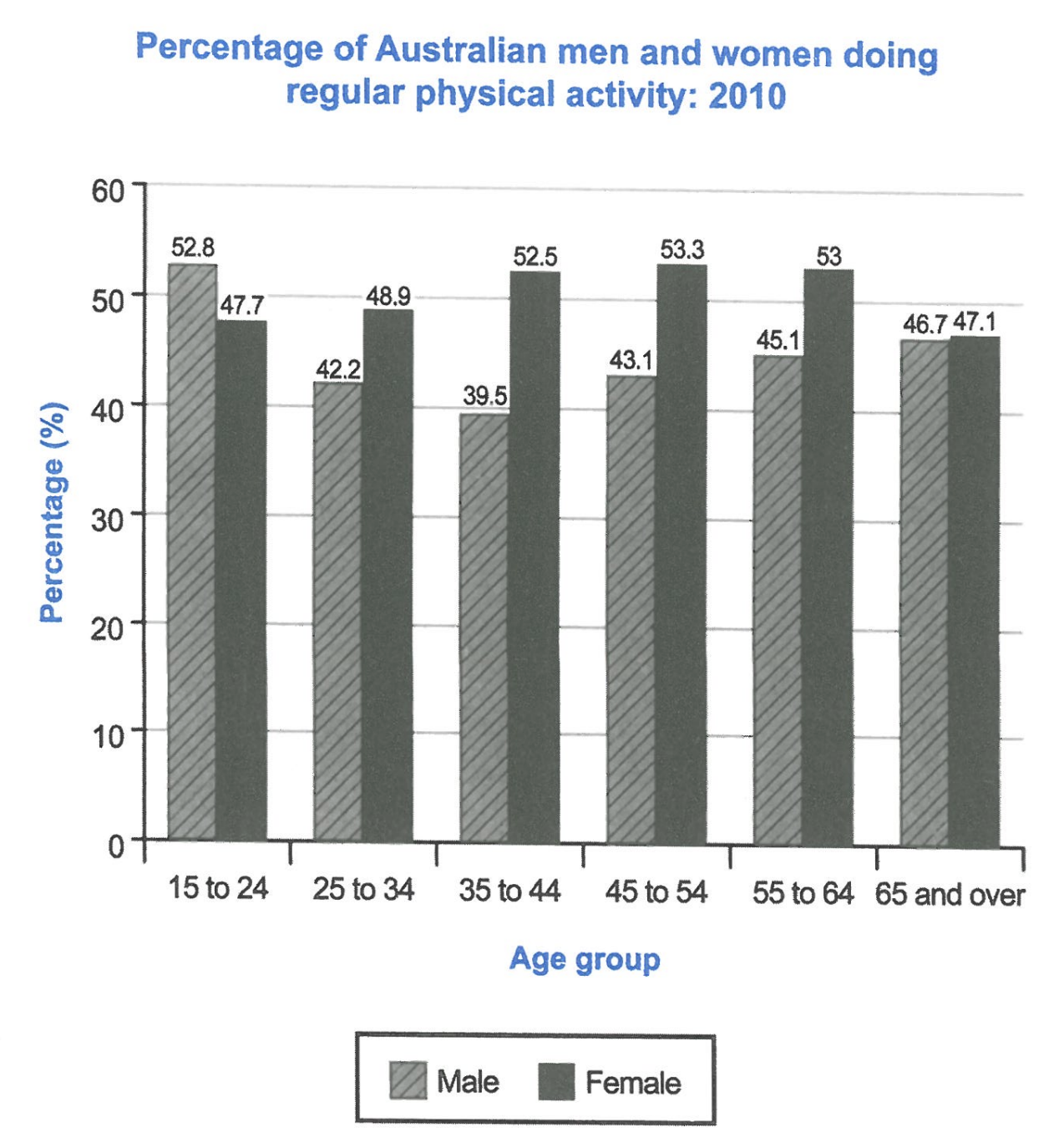
The bar chart below shows the percentage of Australian men and women in different age groups who did regular physical activity in 2010.
Summarise the information by selecting and reporting the main features, and make comparisons where relevant.
Student answer (Band 5.5)
The bar chart illustrated the proportion of everyday physical activity by men and women of different age in Australia,2010.
Overall, the women, aged between 25 to 64 did the regular exercise more the the men but the most noticeable is the age between 15 to 24 ,where the men surpassed the women and came to the top.
52.85% of men aged under 24 did regular while 47.7% of women did the regular activity. In addition, the women did daily exercise of 48.9% surpassing men, men lose their ability of doing regular exercise after 24 years of age. the most noticeable is after the age of 65, both gender get the same result of daily activity of about 47%.
In comparison, women takes over men after the age of 25 to 64 . the aged between 35 to 44, men lose their interest of doing daily activity maybe because of house holding but the women surpasses and try their best to maintain their physical health.
AI examiner evaluation
| Criterion | Band |
|---|---|
| Task Achievement / Task Response | 6.0 |
| Coherence and Cohesion | 5.5 |
| Lexical Resource | 5.5 |
| Grammatical Range and Accuracy | 5.0 |
| Overall | 5.5 |
Task Achievement / Task Response: Band 6.0
You identify the main contrast: men have the higher figure in the youngest group, while women lead across most of the middle age groups. You also include several relevant percentages, such as 52.8% and 47.7% for ages 15–24, and note that both figures are close to 47% among people aged 65 and over. However, the overview is not fully accurate: women lead in the 25–64 groups, but the chart shows men at 46.7% and women at 47.1% in the oldest group, rather than the same result. The claim that men “lose their ability” after 24 is too broad, since their rate rises again after ages 35–44. Explanations about housework and interest are speculative and should be replaced with clearer reporting of the data.
Coherence and Cohesion: Band 5.5
The response has a recognisable structure, with an introduction, an overview and two detail paragraphs, and phrases such as “Overall” and “In comparison” help signal relationships. However, progression within the detail paragraphs is uneven: figures for different age groups are presented without a consistent sequence, and the final paragraph repeats the point that women exceed men. Some links are also unclear, particularly “In addition” before the comparison of the 25–34 group, and the long sentence beginning “the most noticeable is after the age of 65” combines several ideas. Organise the figures in age order and group the male and female trends clearly; use linking expressions only when they accurately describe the relationship between points.
Lexical Resource: Band 5.5
You use relevant task vocabulary, including “proportion,” “surpassed,” and “maintain their physical health,” and the reader can generally understand the comparisons you intend. However, several choices are imprecise or unnatural for describing chart data. “Everyday physical activity” and “daily exercise” suggest daily frequency, which the chart does not specify; “regular physical activity” is more accurate. Phrases such as “men lose their ability” and “lose their interest” make unsupported claims about causes or capacity rather than describing percentages. There is also repetition of “regular” and “daily activity.” Aim for precise reporting verbs and nouns, such as “the proportion fell” or “women recorded a higher rate,” rather than attributing motives.
Grammatical Range and Accuracy: Band 5.0
You attempt a mix of sentence forms, including a relative clause in “women, aged between 25 to 64” and a comparison using “while.” However, errors in sentence construction and agreement are frequent enough to make some passages difficult to follow. For example, “the women … did the regular exercise more the the men” has faulty comparison structure, and “women takes over men” has subject–verb disagreement. The sentence beginning “the most noticeable is after the age of 65” is also awkwardly constructed, while punctuation and capitalisation are inconsistent, as in “2010” and “the age of 65.” Use complete, controlled sentences, check singular and plural agreement, and punctuate each comparison clearly.
See this exact question answered at other band scores. The same prompt compared across bands.
Browse more IELTS Writing model answers or get your own writing scored by the same AI examiner.