Band 6.5 IELTS Writing Task 1 Model Answer
Overall Band Score: 6.5 · Cambridge IELTS 12 · 2026-11-08
IELTS Writing Task 1 question
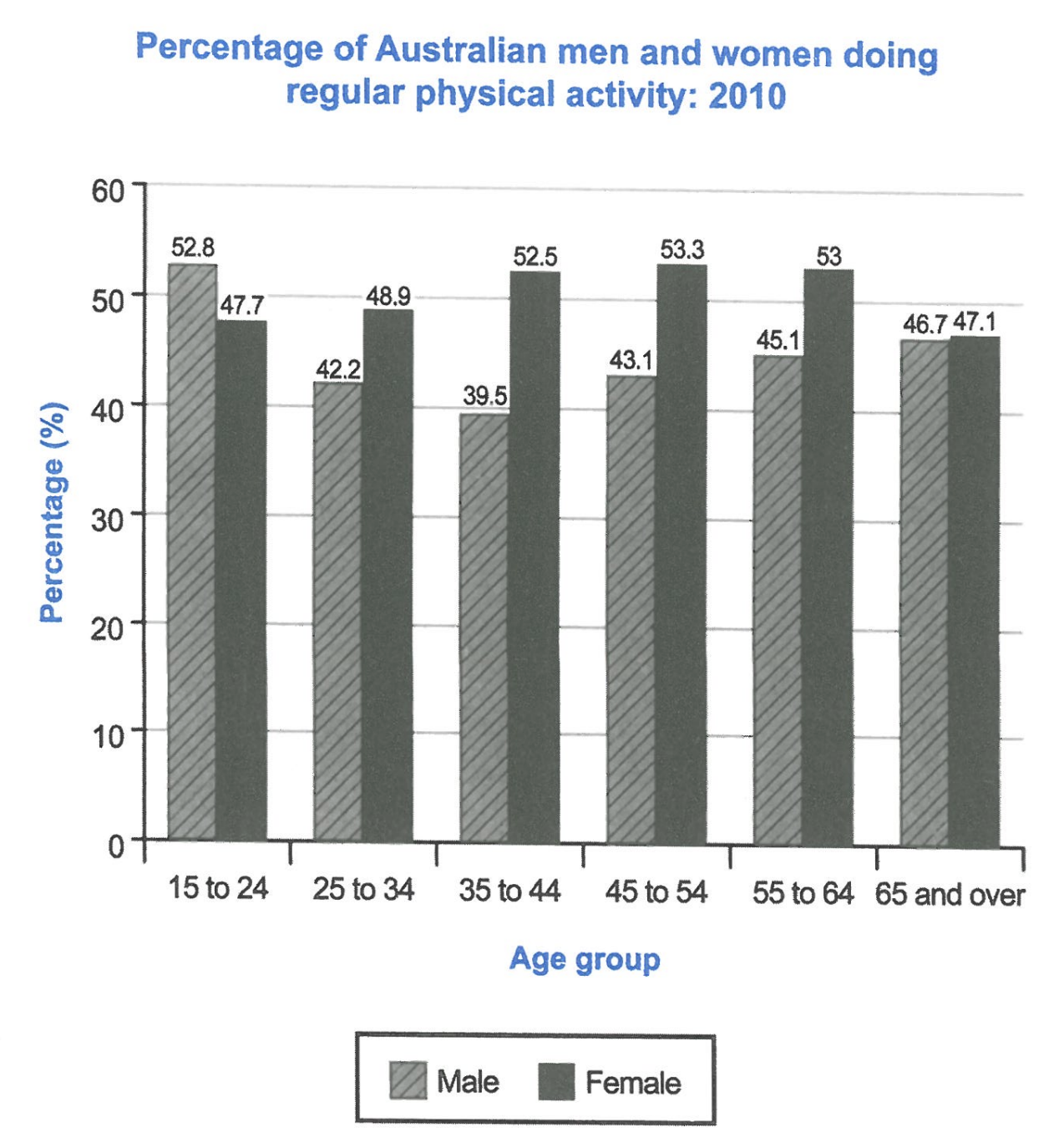
The bar chart below shows the percentage of Australian men and women in different age groups who did regular physical activity in 2010.
Summarise the information by selecting and reporting the main features, and make comparisons where relevant.
Student answer (Band 6.5)
The bar chart compares the proportion of Australian males and females across six age categories who exercised daily in 2010.
Overall, the most of the females from almost all categories were more physicaly active than males, except among youngest cohorts. Although there was a little gap can be seen among those aged 65 and above, those who aged 35 to 44 showed a wider gap.
Males and females aged 15 to 24 accounted for 52.8% and 47.7%, respectively. Moreover, Females aged 25 to 34 stood at 48.9%, which was slightly higher than males, at 42.2%. Likewise, males aged 35 to 44 constituted 39.5%, which was lower than females, at 52.5%.
Similarly, females aged 45 to 54 and those aged 55 to 64 accounted for 53.3% and 53%, compared to males, at 43.1% and 45.1%. By contrast, males and females who were 65 years old and over accounted for 46.7% and 47.1%, respectively.
AI examiner evaluation
| Criterion | Band |
|---|---|
| Task Achievement / Task Response | 7.0 |
| Coherence and Cohesion | 7.0 |
| Lexical Resource | 6.0 |
| Grammatical Range and Accuracy | 6.0 |
| Overall | 6.5 |
Task Achievement / Task Response: Band 7.0
The response gives a clear overview of the main pattern: women recorded higher activity in every age group except 15–24, and the largest gender gap was among 35–44-year-olds. It supports this with relevant figures, including 39.5% for men versus 52.5% for women in that group, and accurately reports the near-equal figures for those aged 65 and over. The comparisons across the remaining groups are also generally well selected and accurate. One imprecision is the phrase “except among youngest cohorts,” which could suggest more than one exception; only the 15–24 group has a higher male figure. Also, “exercised daily” is more specific than the chart’s “regular physical activity.” Keep the overview precise and describe the measure faithfully.
Coherence and Cohesion: Band 7.0
The response is organised effectively into an introduction, an overview and two detail paragraphs. The information progresses logically from the overall gender pattern to comparisons by age group, and linking expressions such as “Moreover,” “Likewise” and “By contrast” help signal relationships between figures. The grouping of the older age categories in the final paragraph is clear, and the comparisons are easy to follow. To make cohesion more flexible, avoid relying on a sequence of similar sentence patterns that repeatedly state one figure and compare it with another. You could group related age bands more explicitly—for example, the groups where women’s rates peak—and use references such as “this difference” to connect comparisons without repeating the same structure.
Lexical Resource: Band 6.0
There is an adequate range of task-related vocabulary, including “proportion,” “accounted for,” “stood at” and “gap,” which allows the main comparisons to be communicated. Some less natural or inaccurate choices limit precision: “exercised daily” changes the chart’s meaning, while “more physicaly active” is an awkward phrase and contains a spelling error. “The most of the females” is also not idiomatic, and “cohorts” is less suitable here than a straightforward reference to age groups. Aim for accurate, natural collocations and check spelling, especially in the overview, where wording needs to summarise the data precisely.
Grammatical Range and Accuracy: Band 6.0
The response uses a mix of simple statements and more complex comparative clauses, as in “which was slightly higher than males” and “which was lower than females.” Most meanings remain clear, but some grammatical errors are noticeable. In the overview, “the most of the females” has an incorrect determiner, and “there was a little gap can be seen” combines incompatible structures. The phrase “those who aged 35 to 44” also needs a relative-clause form such as “those who were aged 35 to 44.” Capitalisation is inconsistent in “Females” after “Moreover.” Review article and clause patterns, and vary sentence structures while keeping them accurate.
See this exact question answered at other band scores. The same prompt compared across bands.
Browse more IELTS Writing model answers or get your own writing scored by the same AI examiner.