Band 5.5 IELTS Writing Task 1 Model Answer
Overall Band Score: 5.5 · Cambridge IELTS 12 · 2026-11-09
IELTS Writing Task 1 question
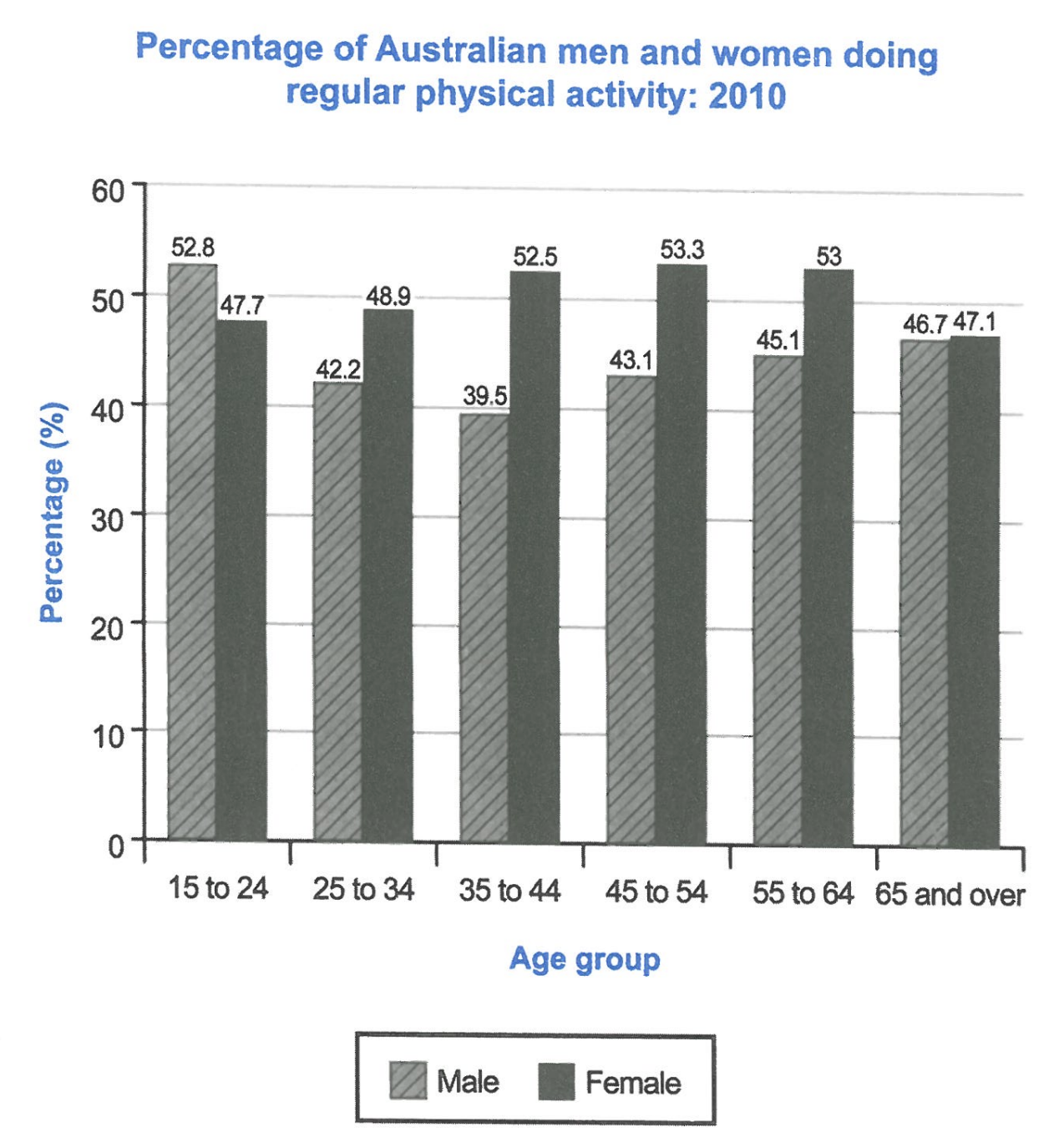
The bar chart below shows the percentage of Australian men and women in different age groups who did regular physical activity in 2010.
Summarise the information by selecting and reporting the main features, and make comparisons where relevant.
Student answer (Band 5.5)
The bar illustrated the percentage of Australian men and women in different age groups who do regular physical activity in 2010. The data was calculated as a percentage.
Overall, adults aged group in male perform more physical activity compare with femal. To follow youngter age group femal perform more physical activity; this trend continued and also dominated the male in physical activity. At the old age group both groups do equally physical activity.
In the 15 to 24 age group, males do more physical activity compared with females; in proportion, males do 52.8% and females 47.7%. The 25 to 34 age group, femal do 48.9% and male recoarded less 42.2 % at activity. For the 35 to 44 age group: males consistently decreased in physical performance male 39.5 % and femal 52.5%. In the 45 to 54 age group, females recorded the highest figure, around 53.3%, and males slightly increased to 43.1%.
In the 55 to 64 age group, females were more active, at around 53% and male 45.1% but at 65 above both age group performed similar physical activity around 46.1.
AI examiner evaluation
| Criterion | Band |
|---|---|
| Task Achievement / Task Response | 6.0 |
| Coherence and Cohesion | 6.0 |
| Lexical Resource | 5.5 |
| Grammatical Range and Accuracy | 5.0 |
| Overall | 5.5 |
Task Achievement / Task Response: Band 6.0
You cover the chart’s main comparisons and include several accurate figures, such as 52.8% for men and 47.7% for women aged 15–24, and the female peak of 53.3% among 45–54-year-olds. The overview also recognises that women exceed men across most age groups. However, it is unclear when you say “adults aged group in male perform more,” since men lead only in the youngest group; the later statement that both sexes are “equally” active is also not quite accurate, as the figures are 46.7% and 47.1%. The overview would be stronger if it clearly stated these two key patterns and the male low point at ages 35–44. Some comparisons are reported more fully than others.
Coherence and Cohesion: Band 6.0
The response has a clear overall structure: an introduction, an overview, and paragraphs reporting the age-group figures. The sequence from the youngest to the oldest group is easy to follow, and phrases such as “In the 15 to 24 age group” help orient the reader. However, the overview’s ideas are difficult to follow because the relationship between “adults aged group in male” and “youngter age group femal” is unclear, and the claim that women “dominated the male” is not expressed precisely. Some transitions are also abrupt, particularly the move into “The 25 to 34 age group.” Use clearer comparison links such as “By contrast” and “whereas,” and make each overview statement express one distinct trend.
Lexical Resource: Band 5.5
You use a relevant range of chart vocabulary, including “percentage,” “recorded,” “decreased,” and “increased,” and the reader can generally understand the comparisons. However, several word choices and collocations are inaccurate or unnatural, including “do regular physical activity,” “perform more physical activity compare with,” and “dominated the male in physical activity.” There are also spelling errors such as “femal,” “youngter,” and “recoarded,” which reduce precision. Aim for standard reporting phrases such as “were more physically active than” and “the proportion of women was higher.” More accurate collocations and careful spelling would make the description clearer and more fluent.
Grammatical Range and Accuracy: Band 5.0
You attempt both simple statements and longer comparisons, and most of the figures remain understandable. However, some sentence structures and verb forms are inaccurate. For example, “adults aged group in male perform” lacks a clear grammatical structure, while “femal do 48.9% and male recoarded less 42.2%” does not form a complete, well-controlled comparison. The present-tense forms “do” and “perform” are also inconsistent with the chart’s past reference year; use “were” or “recorded.” Articles and plural forms need attention in phrases such as “the 35 to 44 age group” and “both age groups.” Practise building accurate comparison clauses, while retaining the range of sentence forms you attempt.
See this exact question answered at other band scores. The same prompt compared across bands.
Browse more IELTS Writing model answers or get your own writing scored by the same AI examiner.