Band 4.0 IELTS Writing Task 1 Model Answer
Overall Band Score: 4.0 · Cambridge IELTS 12 · 2026-11-09
IELTS Writing Task 1 question
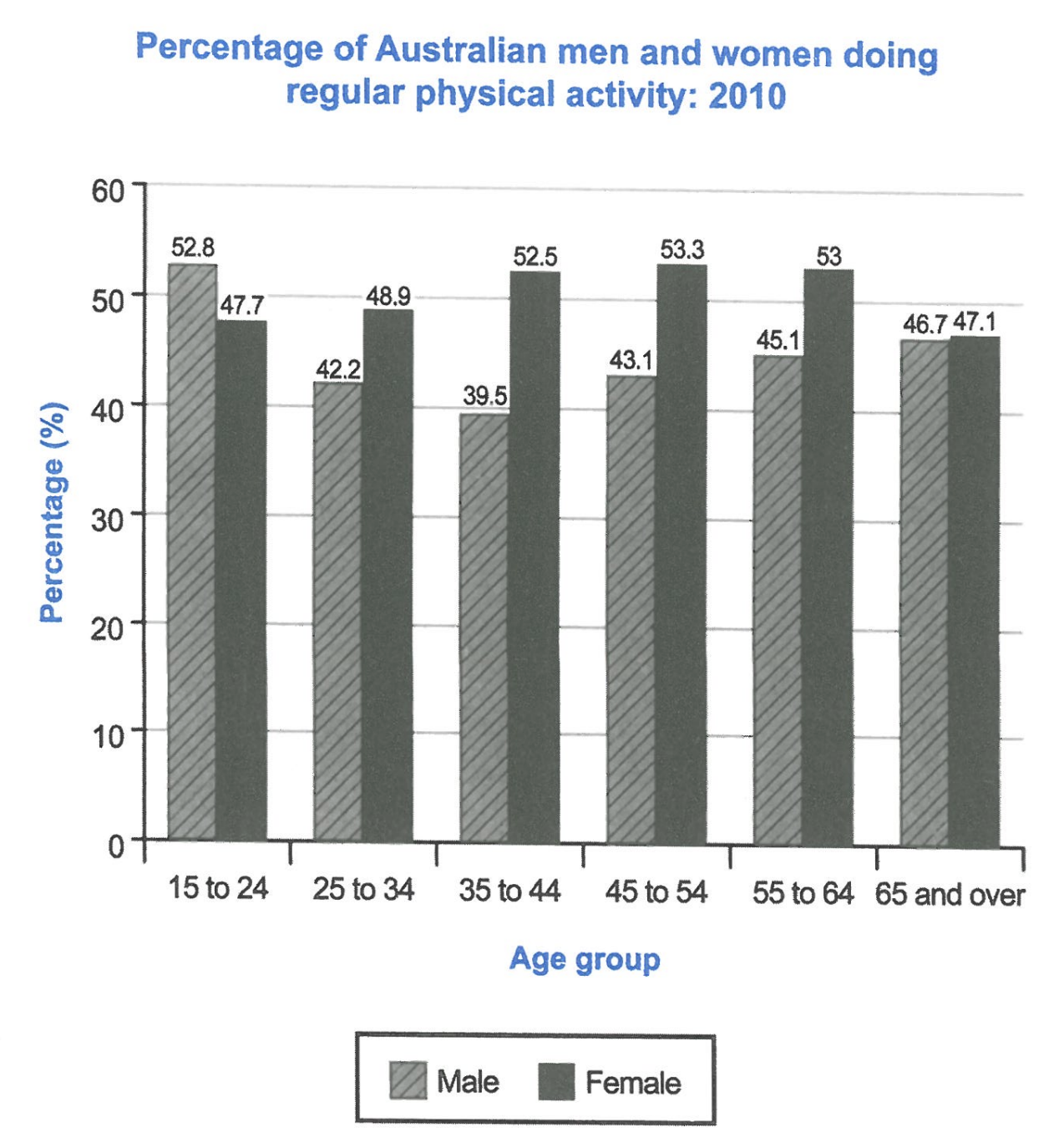
The bar chart below shows the percentage of Australian men and women in different age groups who did regular physical activity in 2010.
Summarise the information by selecting and reporting the main features, and make comparisons where relevant.
Student answer (Band 4.0)
The given bar chart illustrates that the percentage of australian mens and womens that performed physical activities in different ages from 2010. The age aound fifty to sixty in this age the regular physical doing activites range in the 2010.
Firstly, I disscus the young age people of 15 to 34 age group people was doing physical activity of male was 52.8and 42.2 percent inthe other hand the percentage of womens was47.7 and 48.9 percent. while the age of 35to 50 above mans and womens physical activity participation rate of mans was 39.5 and 43.1percent and the range of womens was 43.1 percent. Moreover the people that wasin old age and the age was above to sixty and its over. the percentage of mans was 46.7 and the age of womens was 47.1 pewrcent
ove
AI examiner evaluation
| Criterion | Band |
|---|---|
| Task Achievement / Task Response | 3.5 |
| Coherence and Cohesion | 4.0 |
| Lexical Resource | 4.5 |
| Grammatical Range and Accuracy | 4.5 |
| Overall | 4.0 |
Task Achievement / Task Response: Band 3.5
You identify the chart’s subject and include several relevant figures, including the male rate of 52.8% among 15–24-year-olds and the female rate of 53.3% among 45–54-year-olds. However, the response does not provide a clear overview of the main patterns, and some comparisons are inaccurate or incomplete. For example, you give 43.1% as the women’s rate for the 35–44 and 45–54 groups, although the chart shows 52.5% and 53.3%; the 43.1% figure is for men aged 45–54. The description of “35to 50 above” also blurs the age groups. The response is 15 words below the required minimum. To improve, add a concise overview and report the key gender differences and trends accurately.
Coherence and Cohesion: Band 4.0
There is a basic attempt to organise the response, beginning with an introduction and then using “Firstly” and “Moreover” to move through age groups. This gives the reader some sense of sequence. However, the ideas are not arranged into clear, complete sections, and the overview is missing. Several sentences run together or stop abruptly, such as the opening fragment about “the age aound fifty to sixty,” and the final “ove” is unfinished. Linking phrases such as “while” and “on the other hand” do not consistently clarify the comparisons. Use separate paragraphs for an overview and the detailed comparisons, and connect each age group to its male and female figures in complete sentences.
Lexical Resource: Band 4.5
You use some task-relevant vocabulary, including “percentage,” “age group,” and “participation rate,” so the topic is generally recognisable. However, the range is limited and several phrases are inaccurate or awkward, such as “regular physical doing activities” and “the percentage of australian mens and womens.” Spelling errors—including “disscus,” “aound,” and “pewrcent”—also reduce clarity, while repeated use of “age” and “percentage” makes the description less precise. Aim for natural chart language and accurate forms: for example, “the proportion of men and women who exercised regularly” and “the rate rose” or “was higher.” Proofreading spelling and choosing standard collocations would make your meaning easier to follow.
Grammatical Range and Accuracy: Band 4.5
The response attempts to combine information in longer sentences, for example by using “while” to introduce a comparison, but control of sentence structure is inconsistent. The opening sentence has an unclear construction (“illustrates that the percentage … that performed”), and several clauses lack a clear subject or verb, as in “the age … the regular physical doing activities range.” There are also errors in articles, agreement, and sentence boundaries, such as “the age of womens was” and the run-together figures and clauses. These problems sometimes make relationships between the data difficult to understand. Practise writing complete subject–verb sentences, then join comparisons with accurate conjunctions and punctuation; check plural forms and verb agreement before finishing.
See this exact question answered at other band scores. The same prompt compared across bands.
Browse more IELTS Writing model answers or get your own writing scored by the same AI examiner.