Band 6.0 IELTS Writing Task 1 Model Answer
Overall Band Score: 6.0 · Cambridge IELTS 12 · 2026-11-09
IELTS Writing Task 1 question
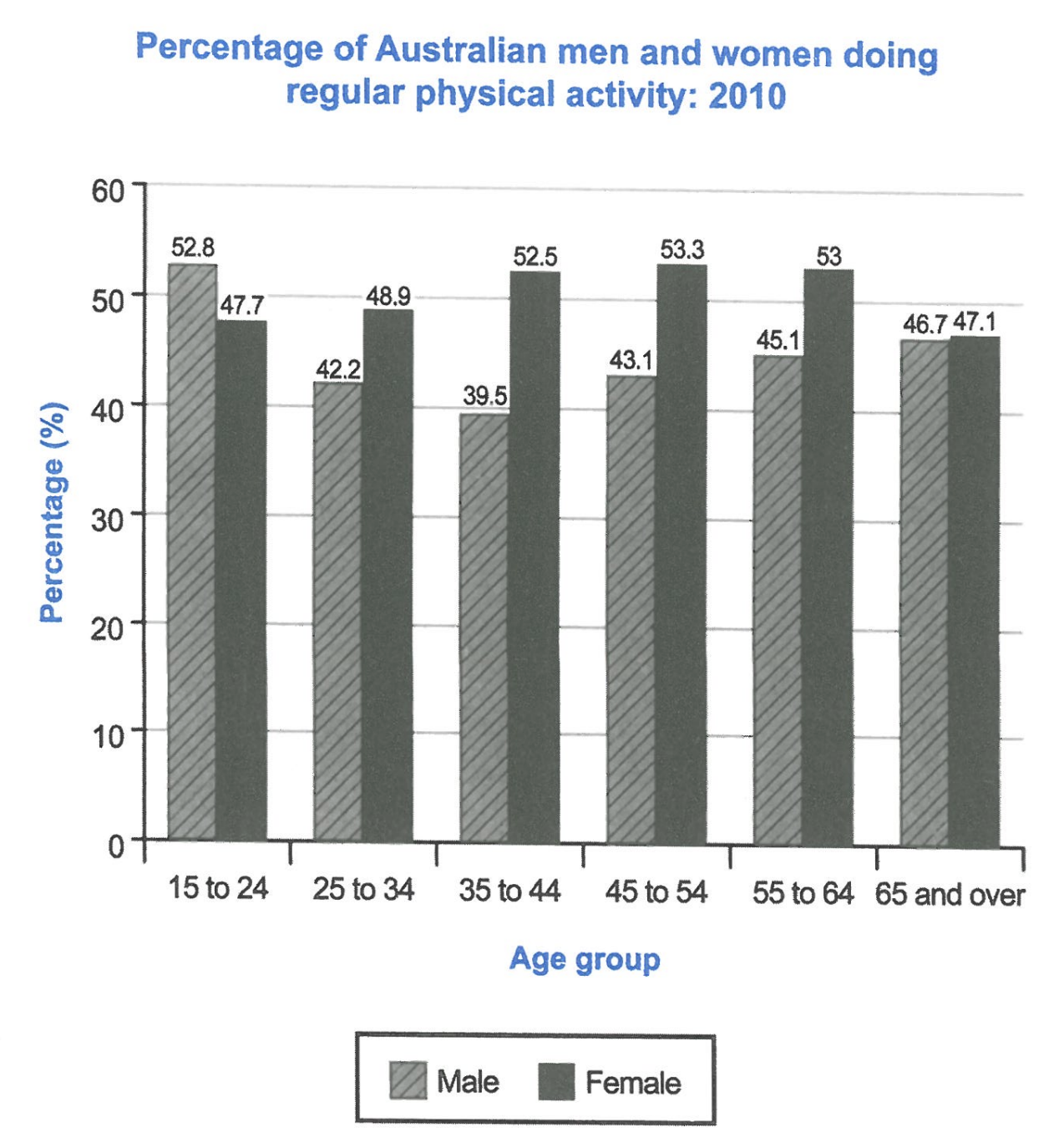
The bar chart below shows the percentage of Australian men and women in different age groups who did regular physical activity in 2010.
Summarise the information by selecting and reporting the main features, and make comparisons where relevant.
Student answer (Band 6.0)
The bar graph depicts the proportion of Australian male and female of different ages that performed exercises in 2010.
Overall, the bar grah delineates the age group between 15 and 65 and over- the male and female physical activities. It is seen that the trend of physical activity in male decreases from age 15 to 44 and then increases from 45 years age group while for female the trend is increasing till the age of 54 and then decreases.
For the male-the age group of 15 to 24 they are the most active exercisers that is 52.8% and the age group of 35 to 44-they are the least active ones with 39.5%. In general the trend from age 15 to 44 the performers decreases significantly.But the men who are older than 45 to 65 and over they are in increasing order of physical active performers,for the age group 45 to 54-they are 43.1% and for 65 and above age group it increases to 46.7%.
For the women,the trend of physical activities are much better than men with increasing proportion from 47.7% to 53.3% for the age group from 15 to 54 years. While the women older than 54,it is seen that the proportion decrease from 53% to 47.1% still better than men which were 39.5% with least percentage.
AI examiner evaluation
| Criterion | Band |
|---|---|
| Task Achievement / Task Response | 6.5 |
| Coherence and Cohesion | 6.0 |
| Lexical Resource | 5.5 |
| Grammatical Range and Accuracy | 5.5 |
| Overall | 6.0 |
Task Achievement / Task Response: Band 6.5
You provide a clear overview of the contrasting patterns: male participation falls to the 35–44 group before rising, while female participation peaks in the 45–54 group and then declines. Several key figures are accurately reported, including the male high of 52.8% and low of 39.5%, and the female peak of 53.3%. This gives the response a sound account of the main features. Some comparisons and details are less fully developed, however. For example, women exceed men in every age group except 15–24, an important overall comparison that is not stated directly. The claim that women’s figures are “still better than men” is also imprecise because it compares the oldest women with the male low rather than with men in the same age group. State the age-by-age comparison more precisely.
Coherence and Cohesion: Band 6.0
The response has a recognisable structure: an introduction, an overview, and separate paragraphs describing men and women. The main trends are generally presented in a sensible order, and linking expressions such as “Overall,” “While,” and “For the women” help signal shifts. However, cohesion is sometimes mechanical or unclear. The overview’s phrase “the age group between 15 and 65 and over” does not clearly explain the chart’s categories, and several long sentences join multiple points without clear punctuation, as in the sentence beginning “But the men who are older than 45.” The final comparison also shifts from the oldest women to the male low, making the reference difficult to follow. Use shorter, clearly punctuated comparisons and connect each figure to the same age group.
Lexical Resource: Band 5.5
You use relevant vocabulary for describing a chart, including “proportion,” “trend,” “increasing,” “decreases,” and “least active.” This is enough to communicate the broad patterns, but word choice and collocation are often awkward or repetitive, which limits precision. Phrases such as “the male and female physical activities,” “active exercisers,” and “in increasing order of physical active performers” are not natural ways to describe participation rates. “Physical activity” is also repeated frequently, and “bar grah” contains a spelling error. Aim for concise, conventional chart language such as “participation rate,” “the proportion of men,” and “rose gradually.” More accurate collocations and a wider range of reporting verbs would make the account clearer and more fluent.
Grammatical Range and Accuracy: Band 5.5
You attempt both simple and more complex sentences, including contrastive structures such as “while for female the trend is increasing…” and clauses describing changes over time. The overall meaning is usually recoverable, but some grammatical errors and punctuation problems remain. For example, “Australian male and female” needs plural nouns, and “the trend of physical activities are” has a subject–verb agreement problem. In “the age group of 15 to 24 they are the most active,” the sentence structure is incomplete or awkward, while several hyphens and missing spaces interrupt sentence boundaries. Use complete clauses with clear subjects—for example, “Men aged 15–24 had the highest rate”—and check agreement, articles, and punctuation. This would improve control while retaining your attempts at varied sentence forms.
See this exact question answered at other band scores. The same prompt compared across bands.
Browse more IELTS Writing model answers or get your own writing scored by the same AI examiner.