Band 6.5 IELTS Writing Task 1 Model Answer
Overall Band Score: 6.5 · Cambridge IELTS 12 · 2026-11-10
IELTS Writing Task 1 question
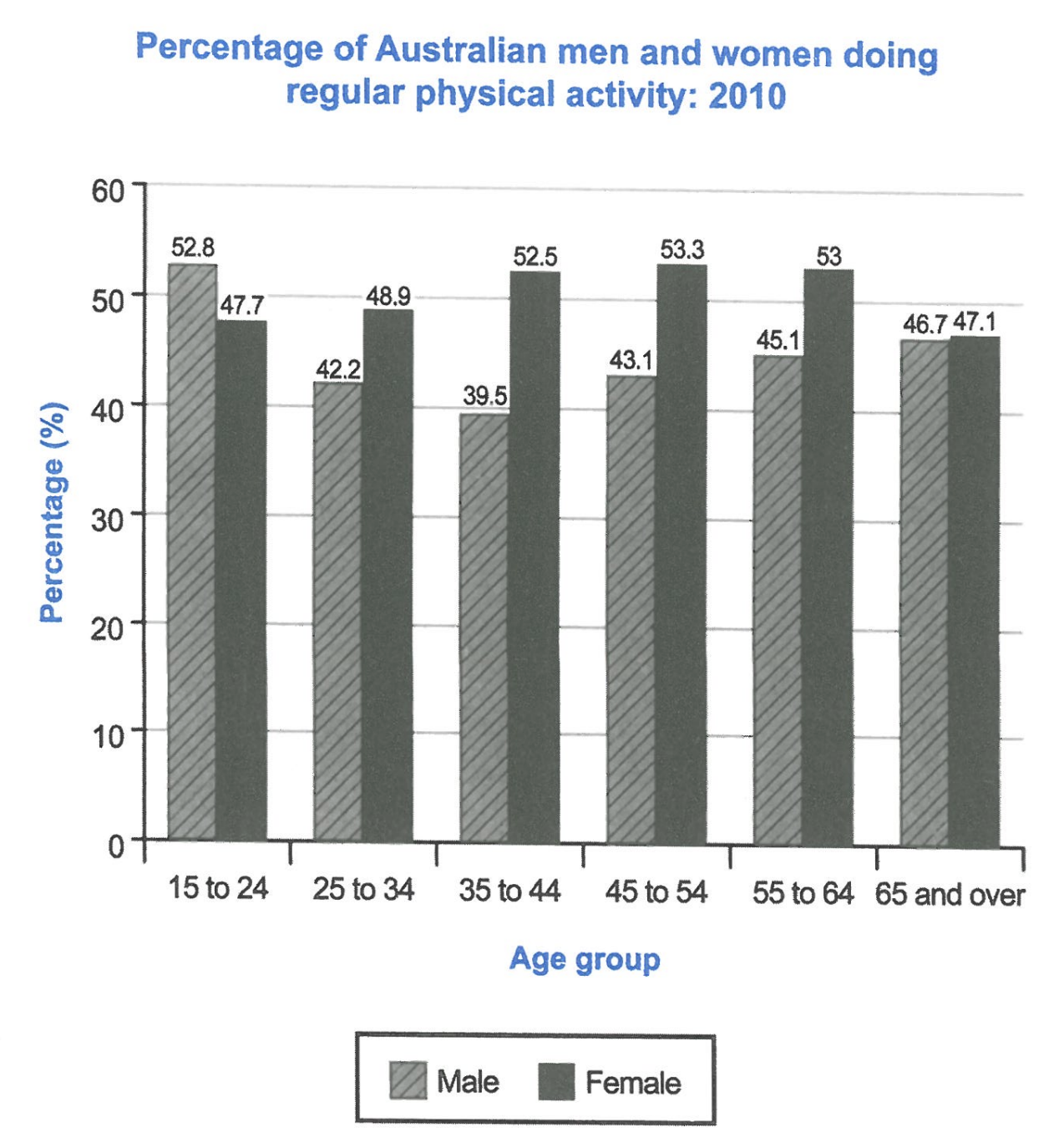
The bar chart below shows the percentage of Australian men and women in different age groups who did regular physical activity in 2010.
Summarise the information by selecting and reporting the main features, and make comparisons where relevant.
Student answer (Band 6.5)
The graph compares the percentage of Australian men and women who participate in regular physical activity in different age groups.
Overall participation of women increases as they get older. Participation of men decreases until they reach 44 years, the percentage of men increases after 44 years.
The peak of participation in regular physical activity by Australian men is at 15 to 24 years age group , in that age 52.8% of men participate regularly. Then the participation decreases and only 39.5% of men between 35 and 44 years age do regular physical activity. On the contrary, 47.7% of 15 to 24 years old women participate in physical activity, then the percentages increase as they get older. The peak participation of women comes from the age group of 45 to 54, 53.3% of women in this age group participate in physical activity regularly.
After 44 years, the participation of men increases and reaches up to 46.7% of men at the age group of 65 and over. Although the participation of women decreases after 54 years, it's still higher than men. 47.1% percentage of women participated in the age group of 65 and over.
AI examiner evaluation
| Criterion | Band |
|---|---|
| Task Achievement / Task Response | 7.5 |
| Coherence and Cohesion | 7.0 |
| Lexical Resource | 6.0 |
| Grammatical Range and Accuracy | 6.0 |
| Overall | 6.5 |
Task Achievement / Task Response: Band 7.5
The response identifies the chart’s subject and gives a clear overview of the contrasting trends: men’s participation falls to a low in middle age before rising, while women’s rate is higher in most older groups and later declines. Several key figures are accurately reported, including the male high of 52.8%, the male low of 39.5%, and the female peak of 53.3%. The account also notes that women remain ahead of men among those aged 65 and over. To make the summary more complete and precise, include the important crossover: men have the higher rate only in the youngest group, while women lead from ages 25–34 onward. The overview’s claim that women’s participation “increases as they get older” is too broad because it falls after the 45–54 peak.
Coherence and Cohesion: Band 7.0
The information is arranged in a clear sequence: an introduction, an overview, and then details about men followed by women and the oldest group. This makes the main comparisons easy to follow, and linking expressions such as “Overall,” “On the contrary,” and “Although” help signal relationships between ideas. However, some connections are repetitive or slightly awkward. For example, the rise in men’s participation after age 44 is stated in the overview and repeated again in the final paragraph. The overview could instead summarise both series more precisely, leaving the body paragraphs to provide the figures. Grouping the age trends into a more deliberate comparison would also strengthen progression and reduce repetition.
Lexical Resource: Band 6.0
The vocabulary is adequate for describing the chart, and phrases such as “participate in regular physical activity,” “peak participation,” and “decreases” communicate the main trends. There is some variation in how the data are described, but several expressions are repetitive or imprecise: “participation” appears frequently, and “47.1% percentage” is redundant. Some collocations are also unnatural, including “comes from the age group” and “at the age group.” Use more precise chart language and vary terms for rates and trends, while keeping the wording natural. For instance, “women’s rate peaked among those aged 45 to 54” is clearer and more idiomatic than the current phrasing.
Grammatical Range and Accuracy: Band 6.0
The response uses a mix of simple and more complex structures, including the contrast in “Although the participation of women decreases after 54 years, it’s still higher than men.” Most sentences remain understandable, but some grammatical and punctuation errors are present. In “Participation of men decreases until they reach 44 years, the percentage of men increases,” two independent clauses are joined with a comma; use a full stop or a conjunction. The phrase “in that age 52.8%” needs a clearer grammatical link, such as “in this age group, 52.8%.” There are also inconsistent constructions around age groups, as in “between 35 and 44 years age.” More consistent sentence patterns and careful punctuation would improve accuracy.
See this exact question answered at other band scores. The same prompt compared across bands.
Browse more IELTS Writing model answers or get your own writing scored by the same AI examiner.