Band 5.0 IELTS Writing Task 1 Model Answer
Overall Band Score: 5.0 · Cambridge IELTS 12 · 2026-11-10
IELTS Writing Task 1 question
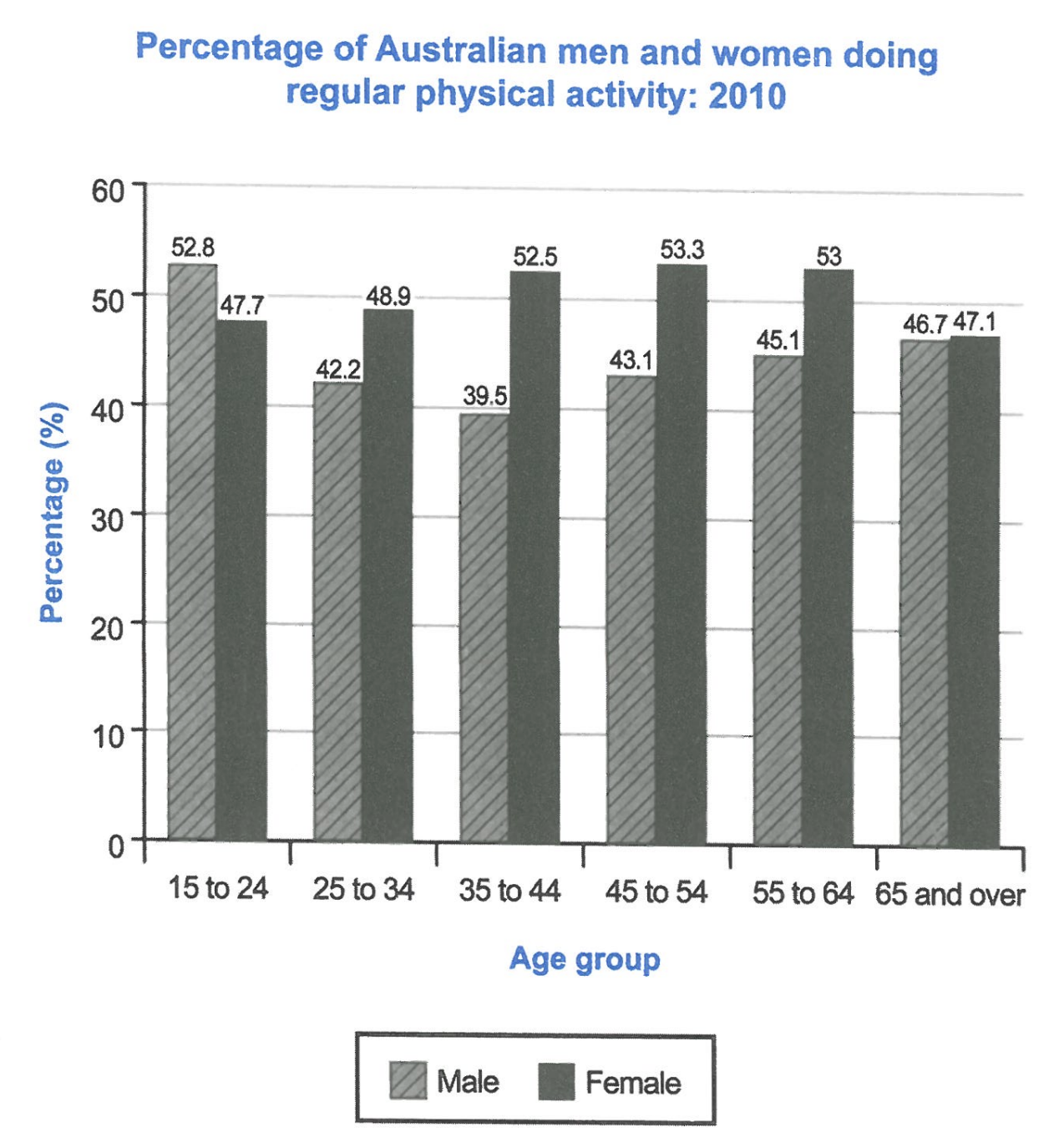
The bar chart below shows the percentage of Australian men and women in different age groups who did regular physical activity in 2010.
Summarise the information by selecting and reporting the main features, and make comparisons where relevant.
Student answer (Band 5.0)
This picture shows tha percentage of working men and women with their age.This chart is describing the Australian men and women.
Overall, It shows that women work more then men in 2010.
Men in the age of 15 to 24 work more then women, women in the age of 35 to 44 work more then men, and in the age of 65 and over men and women works almost equally.
On the on hand, men in small age works hard and did more work. They did 52.8% work. In this age, women did 47.7% work.
On the other hand, in old age women did 53.3% work while, men did 43.1% to 45.1% work.
In conclusion, work done by men and women had different percentage in different age but at the age of 65 and over they did almost equal work or physical activites. In this graphe it shows that men and women are equal in every aspect of life.
AI examiner evaluation
| Criterion | Band |
|---|---|
| Task Achievement / Task Response | 4.5 |
| Coherence and Cohesion | 5.5 |
| Lexical Resource | 4.5 |
| Grammatical Range and Accuracy | 5.0 |
| Overall | 5.0 |
Task Achievement / Task Response: Band 4.5
You identify the broad comparison that women recorded higher activity than men in many age groups, and you include some accurate figures, such as 52.8% for young men and 47.7% for young women. However, the response only partially reports the chart: it describes physical activity as “work,” and the overview that women “work more” is imprecise. The claim that men did more in the youngest group is correct, but the statement about women aged 35–44 does not capture the wider pattern: women also lead in the 25–34, 45–54 and 55–64 groups. The figures “53.3%” and “43.1% to 45.1%” are assigned to old age, although they refer to ages 45–54 and 45–64 respectively. Focus on the activity data and summarise the main trends accurately.
Coherence and Cohesion: Band 5.5
The response has a recognisable structure, moving from an introduction and overview to comparisons and a conclusion. Paragraphing and signposts such as “Overall” and “On the other hand” help the reader follow the intended stages. However, progression is weakened by repetition: the conclusion repeats the near-equality point already made in the overview, then adds the unrelated claim that men and women are “equal in every aspect of life.” Some linking phrases are also inaccurate or awkward, including “On the on hand,” and the age comparisons are not grouped consistently. Organise the body by the main pattern—men leading only among the youngest group, women leading in most others, and the sexes being close in the oldest group—and use clear, accurate transitions.
Lexical Resource: Band 4.5
You use a basic range of words to identify the groups and make comparisons, including “percentage,” “age,” “more,” and “almost equally.” The meaning is generally recoverable, but vocabulary is repetitive and several choices do not fit the chart. In particular, “work” and “work hard” repeatedly replace the key idea of doing regular physical activity, while “old age” is too broad for the specific age bands. There are also noticeable spelling and word-form errors, such as “tha,” “graphe,” and “activites.” Use precise chart language consistently, and check spelling before submitting. More varied comparison terms would also help you describe rises, falls and differences without repeating “more.”
Grammatical Range and Accuracy: Band 5.0
You communicate through mostly short, simple statements and attempt some longer sentences, for example, “Men in the age of 15 to 24 work more then women.” However, the range of sentence structures is limited, and errors in agreement, articles and sentence construction recur. Examples include “men and women works,” “in the age of,” and “while, men did,” where the verb form, phrasing or punctuation is not controlled. Capitalisation is also inconsistent in “Overall, It.” These errors do not usually prevent the reader from understanding the basic comparisons, but they make the writing less accurate and fluent. Practise forming accurate comparative sentences and checking subject–verb agreement, for example, “women were more active than men in most age groups.”
See this exact question answered at other band scores. The same prompt compared across bands.
Browse more IELTS Writing model answers or get your own writing scored by the same AI examiner.