Band 5.5 IELTS Writing Task 1 Model Answer
Overall Band Score: 5.5 · Cambridge IELTS 12 · 2026-11-10
IELTS Writing Task 1 question
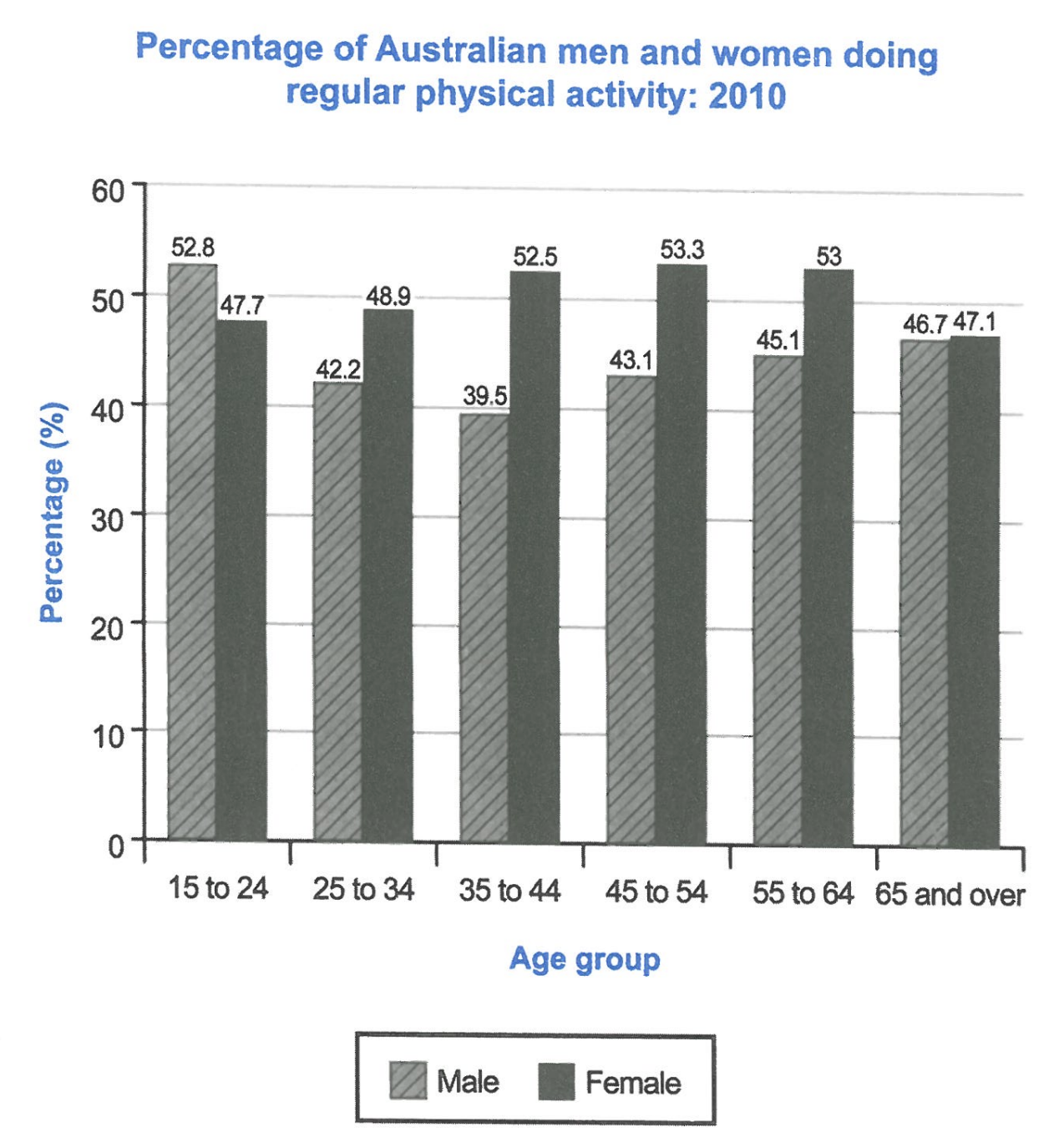
The bar chart below shows the percentage of Australian men and women in different age groups who did regular physical activity in 2010.
Summarise the information by selecting and reporting the main features, and make comparisons where relevant.
Student answer (Band 5.5)
The bar chart gives information about physical activities performed by australian men and women in year 2010.
Overall it can be seen that female percentage showed a significant rise during the period,while the propotion of men experiences a downfall in different age groups.
In detail, from age group 15 to 24 men percentage was 52.8 % highest achieved by mens whereas females were at 47.7%.respectively in 25 to 34 age group women went sharpley up to 48.9% whereas as men fall to 42.2 %.As we move forward to 35 to 44 age group men physical activity shows a decline in percentage to lowest level on the other hand female activity figure rises to 52.5%.In the age group of 45 to 54 men activity is increased to 43.1%,it was the increas after consective downfalls however women activity keep on increasing.
Moving on to the highest and lowest percentages achieved by both groups,highest percentage in physical activity achieved by men is 52.8% in age group of 15 to 24 on the other hand in case of women highest figure achieved is 53.3% in age group of 45 to 54
AI examiner evaluation
| Criterion | Band |
|---|---|
| Task Achievement / Task Response | 5.5 |
| Coherence and Cohesion | 6.0 |
| Lexical Resource | 5.5 |
| Grammatical Range and Accuracy | 5.0 |
| Overall | 5.5 |
Task Achievement / Task Response: Band 5.5
You identify the chart’s subject and make a relevant overview by noting that women’s activity generally rises while men’s figures fall and then recover. Several key comparisons are accurate, including the male high of 52.8% among 15–24-year-olds and the female high of 53.3% among 45–54-year-olds. However, the overview is too broad: women do not rise throughout, since their rate falls from 53.0% to 47.1% in the oldest group, and men’s rate does not simply decline across the age groups. The account also stops before reporting the 55–64 and 65-and-over figures, so the final trends and the overall comparison are incomplete. Include these groups and summarise where women exceed men and where the reverse is true.
Coherence and Cohesion: Band 6.0
The response has a recognisable structure: an introduction, an overview and a sequence of age-group comparisons. Linking phrases such as “Overall,” “In detail” and “Moving on” help signal the stages of the report, and the figures are generally presented in a logical order. However, the progression becomes less clear when the final paragraph repeats the highest figures rather than completing the comparison of the older groups. Some transitions are mechanical, and long sentences joined by commas make relationships between ideas harder to follow—for example, the sentence beginning “As we move forward to 35 to 44 age group.” Use clearer sentence boundaries and group the data into meaningful comparisons, such as younger versus older groups or male versus female rates.
Lexical Resource: Band 5.5
You use relevant chart vocabulary, including “percentage,” “age group,” “highest” and “decline,” and the reader can usually understand the comparisons. There is also some attempt to vary expressions, such as “figure” and “activity.” However, the range is limited and several word choices or collocations are inaccurate or awkward: “physical activities performed” suggests specific activities rather than participation rates, “women went sharpley up” is imprecise, and “highest percentage … achieved” is unnatural for describing chart data. Spelling errors such as “propotion,” “sharpley” and “consective” also reduce control. Prefer precise reporting language such as “the proportion participating,” “rose to” and “reached a peak,” and check spelling before submitting.
Grammatical Range and Accuracy: Band 5.0
You attempt both simple and more complex sentences, including comparisons introduced by “whereas” and “on the other hand.” The main meaning is often recoverable, but frequent errors in sentence construction and grammatical forms make the report less controlled. For example, “the propotion of men experiences a downfall” shifts tense and has faulty agreement, while “women activity keep on increasing” lacks a possessive form and subject–verb agreement. Several sentences run together with commas or full stops placed incorrectly, as in “52.8 % highest achieved by mens whereas females were at 47.7%.respectively.” Articles and sentence framing are also often missing. Build shorter, complete sentences first, then add subordinate clauses; maintain past tense and check agreement, possessives and punctuation.
See this exact question answered at other band scores. The same prompt compared across bands.
Browse more IELTS Writing model answers or get your own writing scored by the same AI examiner.