Band 5.5 IELTS Writing Task 1 Model Answer
Overall Band Score: 5.5 · Cambridge IELTS 12 · 2026-11-10
IELTS Writing Task 1 question
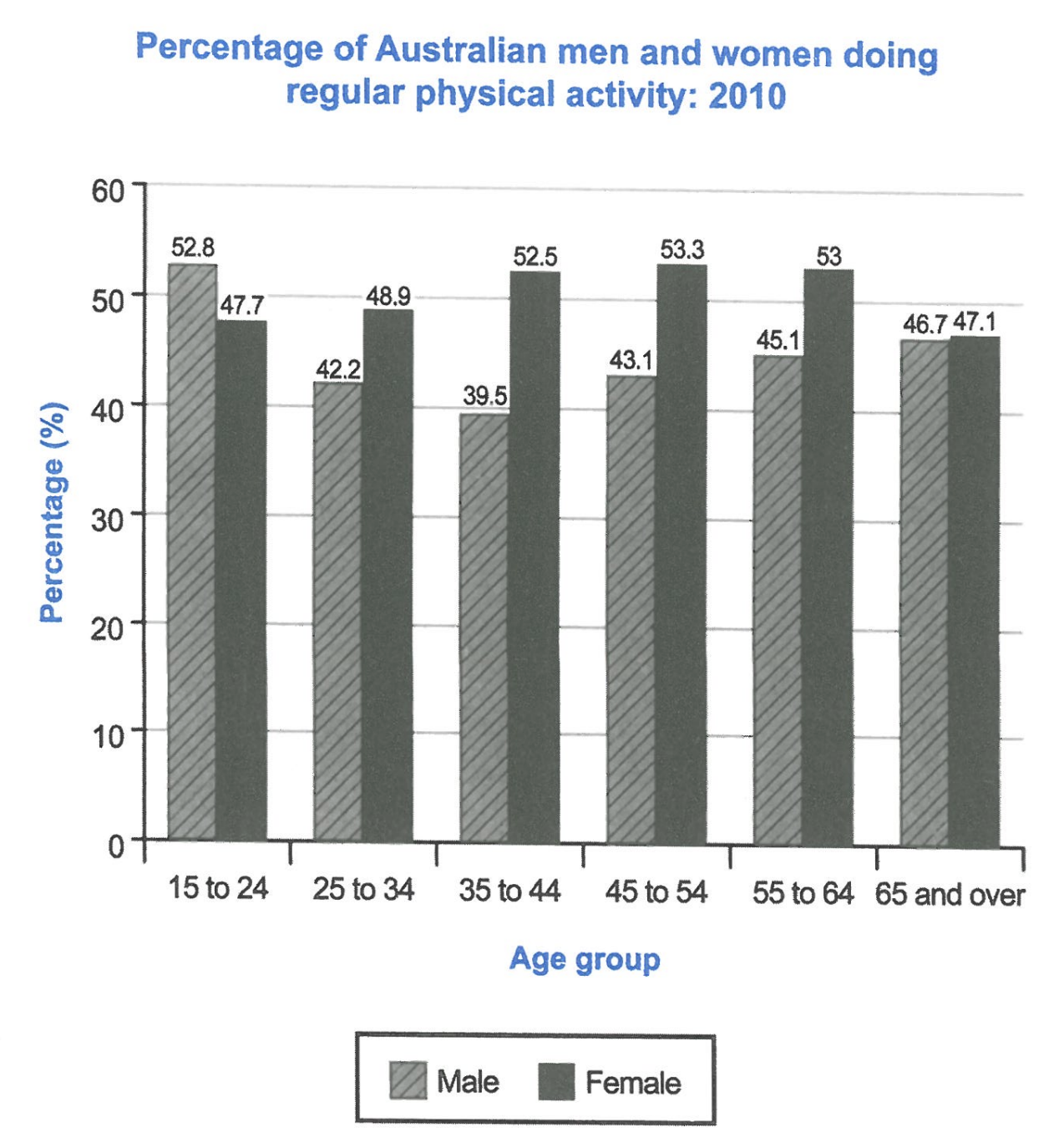
The bar chart below shows the percentage of Australian men and women in different age groups who did regular physical activity in 2010.
Summarise the information by selecting and reporting the main features, and make comparisons where relevant.
Student answer (Band 5.5)
The bar graph illustrates the percentage of Australian men and women in various age groups who did regular physical activities during 2010. And the age groups are upto 65 and over.
Percentage of female aged 45 to 54 who do physical activities is about 53.3%, which marked the highest figure and percentage of people who aged 55 to 64 is 53%. Followd by the people of age 35 to 44 is approximately 52.5% and who's age is 25 to 34 is 48.9%. Lastly, female aged 15 to 24 and 65 and over is almost same approximately 47.7% and 47.1% respectively.
Therefore, if we talk about the percentage of male's doing regular physical activities during 2010 aged 15 to 24 is about 52.8%, which marked the highest figure. And the people who aged 65 and over is 46.7% followed by the people age group 55 and 64 is 45.1%. Afterthat, people who do regular activities is 43.1% and 42.2% is people who aged 25 to 34 whereas, male aged 35 to 44 is 39.5%, which marked the lowest figure.
AI examiner evaluation
| Criterion | Band |
|---|---|
| Task Achievement / Task Response | 5.0 |
| Coherence and Cohesion | 5.5 |
| Lexical Resource | 5.5 |
| Grammatical Range and Accuracy | 5.0 |
| Overall | 5.5 |
Task Achievement / Task Response: Band 5.0
You report many of the chart’s figures accurately, including the female peak of 53.3% among 45–54-year-olds and the male low of 39.5% among 35–44-year-olds. However, the response mainly lists values by sex rather than summarising the most important overall patterns. It does not clearly state that women were more active than men in every age group except 15–24, or that female activity peaked in middle age while male activity fell and then rose. There is also a factual error: you describe 52.5% as the figure for women aged 35–44, but it belongs to that group’s female rate only if read correctly; the sequence is otherwise confusing, and the male figures for ages 45–54 and 25–34 are not clearly assigned. Add a concise overview and make comparisons explicit.
Coherence and Cohesion: Band 5.5
The response has a basic structure: an introduction followed by separate paragraphs for female and male figures. This makes the two groups easy to identify, and sequencing words such as “Followed by,” “Lastly,” and “Afterthat” show an attempt to organise details. However, the progression is largely a list, with little comparison between the sexes or synthesis of trends. Some links are awkward or unclear: “Therefore, if we talk about” does not establish a logical conclusion, and “Afterthat” is joined incorrectly. The opening sentence fragment beginning “And the age groups…” also interrupts the flow. Grouping the data around key comparisons—such as the age groups where women lead and the exception among the youngest men—would create clearer progression and more effective cohesion.
Lexical Resource: Band 5.5
You use relevant chart vocabulary, including “percentage,” “age groups,” “highest figure,” and “lowest figure,” so the topic is generally clear. However, the range is limited and several phrases are repetitive or imprecise, especially repeated references to “people who aged” and “do regular activities.” Some word choices and forms are inaccurate, such as “physical activities” where the chart describes regular physical activity, and “male’s” when referring to men as a group. Spelling errors such as “Followd” and “Afterthat” also reduce accuracy. Use a wider set of precise trend and comparison terms, for example “the proportion,” “stood at,” “exceeded,” and “declined before recovering.” This would make the report more concise and appropriately formal.
Grammatical Range and Accuracy: Band 5.0
The response attempts longer sentences and subordinate clauses, but the range is limited and complex constructions are often faulty. For example, “Percentage of female aged 45 to 54 who do physical activities is about 53.3%” lacks an article and has an awkward subject structure; “the people who aged 65 and over” also uses an incorrect clause form. The opening “And the age groups are upto 65 and over” is not a complete, well-formed sentence, while “Therefore, if we talk about…” creates an incomplete conditional-style construction. Agreement and number are inconsistent in phrases such as “male aged” and “people age group.” Aim for clear comparative sentences with controlled clauses, such as “Women aged 45–54 recorded the highest rate, at 53.3%.”
See this exact question answered at other band scores. The same prompt compared across bands.
Browse more IELTS Writing model answers or get your own writing scored by the same AI examiner.