Band 5.5 IELTS Writing Task 1 Model Answer
Overall Band Score: 5.5 · Cambridge IELTS 12 · 2026-11-10
IELTS Writing Task 1 question
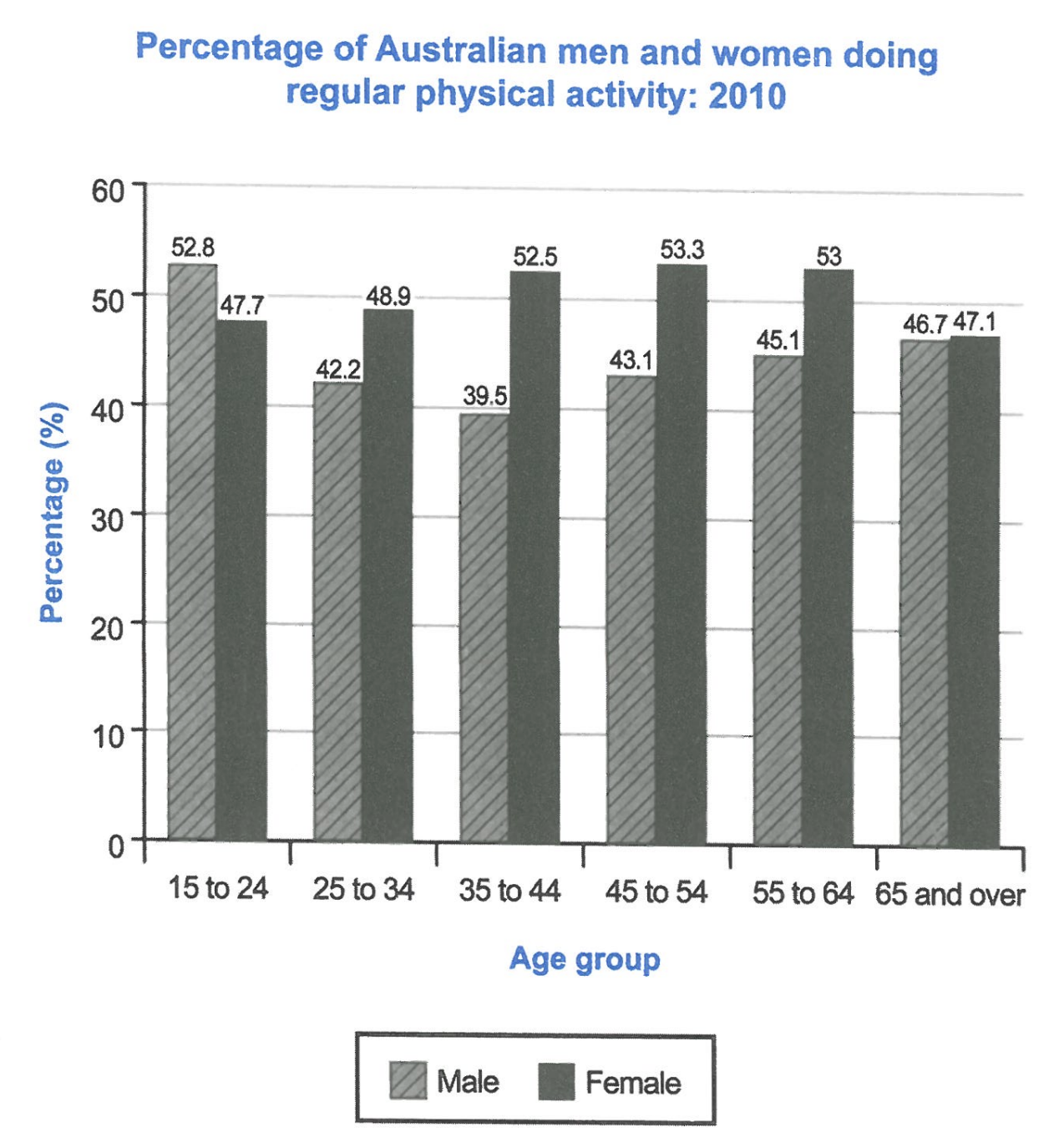
The bar chart below shows the percentage of Australian men and women in different age groups who did regular physical activity in 2010.
Summarise the information by selecting and reporting the main features, and make comparisons where relevant.
Student answer (Band 5.5)
The chart presents the ratio of Australian males and females in different ages who did exercise regularly in 2010.
Overall, the most imporant point is that males who were above 24 years doing probably less exercise then females .Boys who were less than 24 years were more active than girls in 2010.
Male minors were spent more time in physical activities then females .The male percentage of 25 to 44 years was approximately same.There was a small difference of only 3 percent .The lowest percentage of men was registered at the age of 35 to 44 .The ratio of exercise in males were seeing increased slowly after the age of 44 years .
The females spent more time in daily routine exercises then compare to men.The highest percentage of females was between 52 to 54 percent at the age of 35 to 64.There was a slight decrease in the ratio of regular physical activities in both jenders when they were over then 65 years old maybe because they get older .
AI examiner evaluation
| Criterion | Band |
|---|---|
| Task Achievement / Task Response | 6.0 |
| Coherence and Cohesion | 5.5 |
| Lexical Resource | 5.5 |
| Grammatical Range and Accuracy | 5.0 |
| Overall | 5.5 |
Task Achievement / Task Response: Band 6.0
You identify the main contrast: men have the higher figure in the youngest group, while women lead in the other age groups. You also note the male low point at ages 35–44 and the decline for both sexes among those aged 65 and over. These are relevant features and give the response a clear overview. However, some comparisons are inaccurate or unclear: men aged 25–44 were not approximately the same as women, since the gaps are about 7 and 13 percentage points; the male figure rises after 35–44, not after 44. The claim that males over 24 did less exercise than females is broadly true, but the age range and figures should be reported more precisely. Develop the overview with accurate key comparisons and selected data.
Coherence and Cohesion: Band 5.5
The response has a recognisable structure, beginning with an introduction and overview before describing male and female patterns. This helps the reader identify the main topic, and the age groups provide a basic organising thread. However, progression within the body is uneven: the male and female descriptions repeat the general comparison, while some statements are placed together without a clear link. For example, the claim that men aged 25–44 were similar is followed by the low point at 35–44, but the relationship between these observations is not explained. Use separate, clearly focused paragraphs for the overview and detailed comparisons, and connect figures by age group or trend. More precise referencing would also make the sequence easier to follow.
Lexical Resource: Band 5.5
You use relevant topic vocabulary, including “physical activities,” “percentage,” “regular,” and “slight decrease,” so the subject is generally clear. There are also attempts to describe trends, such as “increased slowly” and “registered.” However, several word choices and collocations are inaccurate or informal for a chart summary: “ratio” is used where “percentage” or “proportion” is intended, “males” and “females” are sometimes less natural than “men” and “women,” and “daily routine exercises” does not match the chart’s measure of regular activity. Spelling errors such as “imporant” and “jenders” also reduce control. Choose precise chart language and check spelling; avoid adding interpretations such as why older people exercise less.
Grammatical Range and Accuracy: Band 5.0
You attempt a mixture of simple statements and longer sentences, and the main message is usually understandable. However, errors in verb forms, agreement, comparison structures, and sentence boundaries are frequent enough to make some sentences awkward. For example, “males who were above 24 years doing” needs a finite verb, while “The male percentage … was approximately same” is missing an article and has an unclear comparison. In “The ratio of exercise in males were seeing increased,” the subject–verb agreement and verb construction are faulty. Punctuation is also inconsistent, particularly around full stops. Practise building accurate sentences with patterns such as “the proportion of men aged … was …” and “women’s figure was higher than men’s,” then proofread each sentence for a complete verb and correct agreement.
See this exact question answered at other band scores. The same prompt compared across bands.
Browse more IELTS Writing model answers or get your own writing scored by the same AI examiner.