Band 6.0 IELTS Writing Task 1 Model Answer
Overall Band Score: 6.0 · Cambridge IELTS 12 · 2026-11-11
IELTS Writing Task 1 question
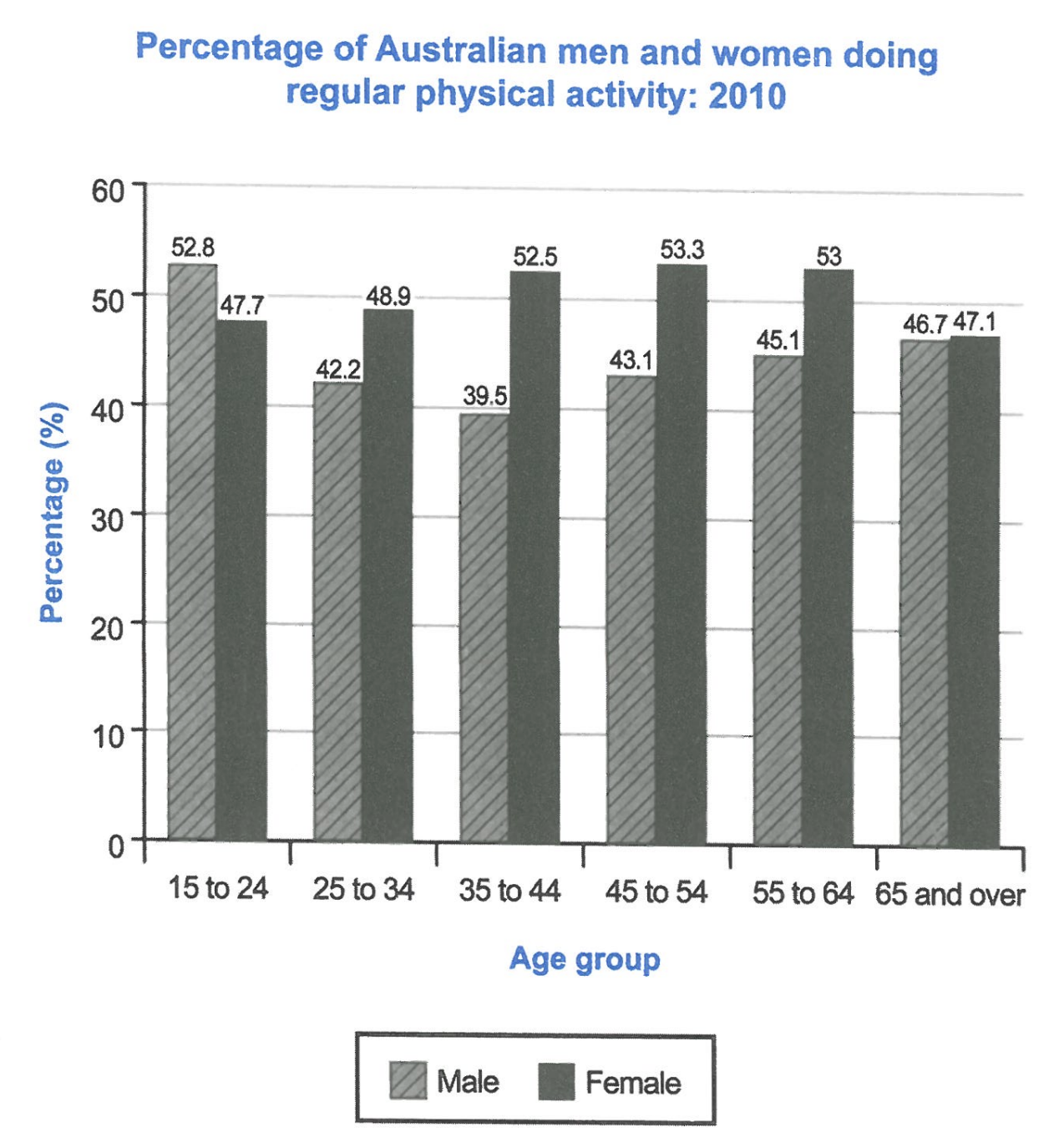
The bar chart below shows the percentage of Australian men and women in different age groups who did regular physical activity in 2010.
Summarise the information by selecting and reporting the main features, and make comparisons where relevant.
Student answer (Band 6.0)
The bar chart illustrates the proportion of Australia's residents by gender in distinct age categories, which who have done daily physical exercise in 2010.
Overall, female have done a lot of physical activity compared to men. The highest contributor to the figure are those female who are aged 45-54, 55-64 and 35-44. Whereas for people aged 15-24 men are higher than the female.
In 2010, those who are aged 15-24; male and female represented a portion of 52.8% and 47.7%. Individuals aged 25-34 reported a data of 42.2% and 48.9% from which the female dominated over male. Similarly, 35-44 accounted for a figure of 39.5% and 52.5%.
In addition, individuals who are 45-54 female also has a higher proportion compared to male with 53.3% and 43.1% respectively. Correspondingly, for those who are aged 55-64 men and women has a figure of 45.1% and 53%. Finally, Australians who are 65 and over have a minimal difference betwen male and female (46.7% and 47.1%).
AI examiner evaluation
| Criterion | Band |
|---|---|
| Task Achievement / Task Response | 6.5 |
| Coherence and Cohesion | 6.5 |
| Lexical Resource | 6.0 |
| Grammatical Range and Accuracy | 5.5 |
| Overall | 6.0 |
Task Achievement / Task Response: Band 6.5
You select the main comparisons and report the figures accurately, including the male lead among 15–24-year-olds and the female lead in every other age group. The overview also identifies the strongest female activity rates, although calling these groups the “highest contributor” is imprecise: the chart shows percentages, not contributions, and 45–54 is marginally highest at 53.3%. The final comparison correctly notes the near-equal rates among people aged 65 and over. This covers the task well, but some features could be expressed more clearly and developed: for example, the overall pattern of men falling to a low at 35–44 and then rising is not highlighted. A sharper overview of these contrasting trends would make the summary more complete.
Coherence and Cohesion: Band 6.5
The response has a clear overall arrangement: an introduction, an overview, and two paragraphs reporting age-group figures. The sequence from younger to older groups is easy to follow, and linking expressions such as “Similarly,” “In addition,” and “Finally” help signal progression. However, some connections feel mechanical or do not clarify the relationship between points. “Whereas” begins a fragment after the overview sentence, while “Correspondingly” does not express a meaningful correspondence in the 55–64 comparison. The repeated pattern of introducing each group and listing two figures also makes the report somewhat formulaic. To strengthen cohesion, combine related comparisons and use references such as “this gap” or “the pattern then reverses” to show how the figures relate, while keeping the paragraph structure.
Lexical Resource: Band 6.0
You use an adequate range of vocabulary for describing chart data, including “proportion,” “dominated,” “higher proportion,” and “minimal difference.” These choices generally make the comparisons understandable, and you vary some of the wording used to introduce figures. However, several expressions are imprecise or unnatural for this task: “highest contributor to the figure” does not accurately describe a percentage, and “reported a data of” is an awkward collocation. “Daily physical exercise” also changes the chart’s wording, which refers to regular physical activity. There is a spelling error in “betwen.” Aim for precise chart language such as “recorded,” “rate,” and “percentage,” and use natural collocations consistently. This would make the vocabulary more accurate and flexible.
Grammatical Range and Accuracy: Band 5.5
You attempt a mix of simple and more complex structures, and most of the numerical comparisons remain understandable. There are, however, some errors in sentence construction and agreement. The opening phrase “which who have done” contains an unnecessary relative pronoun, and “Overall, female have done” has an agreement problem. The sentence beginning “Whereas for people aged 15–24” is incomplete, while “The highest contributor … are those female” has a mismatch between the singular subject and verb. In the later comparisons, “female also has” and “men and women has” also show agreement errors. Use complete clauses and check subject–verb agreement; for example, “Women recorded higher rates than men in most age groups.” More consistently controlled complex sentences would improve accuracy.
See this exact question answered at other band scores. The same prompt compared across bands.
Browse more IELTS Writing model answers or get your own writing scored by the same AI examiner.