Band 4.5 IELTS Writing Task 1 Model Answer
Overall Band Score: 4.5 · Cambridge IELTS 12 · 2026-11-11
IELTS Writing Task 1 question
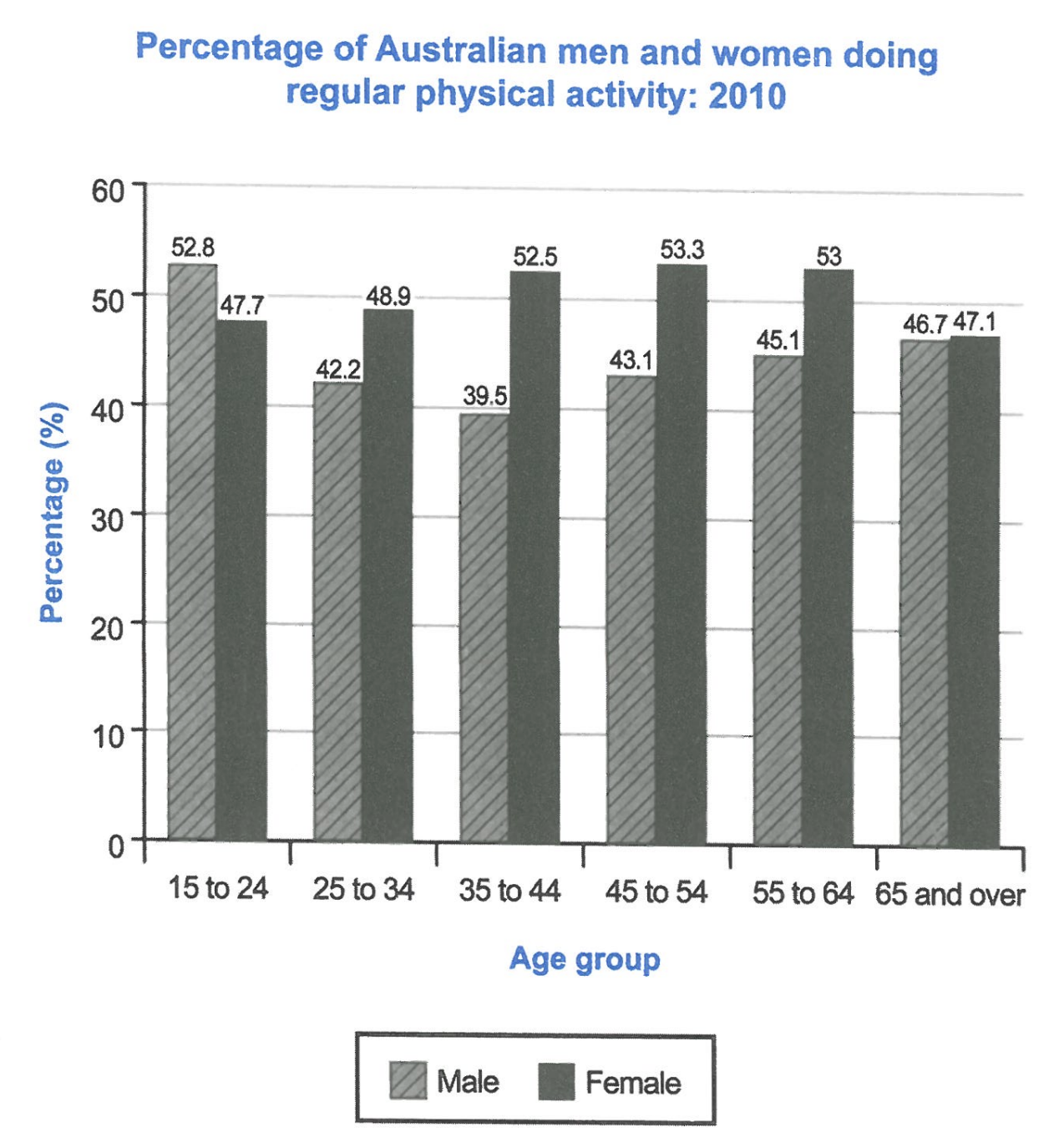
The bar chart below shows the percentage of Australian men and women in different age groups who did regular physical activity in 2010.
Summarise the information by selecting and reporting the main features, and make comparisons where relevant.
Student answer (Band 4.5)
In 2010 the age between 15 to 24 male have more physical activities than females .they do more exercise than females this age group man physical activities percentage is 52.8 .25 to 34 age group females have more physical activites.35 to 44 females has more physical activities and have percentage 52.5 35 onword females have more physical activities than men but in 65 and over age has less physical activities of both gender. in 2010 the women have more physical activities which keeps them healthy but the man physical activities ratio is low and is is disadvantges here proof women keep themself more healthy than men. in the last period women and men both do not care about themselves like at the young age.in this age both gender fell weak so that why it not help to take part in physical activities
AI examiner evaluation
| Criterion | Band |
|---|---|
| Task Achievement / Task Response | 4.5 |
| Coherence and Cohesion | 4.0 |
| Lexical Resource | 5.0 |
| Grammatical Range and Accuracy | 4.5 |
| Overall | 4.5 |
Task Achievement / Task Response: Band 4.5
You identify some relevant comparisons, including that men lead in the youngest group and women have higher participation in several middle-age groups. You also give the accurate figure of 52.8% for men aged 15–24 and 52.5% for women aged 35–44. However, the response only minimally summarises the chart: it lacks a clear, accurate overview of the main pattern, and the claim that women lead from age 35 onward overlooks that women also lead at 25–34, while the oldest group is not the lowest for both sexes. The comments about health, weakness and people not caring for themselves are unsupported by the chart. The response is also 8 words below the required minimum. Focus on reporting the data and its trends rather than explaining causes or effects.
Coherence and Cohesion: Band 4.0
There is a basic attempt to move through age groups, and phrases such as “25 to 34 age group” help signal a change in focus. However, the information is presented as one continuous block, with no clear introduction, overview or organised detail paragraphs. Ideas are often joined abruptly—for example, the shift from age-group comparisons to claims about health and weakness—so the reader cannot follow a consistent progression. Repeated wording such as “more physical activities” also makes the response feel list-like. Separate the response into paragraphs and group the data into a clear overview followed by comparisons, using simple links such as “by contrast” and “in the older groups” accurately.
Lexical Resource: Band 5.0
The response uses a small set of relevant terms, including “age group,” “percentage” and “physical activities,” so the chart’s general subject is understandable. However, vocabulary is basic and repetitive, and several expressions are imprecise or unnatural, such as “the age between 15 to 24,” “the last period” and “the man physical activities ratio.” Spelling errors in “activites” and “disadvantges,” along with inconsistent forms such as “man” for “men,” reduce clarity. Use standard chart language and vary the repeated phrase “more physical activities”; for example, describe participation as “higher” or “lower” and refer to “men” and “women” consistently.
Grammatical Range and Accuracy: Band 4.5
Most sentences rely on simple present-tense statements, and there is little evidence of controlled complex sentence structures. Frequent errors in agreement and sentence formation make several points difficult to read: “male have more physical activities,” “females has,” and “the women have more physical activities which keeps them healthy” do not maintain correct agreement. Sentence boundaries and punctuation are also poorly controlled, as in “females .they” and the long run-on passage beginning “in 2010 the women…”. These errors sometimes obscure the intended comparison. Practise forming complete sentences with a clear subject and verb, and use a small range of accurate comparison structures, such as “Women’s participation was higher than men’s in…”.
See this exact question answered at other band scores. The same prompt compared across bands.
Browse more IELTS Writing model answers or get your own writing scored by the same AI examiner.