Band 5.5 IELTS Writing Task 1 Model Answer
Overall Band Score: 5.5 · Cambridge IELTS 12 · 2026-11-11
IELTS Writing Task 1 question
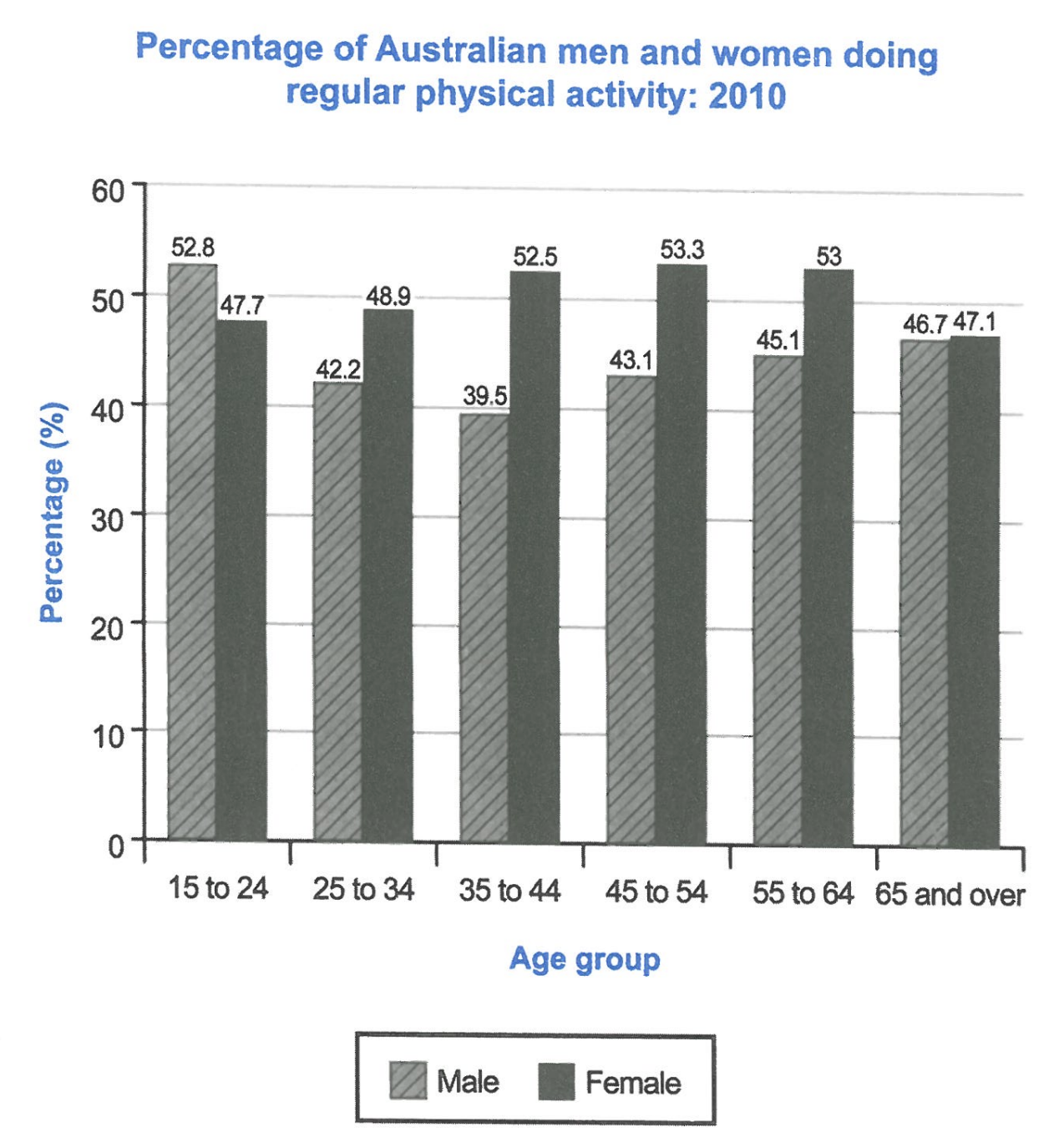
The bar chart below shows the percentage of Australian men and women in different age groups who did regular physical activity in 2010.
Summarise the information by selecting and reporting the main features, and make comparisons where relevant.
Student answer (Band 5.5)
The bar graph illustrates the proportion of male and female, from different age groups, doing excersice in the tear 2010. All the data is presented in the unit of percentage.Black bar presenting females while shahded one males.
Overall the percentage of physical activity is highest in males belong to the age group of 15-24 while lowest in males is in the age group of 35-44. Incase of females, women from the age group of 45-54 are being the most active one. However those who belong to age group 35-44 have least physical activity.
In males, the percentage of physical activity was close to 45%. They were highly active in the age of 15-24 with 52.8% of execise which decrease as the grow older and has minimum activity at the age of 35-44. After that this proportion starts increases and ultimately at the age of 65 it comes at round 46%
For females, it is visible that they have more physical activity than males. The percentage for them is close to 50% with 47.7 in the early age group women. this percentage increases with age but fall to 47.1 for the women of age group 65 and above.
AI examiner evaluation
| Criterion | Band |
|---|---|
| Task Achievement / Task Response | 5.5 |
| Coherence and Cohesion | 6.0 |
| Lexical Resource | 5.0 |
| Grammatical Range and Accuracy | 5.0 |
| Overall | 5.5 |
Task Achievement / Task Response: Band 5.5
You identify several important features, including the male peak at 15–24 (52.8%) and low at 35–44, and the female peak at 45–54. However, the overview is incomplete and one comparison is inaccurate: women were more active than men in every age group except 15–24, so the statement that female activity was generally higher needs that qualification. The account also omits the key female figures around 52.5–53.3% and gives only a broad description of the male pattern. Some details are imprecise: the male rate falls to 39.5% and then rises to 46.7% for those aged 65 and over, rather than simply “at the age of 65.” Select the main contrasts more clearly and support them with accurate figures.
Coherence and Cohesion: Band 6.0
The response has a recognisable structure: an introduction, an overview, and separate paragraphs for men and women. This makes the main subject and broad trends easy to follow. Linking expressions such as “Overall,” “However,” and “After that” help signal relationships between points. At times, though, progression is weakened by unclear or awkward connections, as in “For females, it is visible that they have more physical activity than males,” which does not specify the age-group exception. Some information is also repeated, particularly the low point for both sexes. Organise the body around the clearest comparisons and use references such as “this figure” only when their meaning is unmistakable.
Lexical Resource: Band 5.0
You use relevant task vocabulary, including “proportion,” “percentage,” “age group,” and “physical activity,” and the reader can generally understand the intended comparisons. However, the range is limited and several word-choice, collocation, and spelling problems reduce precision: “doing excersice,” “shahded,” “highly active in the age,” and “comes at round 46%.” Repeated use of “percentage” and “activity” also makes the description less varied. Aim for accurate chart language such as “the proportion who exercised,” “the rate declined,” and “reached approximately 46.7%.” Check spelling carefully and choose natural collocations rather than translating expressions directly.
Grammatical Range and Accuracy: Band 5.0
You attempt both simple and more complex sentences, including a contrast with “However” and a sequence using “After that.” Nevertheless, errors occur frequently in sentence structure, verb forms, agreement, articles, and punctuation, sometimes making relationships difficult to follow. For example, “which decrease as the grow older” has an incorrect verb form and unclear subject, while “this proportion starts increases” combines incompatible verb patterns. The opening also has a sentence fragment: “All the data is presented in the unit of percentage.” Improve control by using complete clauses, checking subject–verb agreement and tense, and separating sentences with appropriate punctuation. For example: “The male rate fell as men aged, reaching 39.5% among those aged 35–44.”
See this exact question answered at other band scores. The same prompt compared across bands.
Browse more IELTS Writing model answers or get your own writing scored by the same AI examiner.