Band 6.0 IELTS Writing Task 1 Model Answer
Overall Band Score: 6.0 · Cambridge IELTS 12 · 2026-11-11
IELTS Writing Task 1 question
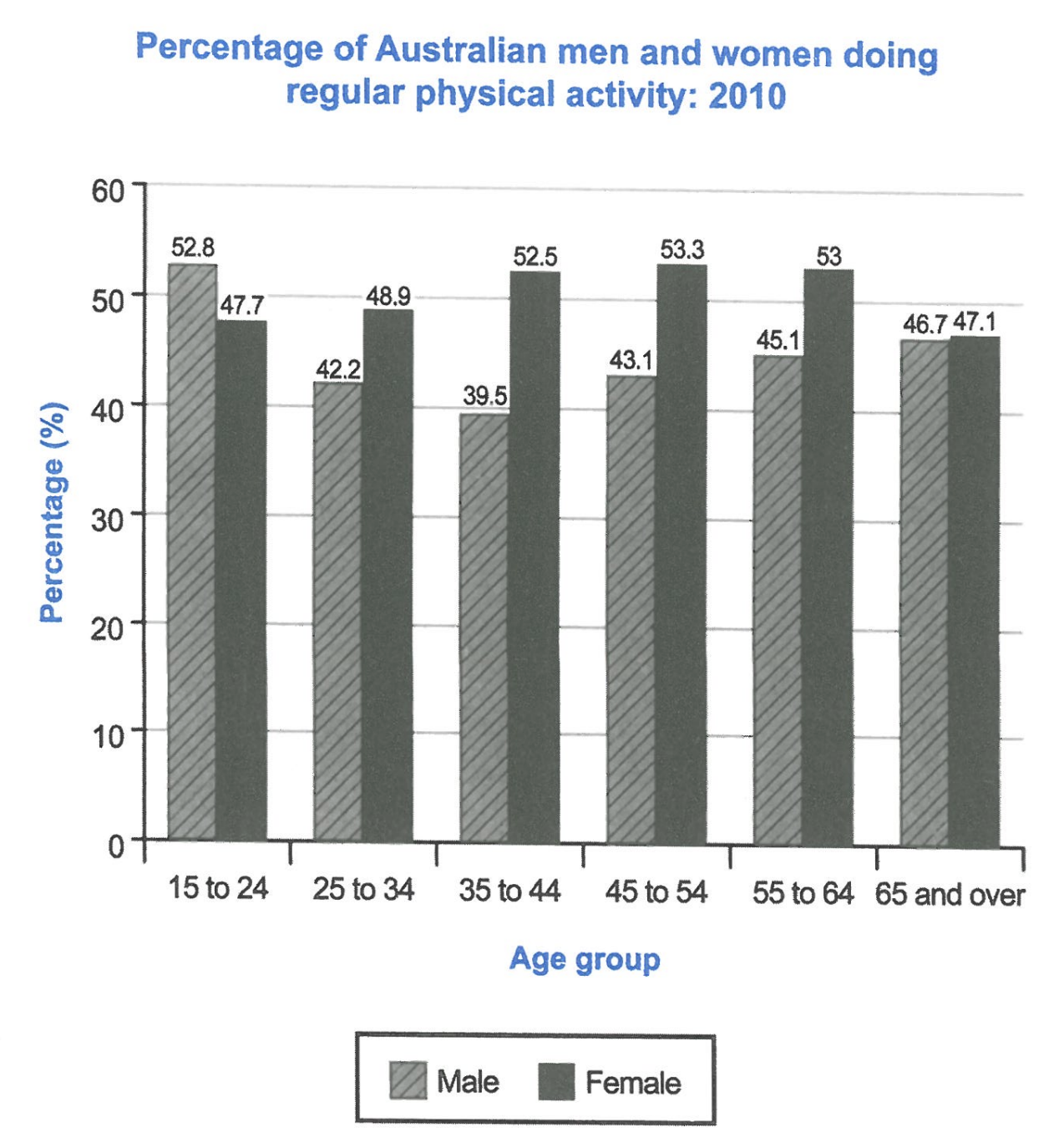
The bar chart below shows the percentage of Australian men and women in different age groups who did regular physical activity in 2010.
Summarise the information by selecting and reporting the main features, and make comparisons where relevant.
Student answer (Band 6.0)
In the given bar chart, the information about percentage of australian men and women doing regular exercise is shown alongside their age groups.
The mens of age group 15-24 shows the highest percentage (52.8%) of regular exercise among themselves. While, womens of age group 45-54 shows the highest percentage in regular exercise among women's and also greater than men's all the time highest record with 53.3%. Also, the lowest showing percentage of men's is age group of 35-44 with only 39.5% of men's showing interest in fitness and regular exercise, and that of women's is age group of 25-34 with least percentage among women's shows 42.2%. However, both mens and womens age group of 65 and over shows very similar percentages 46.7% and 47.1% respectively.
In conclusion, the enthusiasm of regular exercise is on it's peak at the early age of 15-24, then it decreases till the age of 44. While, women's don't show a great percentage at the early ages. Then, they gradually increase their passion towards fitness as they grow up peaking at the age of 45-54. As they both get's old they reach almost the similar percentage of showing interest in fitness.
AI examiner evaluation
| Criterion | Band |
|---|---|
| Task Achievement / Task Response | 6.0 |
| Coherence and Cohesion | 6.0 |
| Lexical Resource | 5.5 |
| Grammatical Range and Accuracy | 5.5 |
| Overall | 6.0 |
Task Achievement / Task Response: Band 6.0
You identify several important features accurately: men peak at 15–24 (52.8%) and reach their low at 35–44 (39.5%), while women peak at 45–54 (53.3%); you also note the close figures for the oldest group. However, one key figure is misreported: women’s lowest rate is 47.7% among 15–24-year-olds, not 42.2% among 25–34-year-olds. The overview also says men’s activity decreases until age 44, but it rises again after the 35–44 low, and women’s rates are already higher than men’s from age 25 onward. These omissions and inaccuracies make some comparisons unclear, although the response addresses the chart and reports relevant data.
Coherence and Cohesion: Band 6.0
The response has a recognisable overall structure: it introduces the chart, reports selected comparisons, and ends with a summary of the trends. The sequence from the male figures to the female figures and then the oldest group is generally understandable. However, the overview is placed in a concluding paragraph and partly repeats details rather than clearly synthesising the main contrast. Linking words such as “While,” “Also,” and “However” are sometimes used mechanically or create incomplete sentence structures, as in “While, womens of age group…” and “While, women's don't show…”. Grouping the data into a clear overview followed by a paragraph comparing the two sexes across age groups would make progression and cohesion more effective.
Lexical Resource: Band 5.5
You use relevant chart vocabulary, including “percentage,” “age group,” “highest,” “lowest,” and “gradually increase,” so the main information is usually understandable. There are also attempts at more descriptive wording, such as “peaking” and “enthusiasm.” However, several choices are unnatural or imprecise: “showing interest in fitness” interprets the chart beyond what it measures, while “the enthusiasm … is on it's peak” is an awkward way to describe a rate. “Mens” and “womens” are also incorrect forms, and “get's old” is not an appropriate expression. Aim for precise reporting language such as “the proportion who exercised regularly,” and use standard forms such as “men” and “women.”
Grammatical Range and Accuracy: Band 5.5
There is some variety in sentence structure, including comparisons and clauses with “while” and “as,” and the intended meaning is generally recoverable. However, errors in agreement, articles, plurals, and sentence boundaries recur. For example, “The mens … shows” has a subject–verb agreement problem, and “the lowest showing percentage of men's is age group” is not a well-formed sentence. The opening also needs an article in “the percentage of Australian men and women,” while “As they both get's old” contains an incorrect verb form and agreement. Some clauses beginning with “While” are left incomplete or punctuated as separate sentences. Use simpler, complete comparison sentences first, then add complex clauses with accurate subjects and verbs.
See this exact question answered at other band scores. The same prompt compared across bands.
Browse more IELTS Writing model answers or get your own writing scored by the same AI examiner.