Band 5.5 IELTS Writing Task 1 Model Answer
Overall Band Score: 5.5 · Cambridge IELTS 12 · 2026-11-12
IELTS Writing Task 1 question
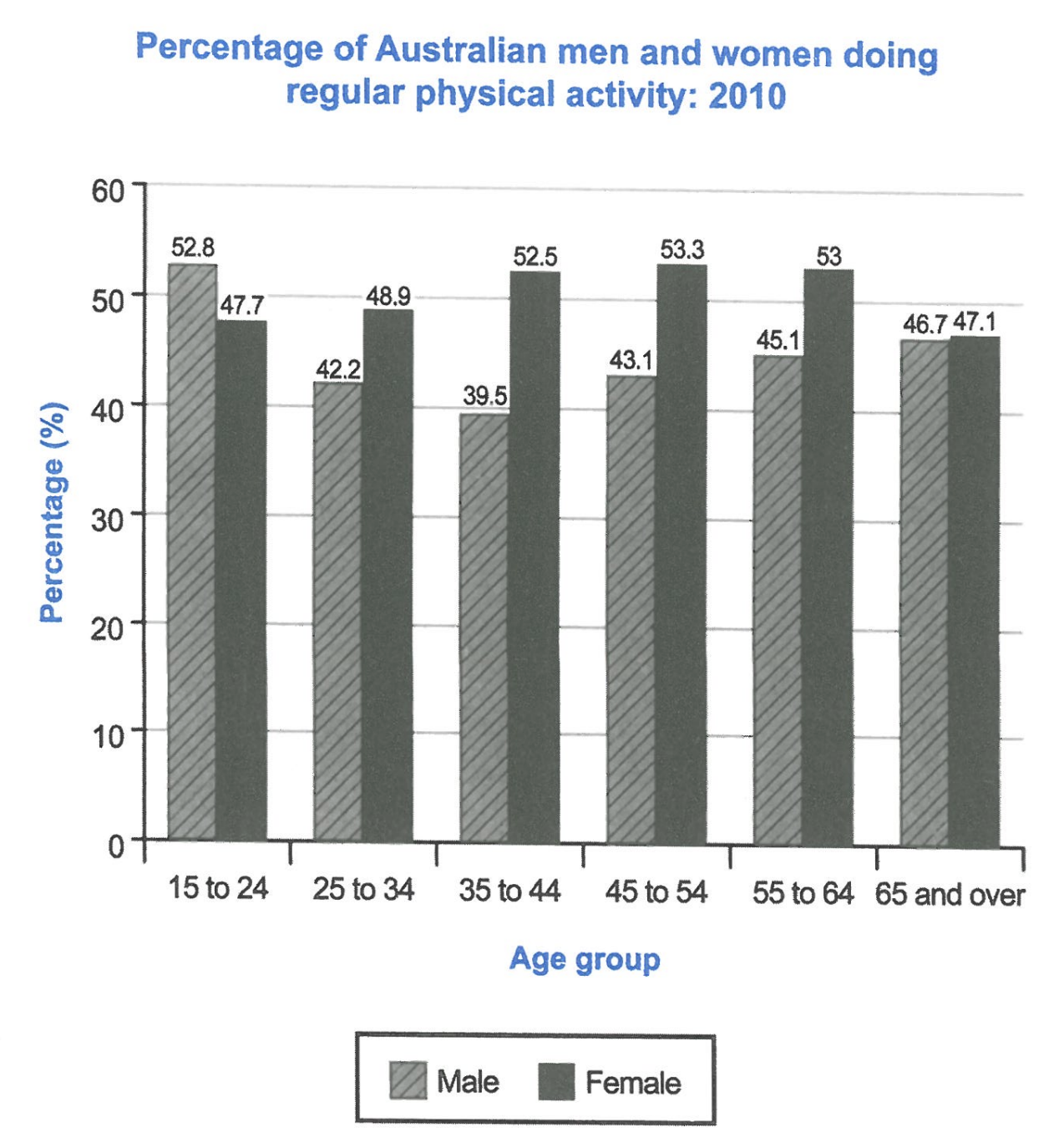
The bar chart below shows the percentage of Australian men and women in different age groups who did regular physical activity in 2010.
Summarise the information by selecting and reporting the main features, and make comparisons where relevant.
Student answer (Band 5.5)
The graph below illustrates the percentage of Australian men and woman from different age groups who did physical activity in the 2010. The bar chart shows that female groups from 25 and over did more physical activity than men.
The age group of females gradually increase, where the group of ages from 25 to 65 and over are superior that the group of men for the same age group. Where the female groups had an increase in the percentage by around 8% for each age group compared with the men group who showed a decrease in the physical activity as they get older.
The age group from 15 to 24 showed a considerably difference, where the percentages of men doing physical activities are slightly higher that the group of females by around 5%. The second biggest gap in the graph was between the age group from 35 to 44; where the group of females are superior by around 11% over the men's group.
AI examiner evaluation
| Criterion | Band |
|---|---|
| Task Achievement / Task Response | 5.5 |
| Coherence and Cohesion | 5.5 |
| Lexical Resource | 5.5 |
| Grammatical Range and Accuracy | 5.0 |
| Overall | 5.5 |
Task Achievement / Task Response: Band 5.5
You identify the broad comparison that women recorded higher activity rates than men in most age groups, and you note the male advantage among 15–24-year-olds. The examples of an approximately five-point gap for the youngest group and an eleven-point gap at ages 35–44 are broadly accurate. However, the overview is incomplete and some trends are misreported: women’s figures do not increase gradually, but rise to a peak of 53.3% at ages 45–54 before edging down; men’s rates fall to 35–44, then rise in each older group. The claim that women’s advantage is “around 8% for each age group” is also too general. Select the main overall patterns accurately and support them with a few precise comparisons.
Coherence and Cohesion: Band 5.5
The response has a basic paragraph structure, moving from an introduction and general comparison to age-specific details. This gives the reader some organisation, and phrases such as “The age group from 15 to 24” signal a shift in focus. However, progression is limited because the second paragraph repeats the general comparison rather than clearly developing the chart’s trends. Several links are awkward or incomplete, including “Where the female groups had an increase” and the semicolon before “where” in the final paragraph. The comparisons would be easier to follow if grouped by the overall pattern first, then the key exceptions and largest gaps, with clearer sentence connections and less repetition.
Lexical Resource: Band 5.5
You use some relevant chart vocabulary, including “percentage,” “age group,” “gap,” “increase,” and “decrease,” so the topic is generally clear. There are also attempts at more formal comparison, such as “considerably difference” and “are superior,” but these are inaccurate or unnatural collocations and reduce precision. “Physical activity” is repeated, while “the group of men” and “female groups” are imprecise ways to refer to the data. Use standard reporting language such as “the proportion of women,” “higher than,” and “the rate peaked at.” More varied, accurate verbs for describing changes and comparisons would make the account clearer and more natural.
Grammatical Range and Accuracy: Band 5.0
You attempt both simple and complex sentences, including clauses introduced by “where” and comparisons using “compared with.” However, errors are frequent, and some sentence structures are difficult to follow. For example, “The age group of females gradually increase” has subject–verb disagreement, while “who showed a decrease … as they get older” shifts tense. The opening also needs “women” rather than “woman,” and “in 2010” rather than “in the 2010.” Sentence fragments or incomplete links occur in “Where the female groups had an increase…” and “The second biggest gap …; where…”. Aim for complete sentences with consistent past tense and check agreement, articles, and punctuation.
See this exact question answered at other band scores. The same prompt compared across bands.
Browse more IELTS Writing model answers or get your own writing scored by the same AI examiner.