Band 5.5 IELTS Writing Task 1 Model Answer
Overall Band Score: 5.5 · Cambridge IELTS 12 · 2026-11-12
IELTS Writing Task 1 question
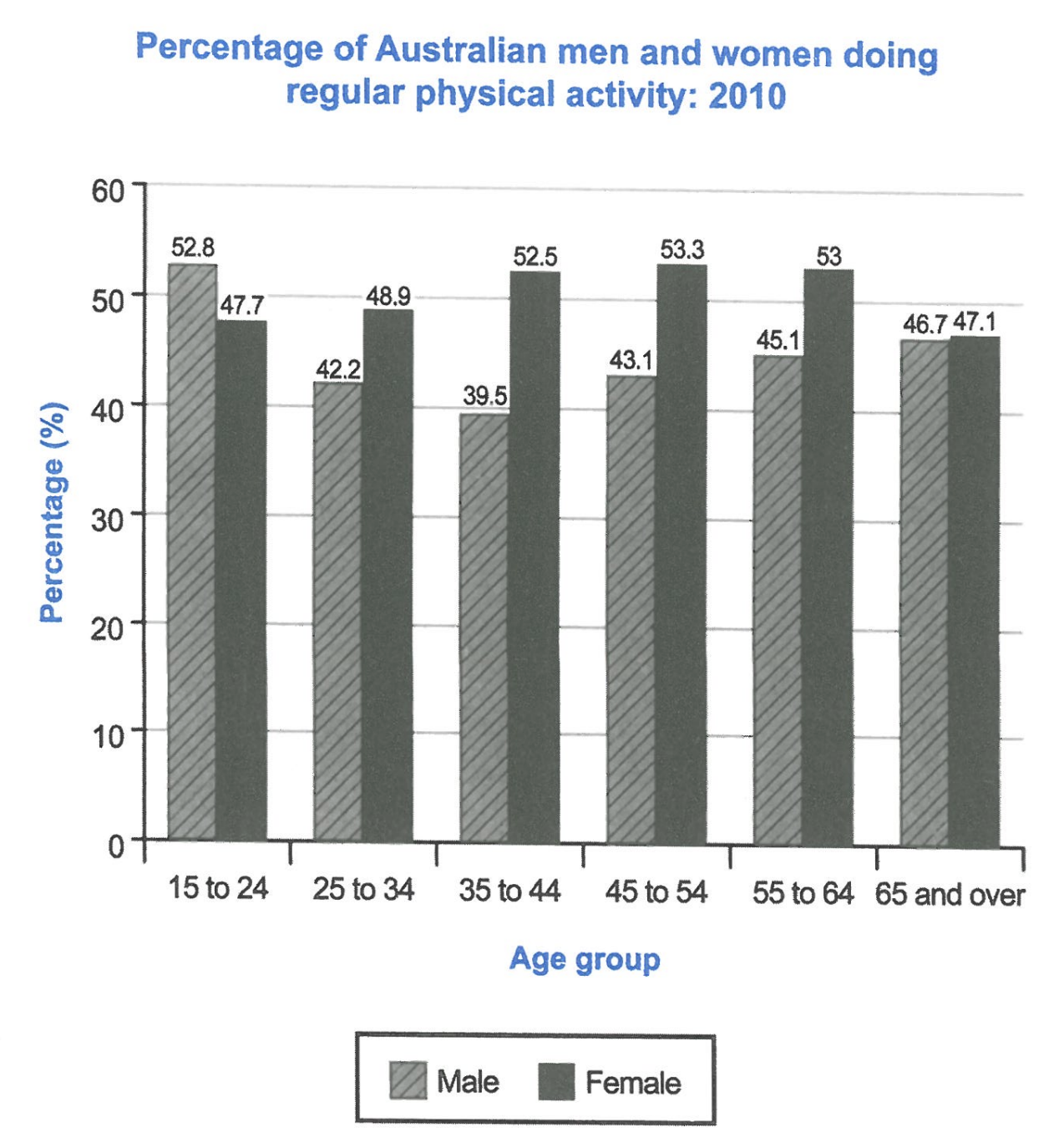
The bar chart below shows the percentage of Australian men and women in different age groups who did regular physical activity in 2010.
Summarise the information by selecting and reporting the main features, and make comparisons where relevant.
Student answer (Band 5.5)
the bar graph illustrates the percentage of australian men and women in various age groups who have done continous physical activity in the year 2010.
overall,women have participated highest percentage then men in diong physical activity however there were six differentiated age groups from 15 to 65 and over while in the age group 15 to 24 male has paticipated more in contradiction to women while all the other age groups there was high percentage of women whom has participated.
initially, in the age group 15 to 24 there was a slight difference in men and women comparising 52 percent in male and 47 percent in women. on the other hand, the remaing all groups calculated huge percentage of women than men in physical acitivities. the age group 25 to 34 male has 42 and women has 48 percentage while the age groups 35 to 52, 45 to 54 and 55 to 64 female percentage remained almost same and male percentage increased a little from 39.5 to 45.1 percentage and the age group 65 and over recorded almost the same percentage.
AI examiner evaluation
| Criterion | Band |
|---|---|
| Task Achievement / Task Response | 5.5 |
| Coherence and Cohesion | 5.5 |
| Lexical Resource | 5.0 |
| Grammatical Range and Accuracy | 5.0 |
| Overall | 5.5 |
Task Achievement / Task Response: Band 5.5
You identify the chart’s subject and give a broad overview that women recorded higher participation in most age groups, while men led among 15–24-year-olds. You also include several relevant figures, such as 52% versus 47% for the youngest group and 42% versus 48% for ages 25–34. However, the account is only partly accurate and developed: the chart has age groups 35–44, 45–54 and 55–64, but you refer to “35 to 52,” and the final comparison that the oldest group had “almost the same percentage” does not specify that the figures were about 46.7% for men and 47.1% for women. Clarify the main trends and report comparisons more precisely.
Coherence and Cohesion: Band 5.5
The response has a recognisable sequence: an introduction, an overview, and then details about the age groups. Linking phrases such as “overall,” “initially” and “on the other hand” help signal the stages of the description. However, progression becomes difficult to follow in the final long sentence, which combines several age groups and trends without clearly separating the comparisons. Some linking is also inaccurate or repetitive: “on the other hand” does not clearly introduce the point that women exceed men in the remaining groups. Use separate sentences or a paragraph to group the age ranges, and connect each comparison directly to the relevant figures so the reader can follow the chart more easily.
Lexical Resource: Band 5.0
You use some task-relevant vocabulary, including “percentage,” “age groups,” “recorded” and “physical activity,” so the topic is generally clear. However, the range is limited and several word choices or collocations are inaccurate, which makes parts of the report awkward to interpret. For example, “participated highest percentage” and “huge percentage” are not natural ways to describe chart data, while “continuous physical activity” changes the meaning of regular activity. There are also noticeable spelling errors, including “diong,” “paticipated,” “remaing” and “acitivities.” Choose precise reporting language and check spelling; alternatives such as “accounted for,” “higher proportion” and “regularly engaged in” would make the comparisons clearer.
Grammatical Range and Accuracy: Band 5.0
You attempt both simple and more complex sentences, including a contrast between the youngest group and the others. However, complex structures are often faulty, and frequent errors in agreement, articles, verb forms and punctuation sometimes make the meaning difficult to follow. For instance, “women have participated highest percentage” lacks a clear grammatical structure, and “female percentage remained almost same” is missing an article and has an awkward subject construction. In “women whom has participated,” the relative pronoun and verb do not agree with the plural noun. Capitalise sentence openings and use full stops to avoid run-on sentences. Practise building accurate comparison patterns, such as “the proportion of women was higher than that of men.”
See this exact question answered at other band scores. The same prompt compared across bands.
Browse more IELTS Writing model answers or get your own writing scored by the same AI examiner.