Band 5.5 IELTS Writing Task 1 Model Answer
Overall Band Score: 5.5 · Cambridge IELTS 12 · 2026-11-13
IELTS Writing Task 1 question
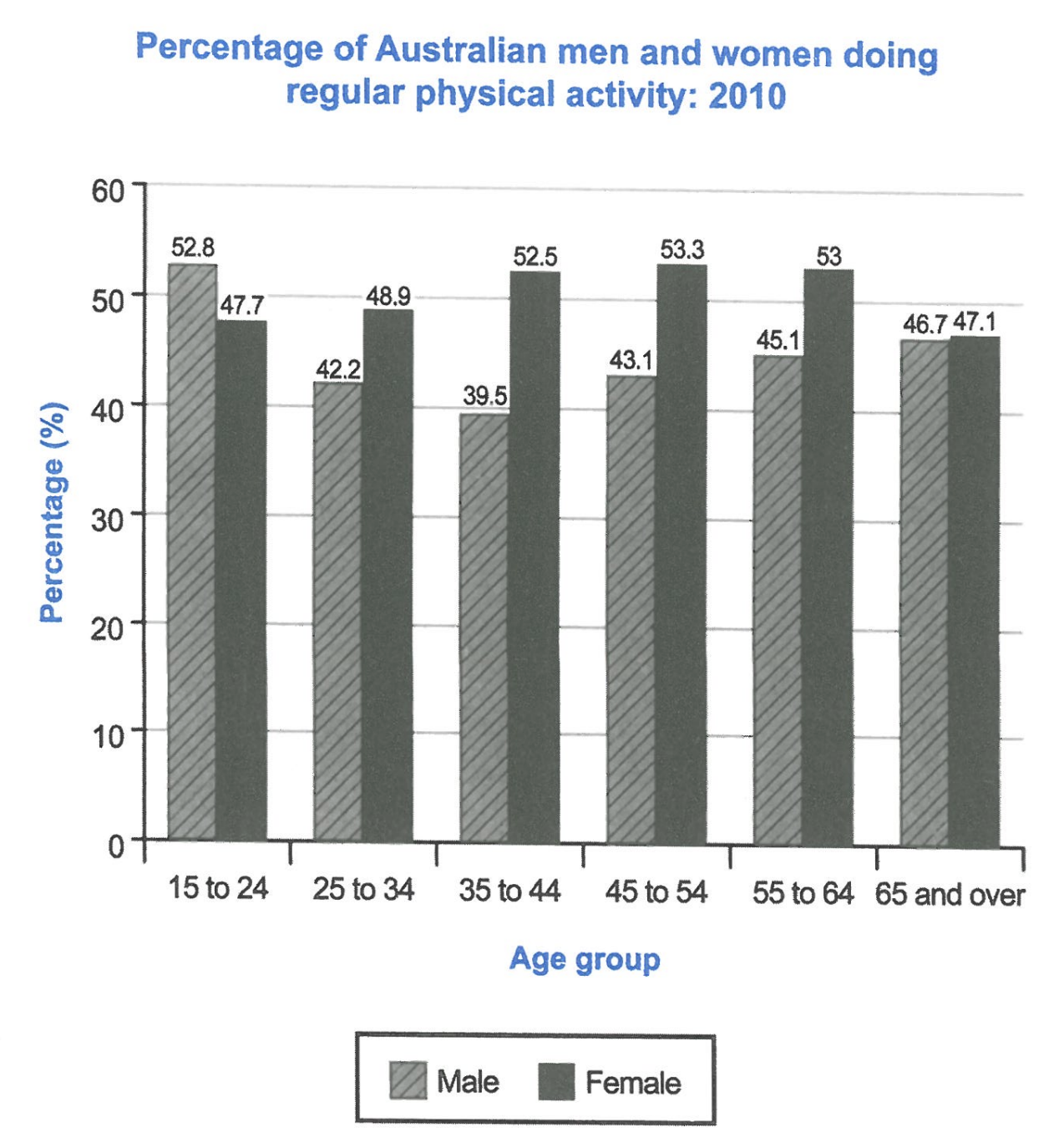
The bar chart below shows the percentage of Australian men and women in different age groups who did regular physical activity in 2010.
Summarise the information by selecting and reporting the main features, and make comparisons where relevant.
Student answer (Band 5.5)
The bar chart illustrates the proportion of men and women doing regular physical activity in Australia in 2010.
Overall, it is evident that female experienced the most significant growth, eventually becoming the highest category in who did regular physical activity in different age groups. In contrast, male witnessed a considerable decline over the period.
In 15 to 24 age group, men are more interested to do regular physical activity as compare to women but, after that men faced a substantial fall from 52.8 to 42.2 percent. Then, In 25 to 34 age group number of women rose slightly from 47.7 to 48.9%. After the age of 44 number of men started incresing by 3.6 percent. Subsequently, after the age of 55 to 64, number of women started declining an in age group of 65 and over the number of men and women who did regular physical activities was approximately same but the difference is of 0.4 percent.
AI examiner evaluation
| Criterion | Band |
|---|---|
| Task Achievement / Task Response | 5.5 |
| Coherence and Cohesion | 5.5 |
| Lexical Resource | 6.0 |
| Grammatical Range and Accuracy | 5.5 |
| Overall | 5.5 |
Task Achievement / Task Response: Band 5.5
You identify the chart’s subject and include relevant comparisons, such as men leading in the youngest group and the sexes being close among those aged 65 and over. You also note the broad contrast between the male decline and female rise, which gives the response a relevant overview. However, the overview is not fully accurate: women do not simply “eventually” become the highest category, since their figures peak at ages 45–54 and then fall. The account also misses key patterns, especially that women exceed men in every group from 25–34 onward, and that men recover after their low at 35–44. Some details are unclear or misreported, including the claim that women rose from 47.7 to 48.9 in the 25–34 group; these are values for two different age groups, not a change within one group.
Coherence and Cohesion: Band 5.5
The response has a recognisable structure: an introduction, an overview, and a paragraph of age-group details. Sequencing words such as “Overall,” “In contrast,” “Then,” and “Subsequently” help signal relationships between points. However, the progression through the data is not consistently clear. The sentence beginning “Then, In 25 to 34 age group” shifts between age groups and sexes without clearly explaining the comparison, while “After the age of 44” and “after the age of 55 to 64” make the sequence difficult to follow. Some linking is mechanical, and the final sentence combines the near-equal figures with an unclear reference to “the difference.” Grouping the figures into a clear comparison of male and female trends would make the progression easier to follow.
Lexical Resource: Band 6.0
You use an adequate range of task-related vocabulary, including “proportion,” “substantial fall,” “declining,” and “approximately same,” and the main topic remains understandable. There are also attempts to vary wording rather than repeat “percentage” throughout. However, some choices are imprecise or unnatural for describing chart data: “female experienced the most significant growth” and “men are more interested” imply personal experience or motivation rather than reported participation rates. “Highest category” is also vague, and “number of women” is less accurate than referring to their percentage. Spelling errors such as “incresing” and awkward phrases such as “as compare to” reduce control. Aim for precise terms such as “proportion,” “rate,” “rose,” and “fell,” and check spelling and collocations.
Grammatical Range and Accuracy: Band 5.5
You attempt both simple and more complex sentence forms, including the contrast in “In contrast, male witnessed…” and the longer sentence beginning “In 15 to 24 age group.” The overall meaning is usually recoverable, but errors in agreement, articles, tense, and sentence construction remain noticeable. For example, “female experienced” and “male witnessed” use singular nouns without appropriate articles or plural forms, while “number of women rose” needs an article and a clearer grammatical construction. The sentence beginning “In 15 to 24 age group” has faulty punctuation around “but,” and “the difference is of 0.4 percent” is awkwardly formed. Use consistent past tense for the 2010 data and check subject–verb agreement and sentence boundaries.
See this exact question answered at other band scores. The same prompt compared across bands.
Browse more IELTS Writing model answers or get your own writing scored by the same AI examiner.