Band 5.0 IELTS Writing Task 1 Model Answer
Overall Band Score: 5.0 · Cambridge IELTS 12 · 2026-11-13
IELTS Writing Task 1 question
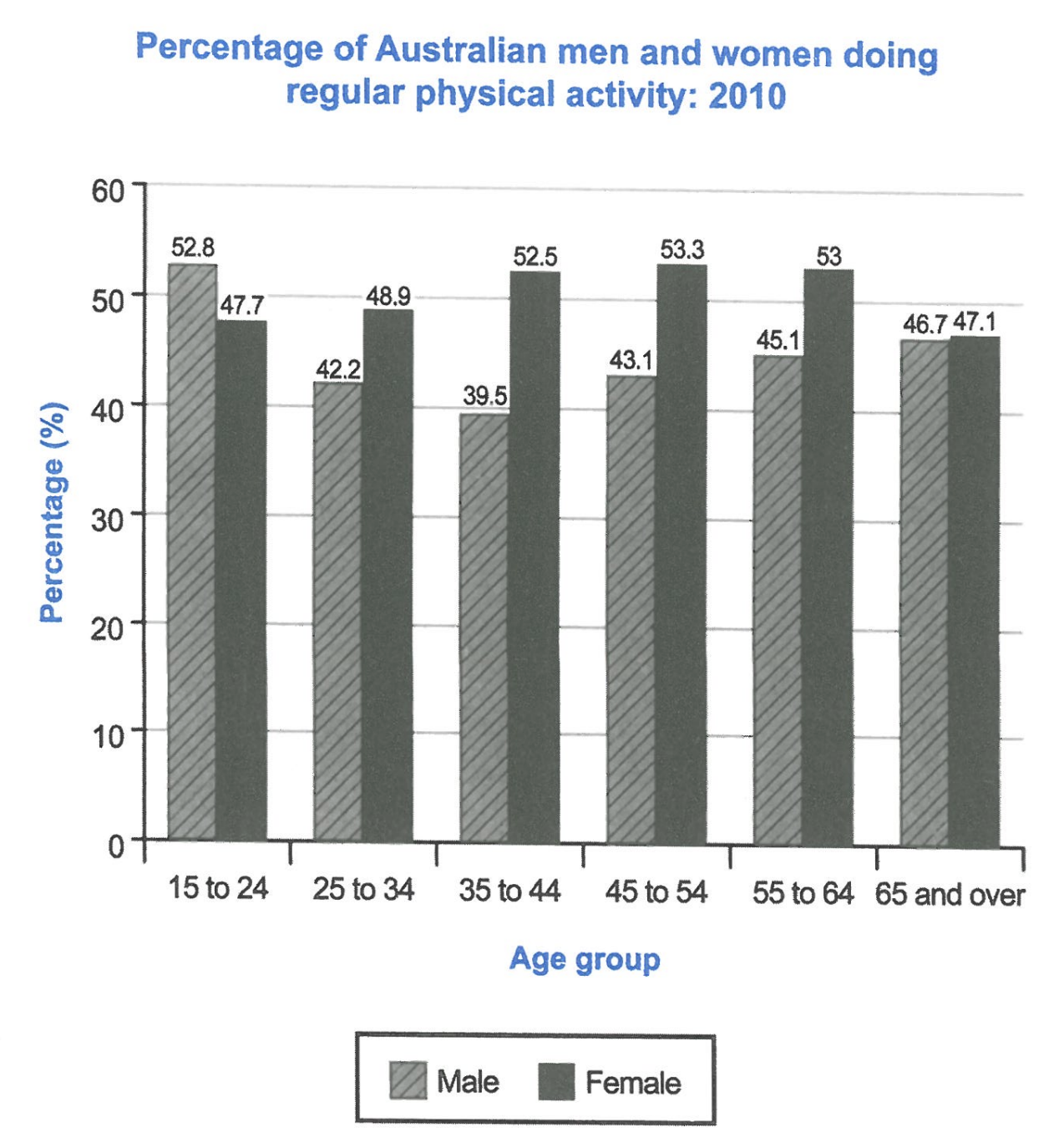
The bar chart below shows the percentage of Australian men and women in different age groups who did regular physical activity in 2010.
Summarise the information by selecting and reporting the main features, and make comparisons where relevant.
Student answer (Band 5.0)
The bar chart illustrates the percentage of australian men and women in diferent age groups who did regylar phyisical activity in 2010.
Overall, it is noticeable that the highest percentage is the age of 15 to 24 which is 52.8 % men and 47.7% women. The lowest percentage is age of 65 and over which is 46.7% men and 47.1% women.
It is evident that the percentage of men and women activities of age group of 15 to 24 is 52.8 and 47.7, 25 to 34 is 42.2 and 48.9, 35 to 44 is 39.5 and 52.5, 45 to 54 is 43.1 and 53.3, 55 to 64 is 45.1 and 53 and people of 65 or over is 46.7 and 47.1.
A closer look reveals that there is a great difference between the physical activities of men of the ages of 15 and 45. the activities of 15 years olsdis far greater than age of 45.
AI examiner evaluation
| Criterion | Band |
|---|---|
| Task Achievement / Task Response | 4.5 |
| Coherence and Cohesion | 5.5 |
| Lexical Resource | 5.0 |
| Grammatical Range and Accuracy | 5.0 |
| Overall | 5.0 |
Task Achievement / Task Response: Band 4.5
You include the chart’s figures for all six age groups, and the overview attempts to identify high and low points. However, the overview is inaccurate: 15–24 is the highest male rate, not the highest overall, while the female peak is 45–54; the lowest figure overall is men aged 35–44, not people aged 65 and over. The final comparison between “15 and 45” is unclear and does not accurately describe age groups or the overall pattern. The response therefore reports data but only partially selects and summarises the main features. It is also 2 words below the 150-word minimum; the 8 words copied from the task prompt were not counted. To improve, give a precise overview of the contrasting trends and support it with the most relevant comparisons.
Coherence and Cohesion: Band 5.5
The response has a recognisable structure: an introduction, an overview, a paragraph listing the figures, and a final comparison. This makes the information reasonably easy to locate. However, the progression is not fully effective because the third paragraph repeats nearly every figure already introduced in the overview, while the final paragraph adds an unclear comparison rather than developing the main trends. Linking is limited, and the repeated opening “It is…” does little to show how the ideas relate. Grouping the data by the main contrast—men’s rates falling and then rising, while women’s rates generally rise before falling—would create clearer progression. Use concise references such as “By contrast” or “After this point” to connect comparisons without repeating the full data list.
Lexical Resource: Band 5.0
You use some relevant chart vocabulary, including “percentage,” “age groups,” and “physical activity,” so the topic is generally clear. However, the range is limited and several word choices or collocations are awkward, such as “the highest percentage is the age of” and “the percentage of men and women activities.” Spelling errors—including “australian,” “diferent,” “regylar,” and “phyisical”—are noticeable and reduce accuracy. The phrase “15 years olsdis” is especially difficult to understand. Aim for precise reporting language such as “the proportion of men who exercised regularly” and “the rate peaked at.” Proofreading spelling and choosing natural collocations would make the data easier to interpret and help you describe trends more flexibly.
Grammatical Range and Accuracy: Band 5.0
You attempt both simple statements and longer sentences, including a sentence that lists figures across all age groups. However, the range is limited, and errors occur frequently enough to make some sentences awkward or unclear. For example, “the highest percentage is the age of 15 to 24” uses an unsuitable sentence pattern, while “the percentage of men and women activities of age group of 15 to 24 is…” has unclear grammatical relationships and missing articles. The final sentence also has faulty punctuation and structure: “the activities of 15 years olsdis far greater than age of 45.” Practise clear comparison patterns, such as “Among men, the figure fell from… to…” and “Women’s rate was higher than men’s in…”. Check articles, sentence boundaries, and parallel phrasing when listing comparisons.
See this exact question answered at other band scores. The same prompt compared across bands.
Browse more IELTS Writing model answers or get your own writing scored by the same AI examiner.