Band 5.0 IELTS Writing Task 1 Model Answer
Overall Band Score: 5.0 · Cambridge IELTS 12 · 2026-11-13
IELTS Writing Task 1 question
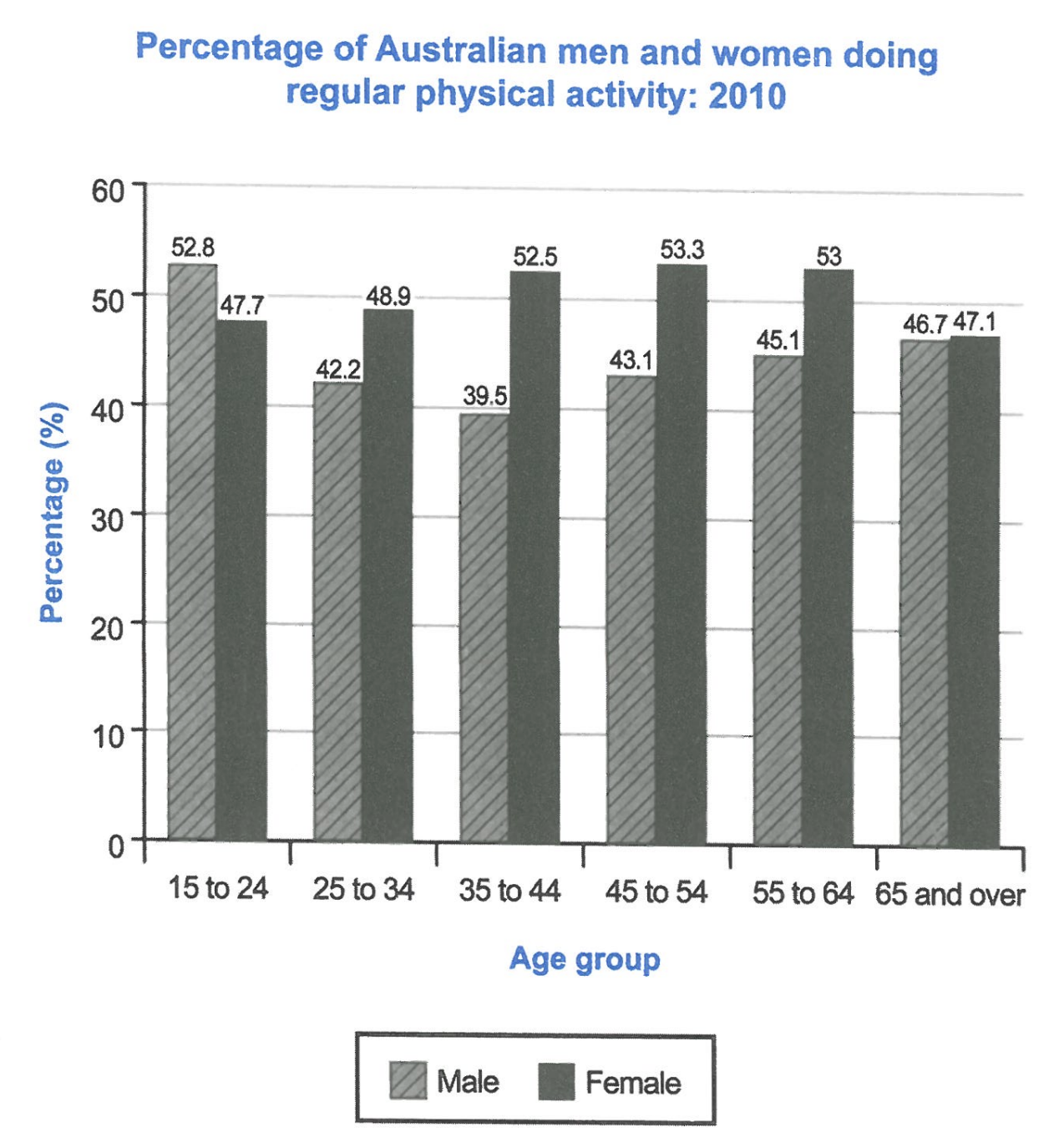
The bar chart below shows the percentage of Australian men and women in different age groups who did regular physical activity in 2010.
Summarise the information by selecting and reporting the main features, and make comparisons where relevant.
Student answer (Band 5.0)
The bar chart illlustrates the percentage of Australian people of various age brackets who do exercise regularly in 2010.
overall, the women represent the majority in various age groups, whereas males make up the largest proportion in the youngest age group.In contrast, Both are identical in the oldest age bracket.
In the 1st age bracket of ages 15 to 24 are men have the largest proportion whereas from 2nd age group to 2nd last women have the majority and in the last age group both are approximatley same.
there is a big change in the age group
AI examiner evaluation
| Criterion | Band |
|---|---|
| Task Achievement / Task Response | 4.5 |
| Coherence and Cohesion | 4.5 |
| Lexical Resource | 5.0 |
| Grammatical Range and Accuracy | 5.0 |
| Overall | 5.0 |
Task Achievement / Task Response: Band 4.5
You identify the chart’s subject and report its broadest comparison: women had higher participation in most age groups, while men led among 15–24-year-olds. However, the overview is not fully accurate: the oldest group was not identical, as women were at 47.1% and men at 46.7%. The response also gives no figures to support its comparisons and does not describe the main pattern across the age groups, such as men’s fall to 39.5% at ages 35–44 followed by a rise, or women’s peak of 53.3% at 45–54. The final statement, “there is a big change,” is too vague to convey a specific feature. The response is 53 words below the required minimum, leaving the task only minimally addressed.
Coherence and Cohesion: Band 4.5
There is a basic attempt to organise the response: an opening identifies the chart, followed by an overview and a comparison of age groups. The main ideas are broadly related to the task, but the progression is weak because the second and third sentences repeat the same male-versus-female comparison rather than developing it with data. The final sentence, “there is a big change in the age group,” is disconnected from a clear explanation of what changes. Capitalisation and spacing problems, such as “overall” after a full stop and “group.In,” also interrupt the flow. To improve, use a clear overview followed by a paragraph comparing the age-group figures in a logical sequence, with linking phrases that clarify contrasts.
Lexical Resource: Band 5.0
The response uses enough basic vocabulary to communicate the chart topic, including “percentage,” “age brackets,” “majority,” and “proportion.” Some wording is repetitive, particularly the repeated use of “age group” and “largest proportion,” and several choices are imprecise for describing chart data. For example, “women represent the majority” is less direct than saying women had higher participation rates, while “big change” does not identify a trend or comparison. There are also spelling errors in “illlustrates” and “approximatley.” Aim for a wider set of accurate terms for trends and comparisons, and use the chart’s specific figures to make descriptions more precise.
Grammatical Range and Accuracy: Band 5.0
The response attempts both simple statements and a longer comparison, but the range is limited and the longer sentence is not controlled: “In the 1st age bracket of ages 15 to 24 are men have the largest proportion” contains an incorrect word order and an unnecessary verb. The sentence beginning “overall” also has a run-on structure, with a full stop missing before “In contrast” and inconsistent capitalisation. “Both are identical” is grammatically understandable, though the comparison would be clearer as a complete sentence stating that the rates were almost the same. Use straightforward, complete sentences first, then add controlled clauses such as “whereas” or “while” to compare groups. Check sentence boundaries, subject–verb structure, and capital letters.
See this exact question answered at other band scores. The same prompt compared across bands.
Browse more IELTS Writing model answers or get your own writing scored by the same AI examiner.