Band 6.0 IELTS Writing Task 1 Model Answer
Overall Band Score: 6.0 · Cambridge IELTS 12 · 2026-11-13
IELTS Writing Task 1 question
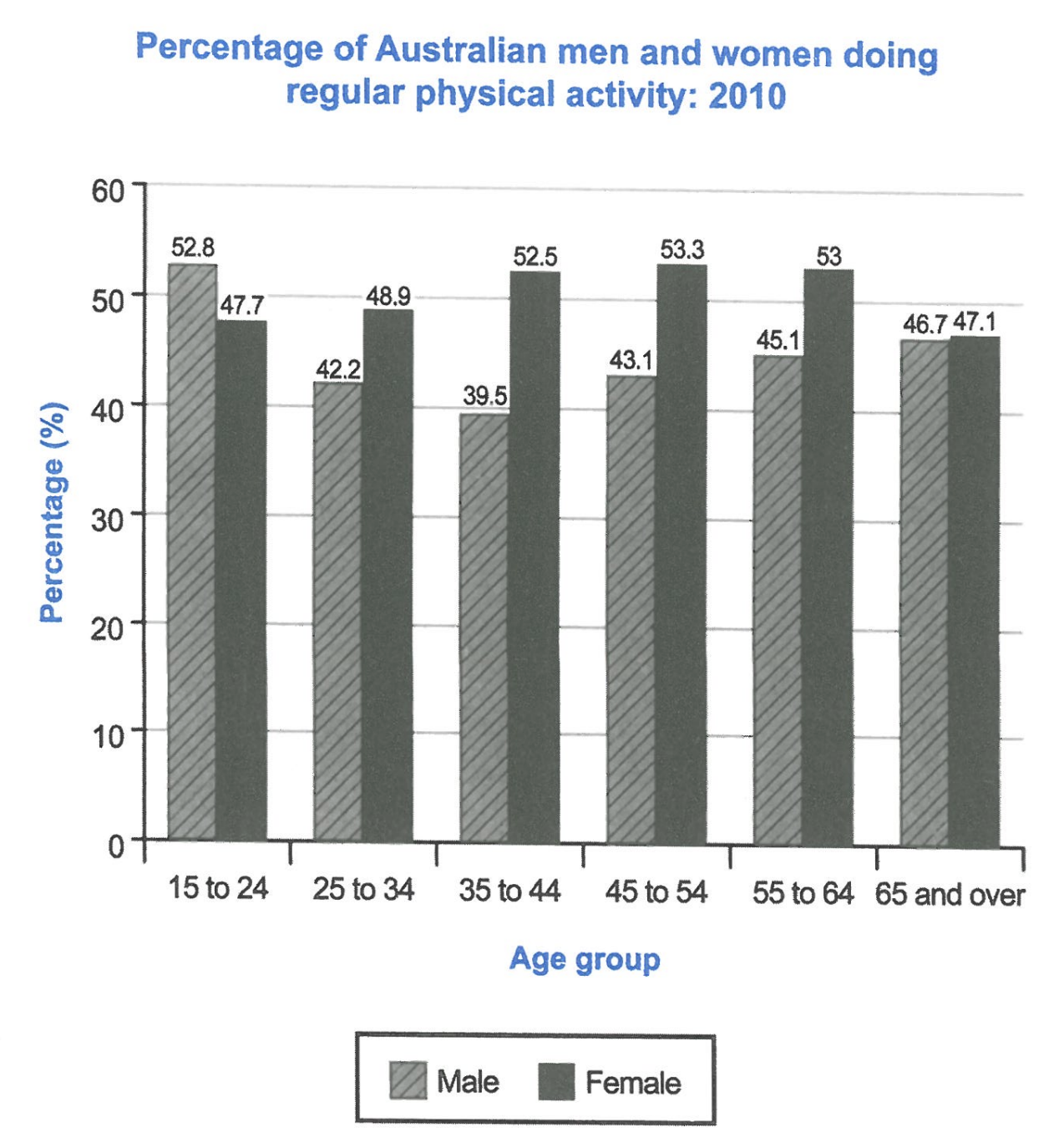
The bar chart below shows the percentage of Australian men and women in different age groups who did regular physical activity in 2010.
Summarise the information by selecting and reporting the main features, and make comparisons where relevant.
Student answer (Band 6.0)
The bar chart illustrates Australian men and women of various age participating in physical activities in 2010.
Overall , men from 15-24 of age group is leading while the age between 35 -44 is taking the least interest amongst the male gender. Women the age period of 45-54 is highly indulging in physical activities whereas the women ages over 65 are less interested in activities.
Male participation in the activities decreases as the age increases as 53% boys from age 15-24 are involving in activities and it reduces to 40% when their age crosses 44.The chart reflect a rise in participation in men between the age of 45-54 is 43% , 55 -64 age group 45.1% and over 65 is 46 %.
The interest of women increases as their age grows . It is starting with 47% accounts for age group 15-24 and it is increasing until their age crosses 64. After the 65 years of women there is a decline in their interest and its is 47% more than all the age group of male except 15-24 years .
AI examiner evaluation
| Criterion | Band |
|---|---|
| Task Achievement / Task Response | 6.0 |
| Coherence and Cohesion | 6.5 |
| Lexical Resource | 6.0 |
| Grammatical Range and Accuracy | 5.5 |
| Overall | 6.0 |
Task Achievement / Task Response: Band 6.0
You identify the main gender contrast and give a relevant overview: men have their highest participation in the youngest group, while women peak in middle age, and both figures are lower among those aged 65 and over. Several figures are also reported accurately, including the male low of about 40% and the female peak of 53.3%. However, some comparisons are unclear or inaccurate. Male participation does not simply decrease with age: it falls to 39.5% at 35–44, then rises in each older group. The claim that women’s participation increases until age 64 overlooks the slight fall from 53.3% to 53.0% at 55–64. The final comparison is also imprecise: women over 65 exceed men in every group except 15–24. Reporting these patterns more precisely would make the summary more complete.
Coherence and Cohesion: Band 6.5
The response has a clear overall arrangement: an introduction, an overview, and separate paragraphs describing male and female figures. This gives the reader a sensible route through the information, and phrases such as “Overall” and “whereas” help signal comparison. The progression is generally understandable, but some links between ideas are awkward or unclear. For example, “Male participation… decreases as the age increases” conflicts with the later description of a rise after the 35–44 group, and “After the 65 years of women” makes the final comparison difficult to follow. The overview also repeats details that are then discussed below. To strengthen cohesion, organise each gender’s figures around its actual trend and use clear references to age groups when comparing the series.
Lexical Resource: Band 6.0
You use an adequate range of vocabulary for describing the chart, including “participation,” “decline,” “increases,” and “accounts for.” These choices show an attempt to vary language rather than simply repeat the chart labels. However, some less natural word choices and collocations reduce precision: “taking the least interest,” “highly indulging in physical activities,” and “boys” are not suitable descriptions of the data. “Interest” also suggests motivation, which the chart does not measure; it reports participation rates. There are a few awkward forms, such as “various age participating” and “the age period.” Aim for standard chart language such as “the proportion of men who exercised” and “the figure peaked,” and choose terms that describe measured activity rather than inferred attitudes.
Grammatical Range and Accuracy: Band 5.5
You attempt both simple and more complex sentence forms, including comparisons with “whereas” and clauses beginning “as” and “when.” The main meaning is usually recoverable, but some grammatical errors recur. Subject–verb agreement is inconsistent in “men… is leading” and “the chart reflect,” while “women the age period of 45-54 is” lacks a clear grammatical subject. There are also problems with articles and number, as in “the age between 35-44,” and sentence boundaries and spacing are not consistently controlled, particularly in “44.The chart.” The final sentence contains an unclear construction, “After the 65 years of women there is a decline.” Practise building complete comparison sentences with accurate subjects and verbs, and check punctuation between clauses.
See this exact question answered at other band scores. The same prompt compared across bands.
Browse more IELTS Writing model answers or get your own writing scored by the same AI examiner.