Band 5.0 IELTS Writing Task 1 Model Answer
Overall Band Score: 5.0 · Cambridge IELTS 12 · 2026-11-13
IELTS Writing Task 1 question
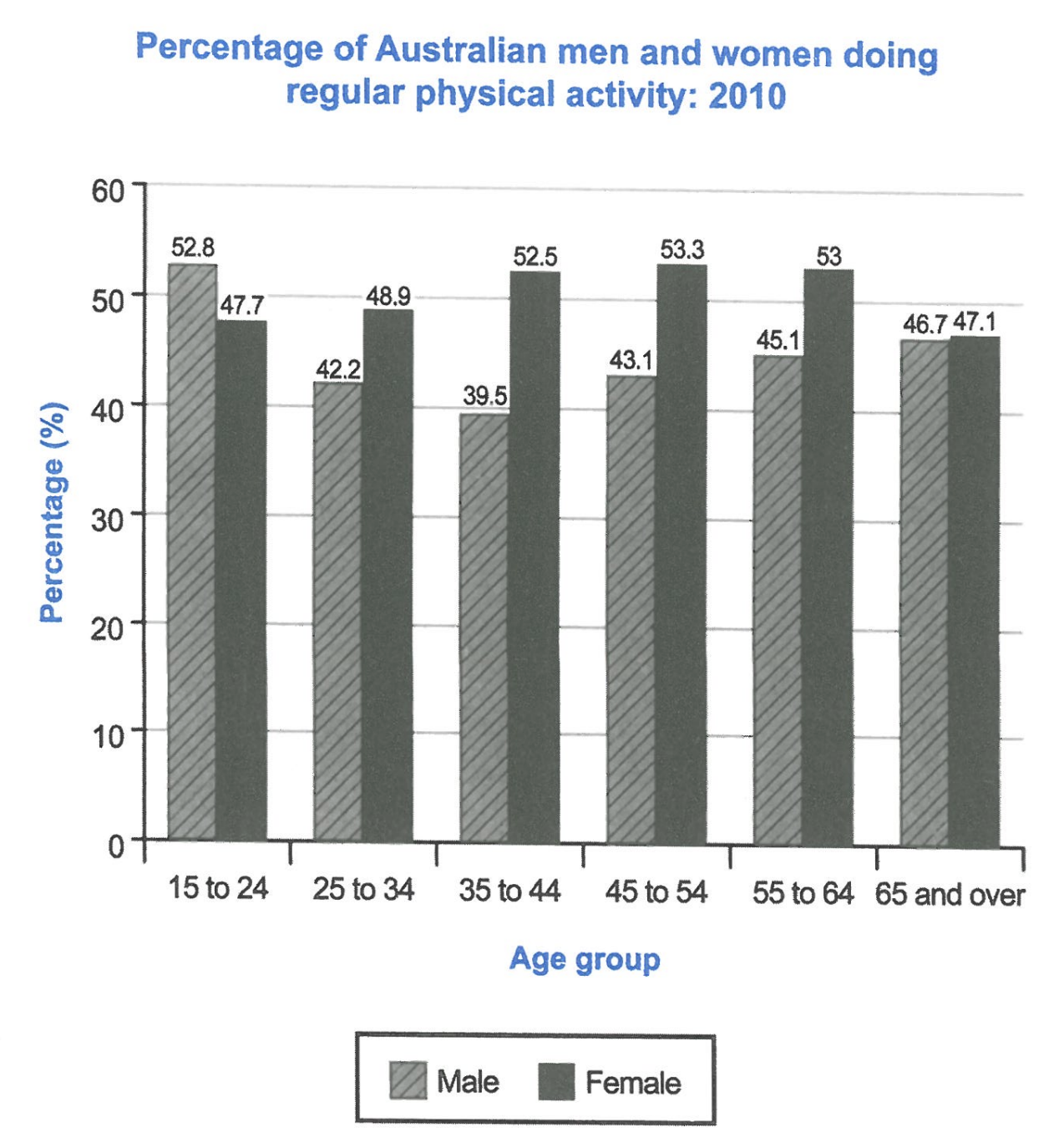
The bar chart below shows the percentage of Australian men and women in different age groups who did regular physical activity in 2010.
Summarise the information by selecting and reporting the main features, and make comparisons where relevant.
Student answer (Band 5.0)
In 2010, Australian men and women doing regular physical activity. At the age of 15 to 24 years, male has physically active 52.8 and physically active female 47.7%. At the age of 25 to 34 years, female has physical activity is. 48.9% and male has physically active in 42.2%. At the age of 35 to 44, female has physical activity is 52.2% and male has 39.5% physically active. At the age of 45 to 54, female has physical activity is 53.3% and male has 43.1% is physically active. Next age is 55 to 64 years, female has physical activity is 53% and male has physical activity is 45.1%. In the age of 65 and over, there is a slight difference in male and female activities. The female has 47.1% and male has 46.7% active in physically. All the age groups have major difference in phhysical activies of male and female. The final conclusion is that femlae is more physically active than male.
AI examiner evaluation
| Criterion | Band |
|---|---|
| Task Achievement / Task Response | 5.0 |
| Coherence and Cohesion | 5.0 |
| Lexical Resource | 5.0 |
| Grammatical Range and Accuracy | 4.5 |
| Overall | 5.0 |
Task Achievement / Task Response: Band 5.0
You report figures across all six age groups and identify the broad pattern that women were more active than men in most groups. However, the overview is limited and the claim that “All the age groups have major difference” is inaccurate: men slightly exceeded women among 15–24-year-olds, while the gap among those aged 65 and over was very small. The 35–44 female figure is also given as 52.2%, rather than 52.5%. To make the summary more complete, highlight the main trends: men’s rate fell to a low among 35–44-year-olds before rising, while women’s rate generally rose to a peak around middle age and then declined. Select these comparisons instead of relying mainly on a list of figures.
Coherence and Cohesion: Band 5.0
The response follows the age groups in chart order, so readers can locate the comparisons, and phrases such as “At the age of” and “Next age” provide some basic linking. However, the writing reads as a sequence of similar statements rather than a clearly organised summary. There is no distinct overview, and the final conclusion repeats the claim that women were more active without resolving the exception in the youngest group. Repeated sentence openings and the abrupt opening fragment also weaken progression. Group the data into a short introduction, an overview of the main trends, and one or two comparison paragraphs. Use linking language to show contrasts and changes, rather than repeating the same age-group formula.
Lexical Resource: Band 5.0
You use relevant chart vocabulary, including “percentage,” “age groups,” “difference,” and “physically active,” so the topic remains understandable. However, the range is limited and several phrases are repetitive or unnatural, such as “has physically active,” “has physical activity is,” and “active in physically.” These choices make some comparisons harder to read and do not describe trends precisely. Spelling errors in “phhysical,” “activies,” and “femlae” also reduce accuracy. Practise concise reporting expressions such as “the proportion of men,” “the female figure,” “exceeded,” and “reached a peak.” Varying these terms and using standard spelling would make the account clearer and more appropriate for an academic chart summary.
Grammatical Range and Accuracy: Band 4.5
The response attempts to report each age group in a complete sentence, but the grammatical range is narrow and errors occur throughout. The opening, “In 2010, Australian men and women doing regular physical activity,” is a fragment without a main verb. Several later clauses have faulty verb patterns, for example “female has physical activity is 48.9%,” and “male has 43.1% is physically active.” Agreement and article use are also problematic in “male has physically active.” Most sentences rely on the same simple structure, with little accurate variation. Build sentences around a clear subject and verb—for example, “The proportion of active men was 52.8%”—and check that each sentence has a complete clause and consistent grammatical pattern.
See this exact question answered at other band scores. The same prompt compared across bands.
Browse more IELTS Writing model answers or get your own writing scored by the same AI examiner.