Band 5.5 IELTS Writing Task 1 Model Answer
Overall Band Score: 5.5 · Cambridge IELTS 12 · 2026-11-14
IELTS Writing Task 1 question
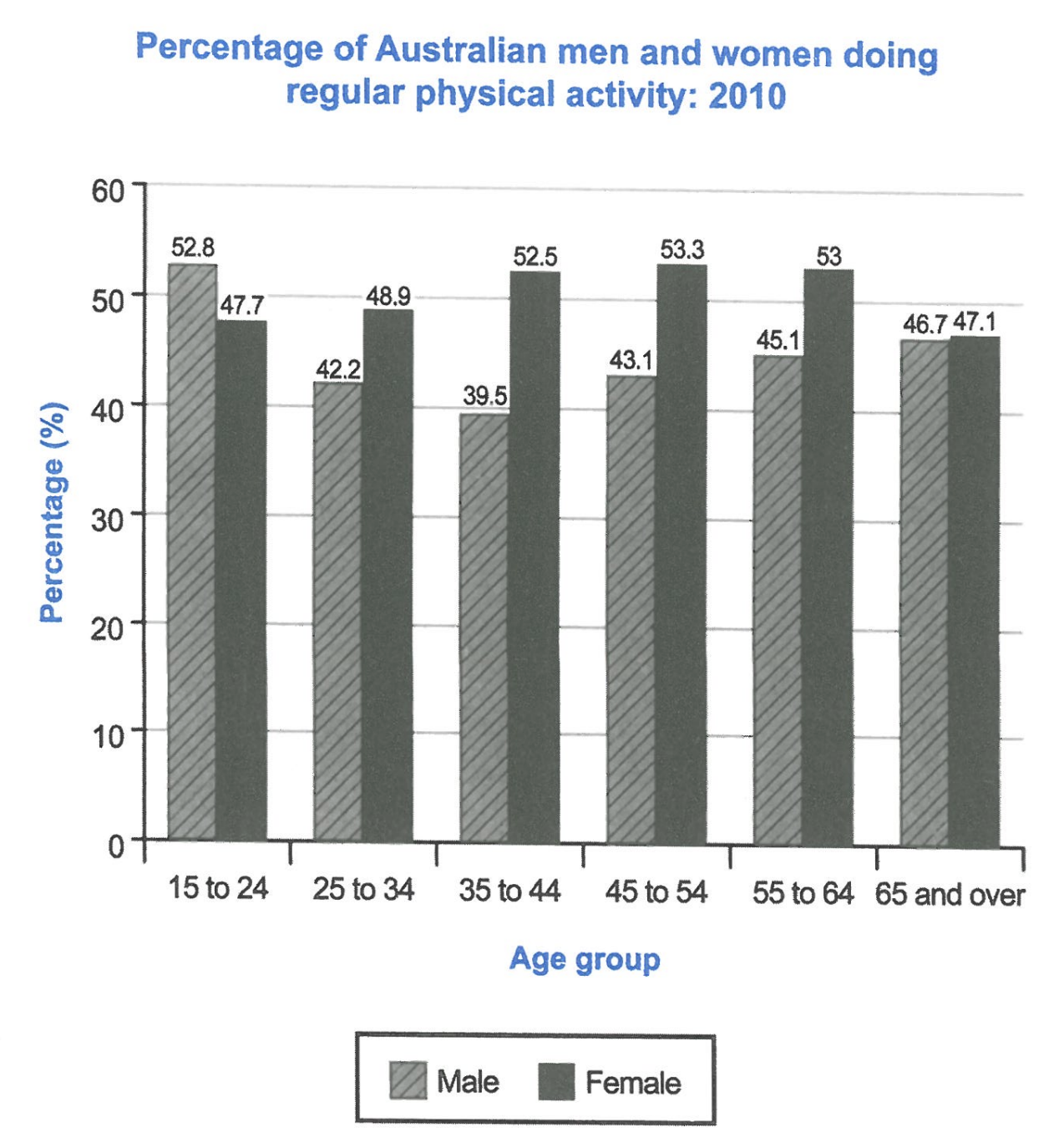
The bar chart below shows the percentage of Australian men and women in different age groups who did regular physical activity in 2010.
Summarise the information by selecting and reporting the main features, and make comparisons where relevant.
Student answer (Band 5.5)
The bar graph illustrates the proportion of Australian men and women in diffrent age groups who did regular physical activity in 2010.
Overall, the male whose the 15 to 24 age group remained the most popular age in this year, while females whose the age 14 to 54 had the largest percentage in 2010. In contrast, the lowest proportion in female had over 65 people, but the males in the age group of 35 to 44.
As shown in the graph, the teenage boys had their regular physical activity at around 52.8%, the highest proportion of men; however, the middle age of men had lower rate in physical activity as 39.5%, this is the lowest percentage of men. Furthermore, the elderly age men had started their physical exercise routine such as 55 to 64 and over 65 at 45.1% and 46.7%. The males proportion increased in under 24 and above 65, but the range of 25 to 54 age group has decreased the percentage.
AI examiner evaluation
| Criterion | Band |
|---|---|
| Task Achievement / Task Response | 5.0 |
| Coherence and Cohesion | 5.5 |
| Lexical Resource | 5.5 |
| Grammatical Range and Accuracy | 5.0 |
| Overall | 5.5 |
Task Achievement / Task Response: Band 5.0
You identify the chart’s subject and report several accurate male figures, including the peak of 52.8% among 15–24-year-olds and the low of 39.5% among men aged 35–44. However, the task is only partly addressed because the female data are not described in the body, despite the overview noting a high female rate. The overview also misstates the female age range as “14 to 54”; the highest figure is 53.3% for ages 45–54, while the lowest is 47.1% for those aged 65 and over. Your final trend statement is unclear and inaccurate: male participation did not simply decrease from 25 to 54, as it rose from 39.5% to 43.1% between the last two groups. Include key female comparisons and describe the trends precisely.
Coherence and Cohesion: Band 5.5
The response has a recognisable structure: an introduction, an overview, and a paragraph giving details about men. Linking expressions such as “Overall,” “In contrast,” and “Furthermore” help signal relationships between points. However, progression is limited because the final paragraph focuses almost entirely on male figures and does not develop the female comparisons introduced in the overview. Some connections are also difficult to follow, particularly “The males proportion increased in under 24 and above 65,” which does not clearly explain the sequence or comparison. Organise the details by comparing men and women within age groups, or by describing each sex’s trend in a clear sequence. This would make the paragraphing and cohesion more effective and reduce abrupt or unclear transitions.
Lexical Resource: Band 5.5
You use some relevant chart vocabulary, including “proportion,” “percentage,” “age group,” and “in contrast,” so the topic is generally clear. However, the range is limited and several word choices or collocations are inaccurate, sometimes making the intended meaning difficult to interpret. For example, “the most popular age” does not describe a participation rate, and “the elderly age men had started their physical exercise routine” suggests a change in personal behaviour that the chart does not show. “The males proportion” is also an awkward phrase. Check spelling, as in “diffrent,” and choose precise terms such as “participation rate” or “proportion of men.” Avoid describing age groups as people or implying causes and routines not shown by the data.
Grammatical Range and Accuracy: Band 5.0
You attempt a mixture of simple and more complex sentences, using structures such as “while” and “however” to compare information. Nevertheless, errors are frequent, and some sentences are difficult to understand. For example, “the male whose the 15 to 24 age group remained” has an unclear subject and faulty clause structure; “females whose the age 14 to 54 had” has a similar problem. There are also errors in articles, agreement, and sentence boundaries, as in “the lowest proportion in female had over 65 people” and the long sentence beginning “the teenage boys had their regular physical activity.” Practise writing direct comparisons with clear subjects and verbs, and separate related points into shorter, accurately punctuated sentences. This will help your complex structures communicate the data reliably.
See this exact question answered at other band scores. The same prompt compared across bands.
Browse more IELTS Writing model answers or get your own writing scored by the same AI examiner.