Band 5.5 IELTS Writing Task 1 Model Answer
Overall Band Score: 5.5 · Cambridge IELTS 12 · 2026-11-14
IELTS Writing Task 1 question
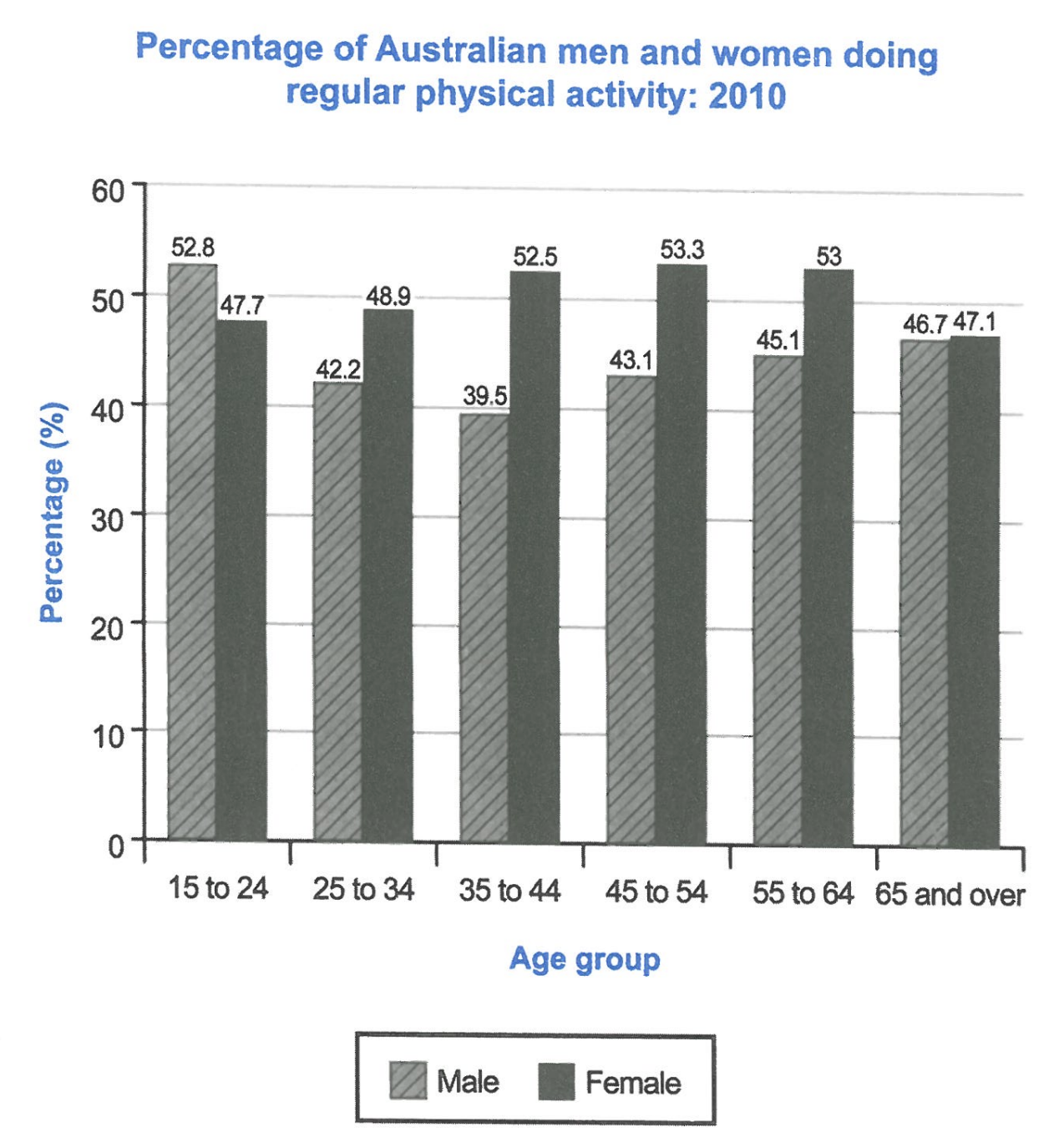
The bar chart below shows the percentage of Australian men and women in different age groups who did regular physical activity in 2010.
Summarise the information by selecting and reporting the main features, and make comparisons where relevant.
Student answer (Band 5.5)
The bar chart illustrates the percentage of Australian men and women of different age groups who did regular physical activity in 2010.
Overall, it is clear that the proportion of female participate in regular physical activity increased with age, whereas the proportion of male decreased with age.
In adult 15 to 24 years old the proportion of regular physical activity was higher in male at 52.8% as compared to female about 47.7%, in 25 to 34 aged groups the proportion of female was increased at 48.9% and in male it decreased to 42.2%, whereas in 35 to 44 years old female proportion increased up to 52.5% and in male it decreased to 39.5%.
In contrast, female stood at 53.3% and male showed slight increase about 43.1% in 45 to 54 aged group. Meanwhile in 55 to 64 aged group the activity rates was almost same about 53% and in male the proportion slightly increased up to 45.1% , whereas in 65 and over aged group the proportion of doing physical activity was almost same in male and female about 46.7% and 47.1% respectively.
AI examiner evaluation
| Criterion | Band |
|---|---|
| Task Achievement / Task Response | 5.5 |
| Coherence and Cohesion | 5.5 |
| Lexical Resource | 5.5 |
| Grammatical Range and Accuracy | 5.0 |
| Overall | 5.5 |
Task Achievement / Task Response: Band 5.5
You identify the chart’s subject and include figures for all six age groups, with relevant comparisons between men and women. However, the overview is not fully accurate: women’s participation did not keep increasing with age, as it peaked at 53.3% among 45–54-year-olds before falling to 47.1% in the oldest group. Men’s rate also did not simply decrease; after reaching a low of 39.5% at ages 35–44, it rose in each older group. The final comparison is useful, but saying the rates were “almost same” at 55–64 overlooks a difference of about eight percentage points. Make the overview reflect the main turning points and gender pattern more precisely.
Coherence and Cohesion: Band 5.5
The response has a recognisable structure: an introduction, an overview, and two paragraphs reporting age-group details. The sequence broadly follows the chart from youngest to oldest, which helps readers locate the comparisons. However, the overview’s inaccurate trend summary weakens the progression, and several long sentences combine multiple age groups and comparisons, making the information harder to follow. Connectors such as “whereas,” “in contrast,” and “meanwhile” are used, but some feel repetitive or do not clearly signal the relationship between the figures. Grouping the data into younger and older age ranges, and using shorter sentences with clear comparisons, would make the organisation more coherent.
Lexical Resource: Band 5.5
You use relevant chart vocabulary, including “percentage,” “proportion,” “increased,” “decreased,” and “slight increase,” so the topic is generally clear. There is also some attempt to vary expressions for reporting figures. However, several word choices and collocations are inaccurate or awkward, such as “female participate,” “in adult 15 to 24 years old,” and “the activity rates was almost same.” Repeated use of “proportion” and “increased” also limits flexibility, while “stood at” is used appropriately only once. Aim for precise, natural phrases such as “the proportion of women,” “among those aged 15–24,” and “the rate reached.” This would improve clarity and make comparisons sound more academic.
Grammatical Range and Accuracy: Band 5.0
You attempt a mixture of simple statements and longer comparative sentences, using clauses with “whereas” and “in contrast.” These structures allow you to report several figures, but complex sentences are often not controlled accurately. For example, “the proportion of female participate” has an incorrect verb form, and “the activity rates was” has a subject–verb agreement error. Articles and sentence patterns are also problematic in “in adult 15 to 24 years old” and “in 25 to 34 aged groups.” Punctuation around the long comparisons is inconsistent, and some sentences become difficult to process because several clauses are joined together. Practise accurate age-group constructions and divide multi-part comparisons into shorter sentences.
See this exact question answered at other band scores. The same prompt compared across bands.
Browse more IELTS Writing model answers or get your own writing scored by the same AI examiner.