Band 7.0 IELTS Writing Task 1 Model Answer
Overall Band Score: 7.0 · Cambridge IELTS 12 · 2026-11-14
IELTS Writing Task 1 question
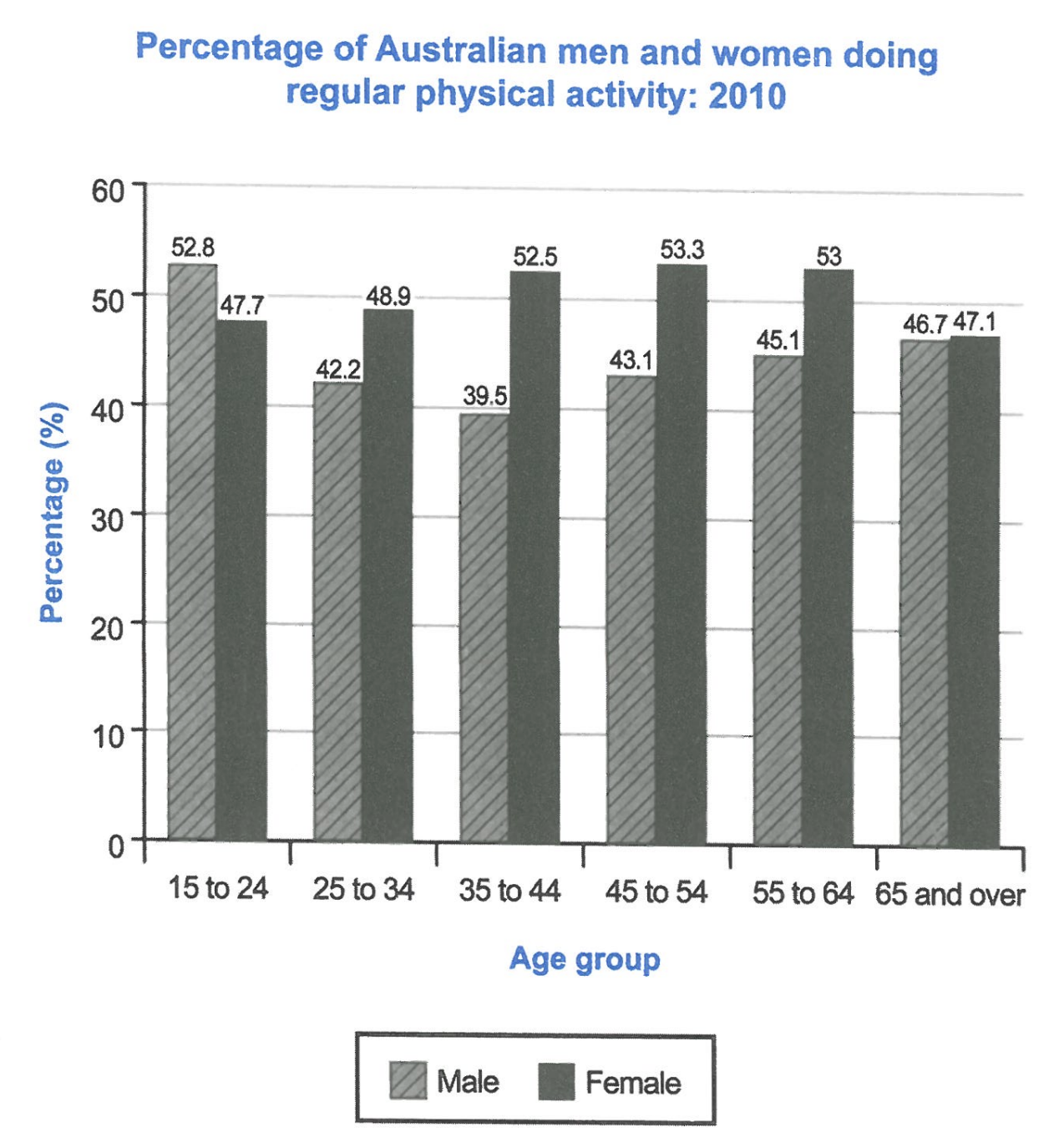
The bar chart below shows the percentage of Australian men and women in different age groups who did regular physical activity in 2010.
Summarise the information by selecting and reporting the main features, and make comparisons where relevant.
Student answer (Band 7.0)
The chart below compares the percentage of Australian Males and females in different age groups who did regular physical exercise in 2010.
Overall, women accounted for the highest figure in most of the age groups, except in the 15-24 age group. While middle aged men showed less regular physical activity, women reached their peak physical activity level in their late forties and early fifties.
Men in 15-24 age group had the highest percentage, stood at 52.8%, whereas women in the same age group were less engaged in regular physical activity. However, in 25-34 age group, the percentage for men decreased at 42.2%, while the percentage for women increased at 48.9%. Males aged 35-44 had the lowest percentage at 39.5%, whereas females rose to 52.5%.
Meanwhile, women in 45-54 age group peaked at 53.3%, and men in that age group showed an increase at 43.1%. In late fifties and early sixties, women fell by 0.3%, and men climbed by 2%. While women aged 65 and over dropped to 47.1%, men rose to 46.7%.
AI examiner evaluation
| Criterion | Band |
|---|---|
| Task Achievement / Task Response | 7.5 |
| Coherence and Cohesion | 7.0 |
| Lexical Resource | 6.5 |
| Grammatical Range and Accuracy | 6.5 |
| Overall | 7.0 |
Task Achievement / Task Response: Band 7.5
You identify the main pattern accurately: women recorded higher participation in four age groups, while men led among 15–24-year-olds, and the female peak was 53.3% at ages 45–54. The figures you give for the age groups are consistent with the chart, and the overview provides a clear summary rather than listing data alone. The comparison of the oldest group is also useful, as the rates are close. To make the account more fully developed, state the female figure for the youngest group (47.7%) and clarify that women’s rate rises to a peak before declining, while men’s rate falls to a low and then recovers. The phrase “late forties and early fifties” is a slightly imprecise description of the 45–54 category.
Coherence and Cohesion: Band 7.0
The response has a clear overall structure: an introduction, an overview, and two paragraphs reporting the age-group comparisons. Its progression from the youngest groups to the oldest is easy to follow, and linking expressions such as “Overall,” “However,” and “Meanwhile” help signal relationships between points. The final paragraph also brings the two trends together effectively. Some connections are less precise: “in late fifties and early sixties” does not clearly identify the 55–64 category, and “fell by 0.3%” and “climbed by 2%” require the reader to infer the comparison with the preceding age group. Naming the age band and specifying that these are percentage-point changes would make the progression more explicit and cohesion more controlled.
Lexical Resource: Band 6.5
You use a suitable range of task-related vocabulary, including “accounted for,” “peaked,” “decreased,” “increased,” and “dropped,” and the meaning remains clear throughout. There is some flexibility in how you describe the trends, rather than relying on one verb repeatedly. However, several choices are imprecise or awkward for chart reporting: “Males” and “females” are less natural here than “men” and “women,” while “showed less regular physical activity” and “less engaged” are not as precise as describing participation rates. “Fell by 0.3%” also risks confusing a percentage-point difference with a relative percentage change. More consistent, precise collocations would strengthen the range and control of your vocabulary.
Grammatical Range and Accuracy: Band 6.5
You use a mix of simple and complex sentence forms, including contrast clauses with “whereas” and “while,” and most sentences communicate the comparisons clearly. There are, however, some recurring grammatical slips. Articles are missing in phrases such as “in 15-24 age group” and “in 25-34 age group”; use “in the 15–24 age group.” The construction “had the highest percentage, stood at 52.8%” is not grammatically complete; write “had the highest percentage, at 52.8%” or “stood at 52.8%.” In “the percentage for men decreased at 42.2%,” the verb pattern is incorrect; use “decreased to 42.2%.” These errors do not prevent understanding, but more accurate sentence patterns are needed for stronger control.
See this exact question answered at other band scores. The same prompt compared across bands.
Browse more IELTS Writing model answers or get your own writing scored by the same AI examiner.