Band 5.5 IELTS Writing Task 1 Model Answer
Overall Band Score: 5.5 · Cambridge IELTS 12 · 2026-11-14
IELTS Writing Task 1 question
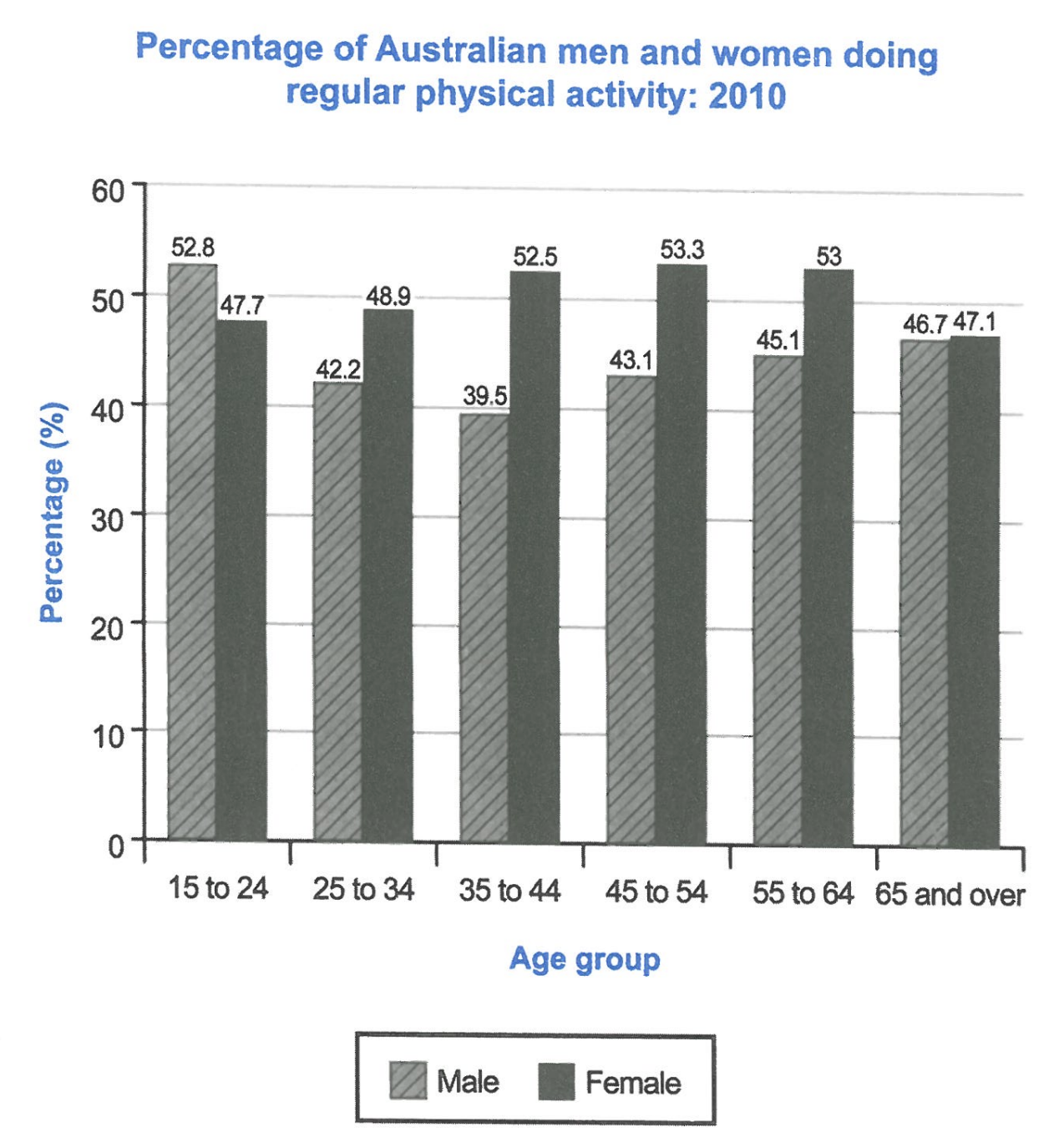
The bar chart below shows the percentage of Australian men and women in different age groups who did regular physical activity in 2010.
Summarise the information by selecting and reporting the main features, and make comparisons where relevant.
Student answer (Band 5.5)
The bar chart illustrates about the percentages of regular physical activities depends on opposite gender from various age groups in Australia in the period of 2010.
Overall, the information is based on two gender men and women. The females proportion of physical activities is high relatively male.
The age group of 15 to 24 in which the men are high round about 52.8 percent and women was 47.7 percent. After that men ratio in exercise was decreased as compared to women. At the age of 35 to 44 the female activities was increased to 52.5 percenr and the male dropped to 39.5 percent. The age group 55 to 64 has women slightly surged was 53 percent and the men was steadily rosed to 45.1 percent.
The age group those ages over to 65 in which the ratio of exercises both gender reached to half. The female percentage sharply decreased to 47.1 percent and male was slightly upward to 46.7.
Finaly, the females doing exercise are high as comapred to male in Australia during 2010.
AI examiner evaluation
| Criterion | Band |
|---|---|
| Task Achievement / Task Response | 5.5 |
| Coherence and Cohesion | 5.5 |
| Lexical Resource | 5.5 |
| Grammatical Range and Accuracy | 5.0 |
| Overall | 5.5 |
Task Achievement / Task Response: Band 5.5
You identify the chart’s subject and include several relevant figures, including the male peak of 52.8% among 15–24-year-olds and the female peak of 53.3% among 45–54-year-olds (although that peak is not explicitly reported). However, the overview that women’s activity was “high relatively” to men is too broad: men were more active in the youngest group, and the figures are close in the oldest group. Some important comparisons are missing, especially the female lead across most age groups and the male low of 39.5% at ages 35–44. The account also skips the 25–34 and 45–54 figures and inaccurately suggests both sexes reached “half” in the oldest group. Select the main patterns more clearly and support them with accurate comparisons.
Coherence and Cohesion: Band 5.5
The response has a recognisable structure, with an introduction, an overview, and paragraphs describing age-group data. This gives the reader a basic route through the information. However, progression is weakened by repeated conclusions: the overview says women’s proportion is higher, and the final sentence repeats this without adding a useful summary. The sequence of details is also incomplete, moving from 15–24 to 35–44 and then 55–64, while omitting other groups. Linking phrases such as “After that” do not accurately describe the changing male trend, which falls and then rises. Organise the body around the main trends—male and female patterns, and where the figures differ—and use transitions that reflect those patterns.
Lexical Resource: Band 5.5
You use some relevant chart vocabulary, including “percentage,” “decreased,” “dropped,” and “sharply decreased,” and the reader can generally understand the topic. However, the range is limited and several choices are inaccurate or unnatural, such as “percentages … depends on opposite gender,” “ratio in exercise,” and “the female activities was increased.” “Reached to half” is also an imprecise way to describe values of 46.7% and 47.1%. Spelling errors such as “Finaly,” “comapred,” and “percenr” further reduce control. Aim for precise, conventional language for describing data, and check spelling and collocations before finishing.
Grammatical Range and Accuracy: Band 5.0
The response attempts both simple and more extended sentences, but control is inconsistent, particularly in clauses describing changes and comparisons. For example, “The age group of 15 to 24 in which the men are high” is not a complete, well-formed sentence, while “the female activities was increased” has subject–verb agreement and verb-form problems. In “the men was steadily rosed,” both agreement and the past-tense construction are faulty. Articles and sentence patterns are also awkward in “two gender men and women.” These errors sometimes make relationships between the data harder to follow. Practise building clear comparison sentences with accurate past-tense verbs, such as “The male figure fell to …, whereas the female figure rose to …,” and check agreement in each clause.
See this exact question answered at other band scores. The same prompt compared across bands.
Browse more IELTS Writing model answers or get your own writing scored by the same AI examiner.