Band 5.5 IELTS Writing Task 1 Model Answer
Overall Band Score: 5.5 · Cambridge IELTS 12 · 2026-11-14
IELTS Writing Task 1 question
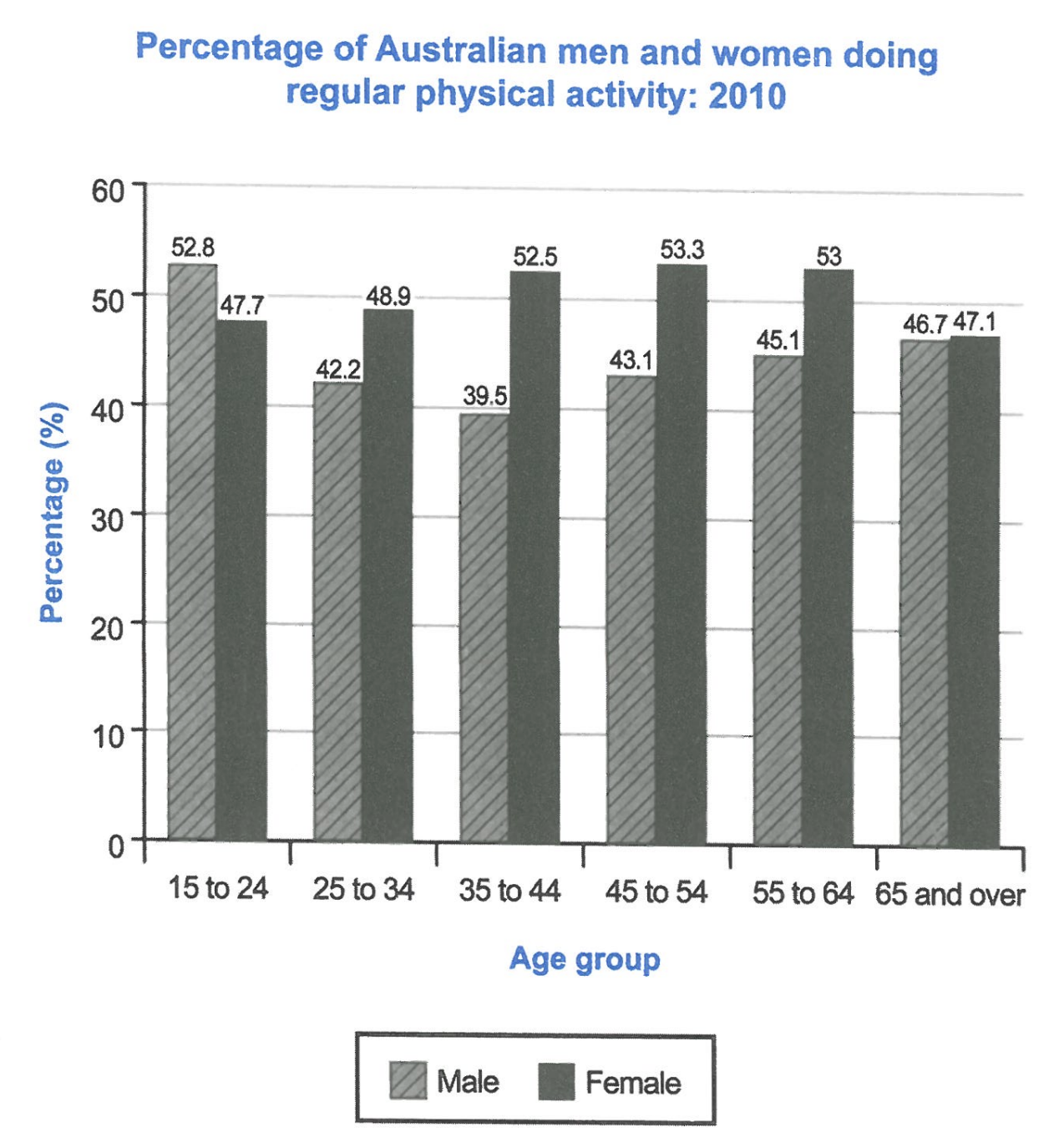
The bar chart below shows the percentage of Australian men and women in different age groups who did regular physical activity in 2010.
Summarise the information by selecting and reporting the main features, and make comparisons where relevant.
Student answer (Band 5.5)
The bar chart illustrates the numbers of individual in both genders of different age groups those involve in exercise.Overall, more than 50 percent of individuals in every age group participate in physical activity.
In every age group more womens are involve in physical activity in contrast to mens.Like in age between 35 to 66 almost 53 perecent of females doing daily activity while in mens there numbers are below than 45 percent.The least numbers of males do regular activites in the age group of 35 to 44.While in the age group of 65 or more than this, similar number of individual in both gender doing their regular work.
Furthermore, the only teenagers participate in more physical work than girls.Almost 53 percent of males practising regular routine work while in females only 47 % girls involve which is at the least in the whole group.
Ultimately, females are exceeding in each group except than youngers which falla in the age group of 15 to 24.
AI examiner evaluation
| Criterion | Band |
|---|---|
| Task Achievement / Task Response | 5.5 |
| Coherence and Cohesion | 5.5 |
| Lexical Resource | 5.0 |
| Grammatical Range and Accuracy | 5.0 |
| Overall | 5.5 |
Task Achievement / Task Response: Band 5.5
You identify the broad comparison that women generally recorded higher activity rates, and you note the male low point among those aged 35–44 and the near-equal figures in the oldest group. However, the overview is inaccurate: “more than 50 percent … in every age group” is not true, since several figures are below 50%. The claim that women are higher “in every age group” also conflicts with your later, correct observation that men lead among 15–24-year-olds. Some details are misreported or unclear: the female rate is about 52.5–53.3% from ages 35–54, not “35 to 66,” and the chart shows regular activity, not necessarily daily exercise. Select the main trends accurately and support them with clear comparisons.
Coherence and Cohesion: Band 5.5
The response has a basic structure: an opening statement, an overview, and further comparisons, with linking expressions such as “Overall,” “Furthermore,” and “Ultimately.” These help signal the direction of the discussion. However, the progression is weakened by contradictory statements: you first say women lead in every age group, then explain that young men have the higher rate. The overview also introduces an inaccurate generalisation, so it does not guide the reader reliably. Several ideas are crowded into long sentences, while full stops are missing after phrases such as “exercise” and “35 to 44.” Organise the report around the overall pattern, then compare the age groups in a logical sequence, using clear sentence boundaries and references.
Lexical Resource: Band 5.0
You use some relevant chart vocabulary, including “age group,” “percentage,” “regular,” and “physical activity,” so the topic is generally recognisable. However, the range is limited and several word choices or forms are inaccurate, sometimes making the meaning difficult to follow. For example, “numbers of individual” is unsuitable for percentages, “more womens are involve” is not a natural expression, and “regular work” does not convey exercise clearly. There are also spelling errors such as “perecent,” “activites,” and “falla.” Use precise terms such as “proportion,” “rate,” and “participated in physical activity,” and check spelling and plural forms. Avoid switching between “girls,” “females,” and “women” when describing adult age groups.
Grammatical Range and Accuracy: Band 5.0
You attempt both simple statements and longer comparisons, for example, “The least numbers of males do regular activites in the age group of 35 to 44.” However, the range is limited, and errors occur frequently in sentence structure, agreement, articles, and verb forms. Examples include “more womens are involve,” “in mens there numbers are below than 45 percent,” and “similar number of individual in both gender.” The sentence beginning “Like in age between 35 to 66” is also incomplete or awkwardly formed. Punctuation contributes to run-on sentences, particularly where a new sentence begins immediately after “activity” or “44.” Practise accurate comparative structures, such as “the proportion of women was higher than that of men,” and check each sentence for a clear subject and correctly formed verb.
See this exact question answered at other band scores. The same prompt compared across bands.
Browse more IELTS Writing model answers or get your own writing scored by the same AI examiner.