Band 5.5 IELTS Writing Task 1 Model Answer
Overall Band Score: 5.5 · Cambridge IELTS 12 · 2026-11-15
IELTS Writing Task 1 question
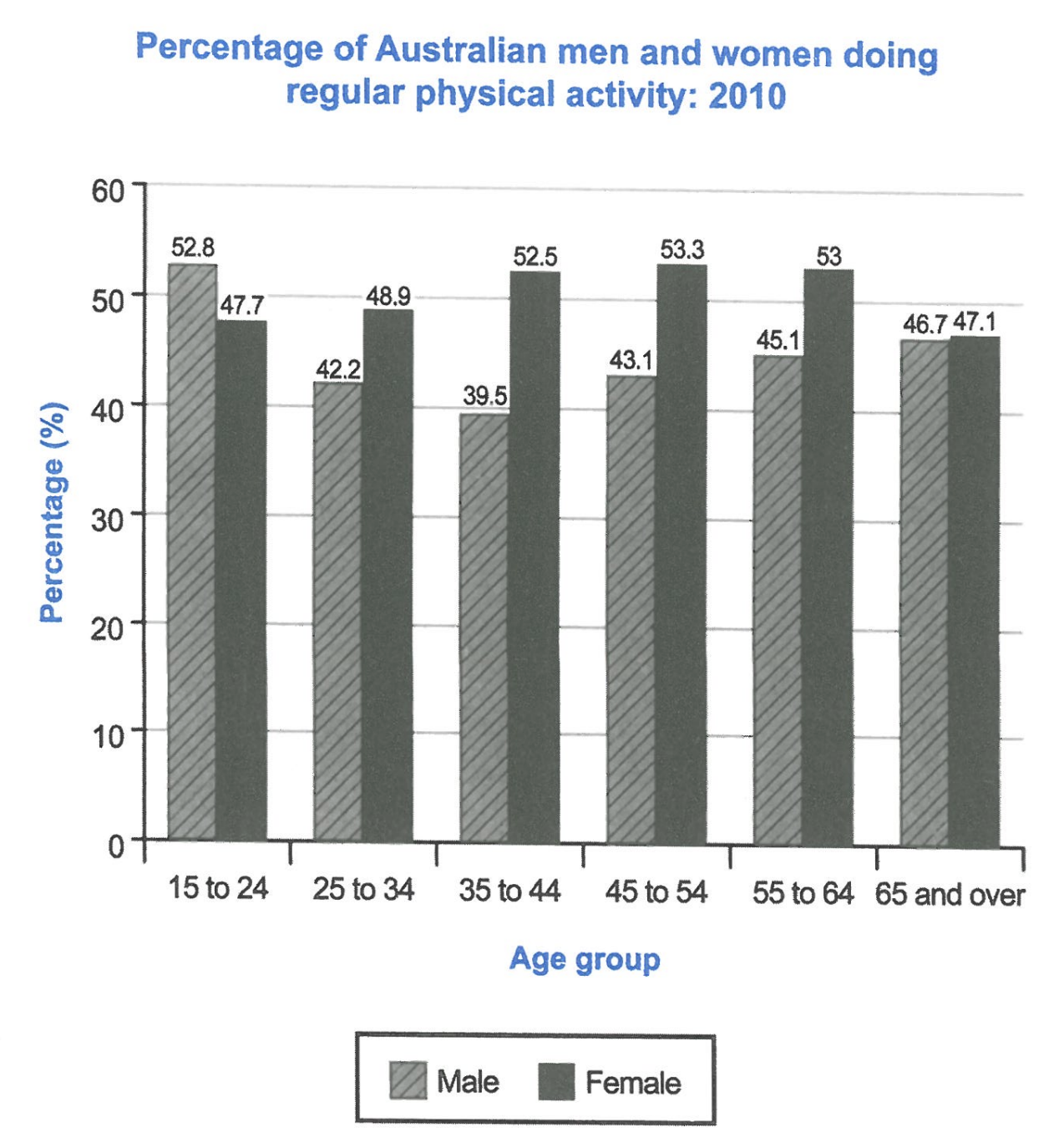
The bar chart below shows the percentage of Australian men and women in different age groups who did regular physical activity in 2010.
Summarise the information by selecting and reporting the main features, and make comparisons where relevant.
Student answer (Band 5.5)
The chart compares the proportion of australian men and women in different age groups who did rugular physical activity in 2010, the figure given in percetages.
Overall, the proportion for both gender flactuate with age, but men have high rates were youngest and oldest groups, while female have ratio was middle age group.
Initially, men have highest rate in age group of 15 to 24, at 52.8%, in the age group of 25 to 34% slighly decline to 42.2%, in the age group 35 to 44% were the lowest group in physical activity. Then reached to 46.7% in the age of 65 and over.
In contrast, in age group 15 to 24% the percentage is decrease from 52.8% to 47.7%, while age group 25 to 34 rose from 42.2% to 48.9%. Female highest group who done physical activity is the age group 45 to 54, increased from 43.1% to 53.3%.
In the age group 65 and over both gender were approximatly same 46.7% and 47.1% respectively.
AI examiner evaluation
| Criterion | Band |
|---|---|
| Task Achievement / Task Response | 6.0 |
| Coherence and Cohesion | 6.0 |
| Lexical Resource | 5.5 |
| Grammatical Range and Accuracy | 5.0 |
| Overall | 5.5 |
Task Achievement / Task Response: Band 6.0
You identify the chart’s subject and give a broad overview: male participation is highest among the youngest group, while female rates peak in middle age, and the oldest group is nearly equal. Several figures are accurately reported, including 52.8% for young men, 48.9% for women aged 25–34, and the near-equal 46.7% and 47.1% among those 65 and over. However, some key details are incomplete or unclear. You call the male rate for ages 35–44 the lowest without giving its value, and the overview’s claim that men have high rates in both the youngest and oldest groups is not clearly supported by comparison with the other male age groups. Include the female peak and the main gender pattern more precisely, and report the intervening trends consistently.
Coherence and Cohesion: Band 6.0
The response has a recognisable structure: an introduction, an overview, and paragraphs comparing male and female figures. Sequencing words such as “Overall,” “Initially,” “In contrast,” and “Then” help signal the movement between points. However, progression is sometimes difficult to follow because several comparisons are compressed into long sentences, and the reference in “Then reached to 46.7%” is unclear. The paragraph beginning “In contrast” shifts between age groups and genders without a clear organising principle, while the final sentence repeats a comparison already introduced. Group the male trend together and then describe the female trend, using clear links between corresponding age groups; this would make the organisation more coherent and cohesion less mechanical.
Lexical Resource: Band 5.5
You use relevant chart vocabulary, including “proportion,” “percentage,” “decline,” and “increased,” and the meaning is generally recoverable. However, spelling errors such as “australian,” “rugular,” “percetages,” “flactuate,” and “approximatly” are noticeable. Some word choices and collocations are also inaccurate or awkward: “both gender,” “men have high rates,” and “female highest group who done physical activity” do not express the comparisons naturally. Use precise terms such as “participation rate,” “women,” and “the highest proportion,” and check spelling carefully. A more controlled range of verbs for trends—such as “fell,” “recovered,” and “peaked”—would help you describe the data more precisely without relying on repeated or imprecise phrasing.
Grammatical Range and Accuracy: Band 5.0
You attempt both simple and more complex sentences, including comparisons introduced by “while” and “in contrast,” but grammatical control is uneven. For example, “the proportion for both gender flactuate” has problems with number agreement and verb form, while “men have highest rate” is missing an article. The sentence “In the age group 15 to 24% the percentage is decrease” uses an incorrect verb construction, and “Then reached to 46.7%” is a fragment without a clear subject. These errors sometimes make relationships between figures harder to understand. Practise complete sentences with a clear subject and verb, consistent past-tense reporting (“fell,” “rose,” “reached”), and accurate articles and plural forms. This will improve accuracy while preserving your attempts at varied sentence structures.
See this exact question answered at other band scores. The same prompt compared across bands.
Browse more IELTS Writing model answers or get your own writing scored by the same AI examiner.