Band 6.5 IELTS Writing Task 1 Model Answer
Overall Band Score: 6.5 · Cambridge IELTS 12 · 2026-11-15
IELTS Writing Task 1 question
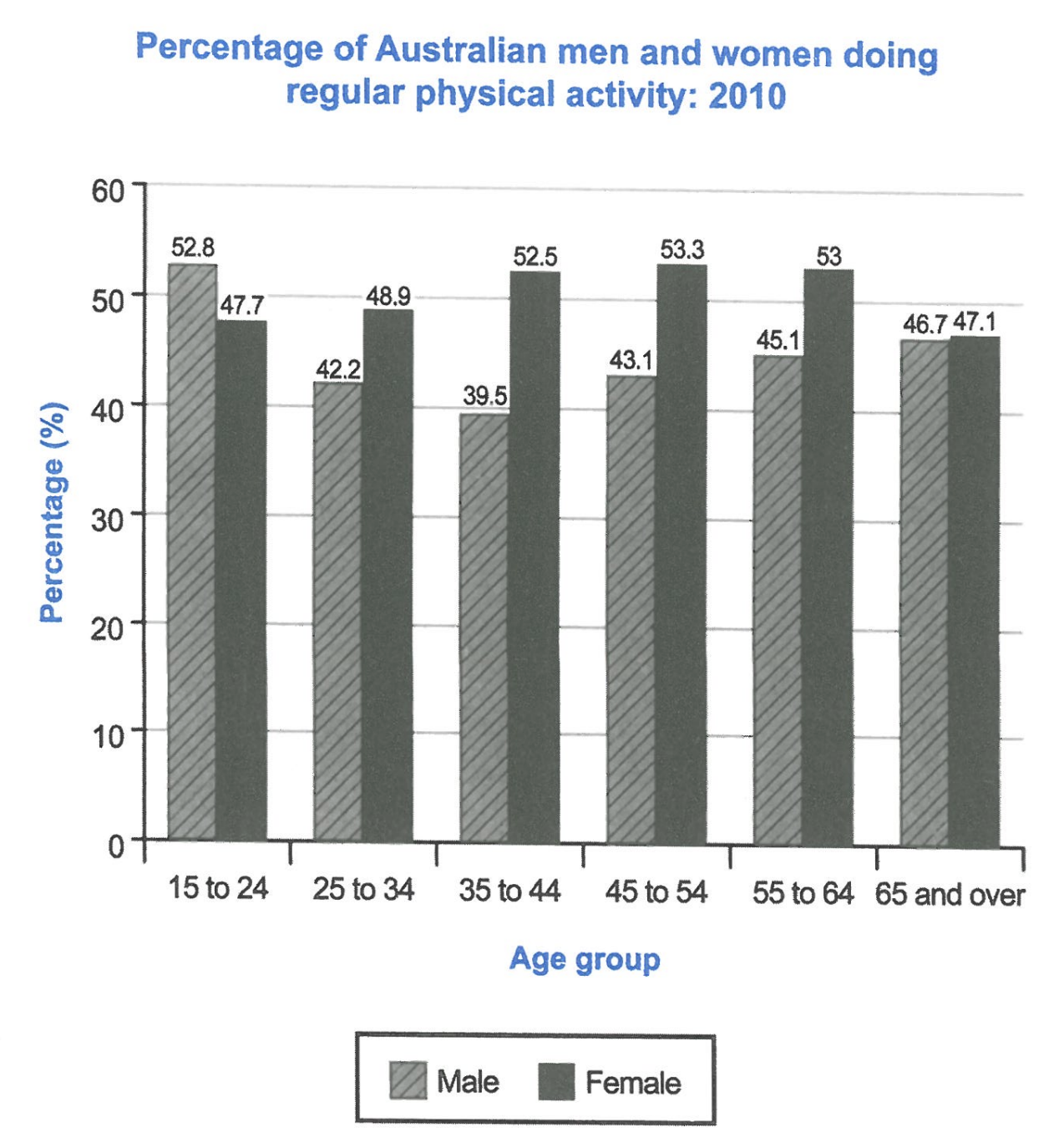
The bar chart below shows the percentage of Australian men and women in different age groups who did regular physical activity in 2010.
Summarise the information by selecting and reporting the main features, and make comparisons where relevant.
Student answer (Band 6.5)
The chat illustrates the proportion of different age groups of men and women in Australia who take part in physical activities regularly in 2010.
Overall, 15 to 24 age group of male accounted for the highest percentage of physical activity as compared to all age groups, while male age group of 35 to 44 showed the lowest percentage. Apart from 15 to 24 age group women displayed the highest proportion of physical activity than men.
Starting from the first age group, men accounted for the highest percentage of activities at 52.8% as compared to women at 47.7%. Followed by 25 to 34 age group activity droped to 42.2% for males and rose slighty to 48.9% for females. The value than further dropped to 39.5% for men and increased to 52.5% for women, for 35 to 44 age group.
Activity for 45 to 54 age group, value for men showed a slight upward trend at 43.1% and for females it rose to 53.3%, the value remained same for 55 to 64 age group at 45.1% for the men and 53% for the women. Percentage for 65 and over age group was approximately same, 46.7% for men and 47.1% for women.
AI examiner evaluation
| Criterion | Band |
|---|---|
| Task Achievement / Task Response | 6.5 |
| Coherence and Cohesion | 7.0 |
| Lexical Resource | 6.0 |
| Grammatical Range and Accuracy | 5.5 |
| Overall | 6.5 |
Task Achievement / Task Response: Band 6.5
You cover the chart’s main comparisons and include accurate figures for all six age groups. The overview identifies the male peak at 15–24 and low at 35–44, and correctly notes that women exceed men in every other group; the body then supports this with relevant data. This gives the response a clear account of the key patterns. However, the overview’s wording that men had the highest activity “as compared to all age groups” is imprecise, since it means only the highest male figure, not the highest overall figure. The description also says the 55–64 male value “remained same,” although it rose from 43.1% to 45.1%. More precise trend summaries and clearer distinctions between the sexes would strengthen the overview further.
Coherence and Cohesion: Band 7.0
The response is organised effectively into an introduction, an overview and two body paragraphs, with the age groups presented in a logical sequence. Linking expressions such as “Starting from the first age group,” “Followed by,” and “for 45 to 54 age group” help guide the reader through the data, and the comparisons are generally easy to follow. Some connections are less smooth because several figures are packed into long sentences, particularly the sentence about the 45–54 and 55–64 groups. The repeated use of “value” also makes the progression sound mechanical. Grouping the figures into clearer comparison sentences and using more precise references would make the cohesion more flexible and polished.
Lexical Resource: Band 6.0
You use a suitable range of chart vocabulary, including “proportion,” “accounted for,” “percentage,” and “upward trend,” and the meaning is generally clear. There are, however, some inaccurate or awkward choices that limit precision. “The chat illustrates” misidentifies the visual, while “percentage of activities” is less natural than a phrase describing participation or activity rates. “The value remained same” is also an imprecise way to describe the figures, especially as the male percentage changes between those groups. Spelling slips such as “droped” and “slighty” are noticeable. Aim for accurate collocations and consistent terms for the rates, and proofread spelling to make the vocabulary more controlled.
Grammatical Range and Accuracy: Band 5.5
You attempt both simple and more complex sentence forms, and the overall meaning remains understandable. Some grammatical errors occur in articles, agreement and sentence construction. For example, “15 to 24 age group of male” needs a more complete noun phrase, while “the value remained same” is missing an article. In “Activity for 45 to 54 age group, value for men showed…,” the opening phrase is not connected cleanly to the main clause. The overview sentence beginning “Apart from 15 to 24 age group women…” also needs clearer punctuation and structure. These issues do not usually prevent understanding, but they reduce accuracy. Practise complete comparison clauses and check articles, plural forms and punctuation when combining several figures.
See this exact question answered at other band scores. The same prompt compared across bands.
Browse more IELTS Writing model answers or get your own writing scored by the same AI examiner.