Band 5.0 IELTS Writing Task 1 Model Answer
Overall Band Score: 5.0 · Cambridge IELTS 12 · 2026-11-15
IELTS Writing Task 1 question
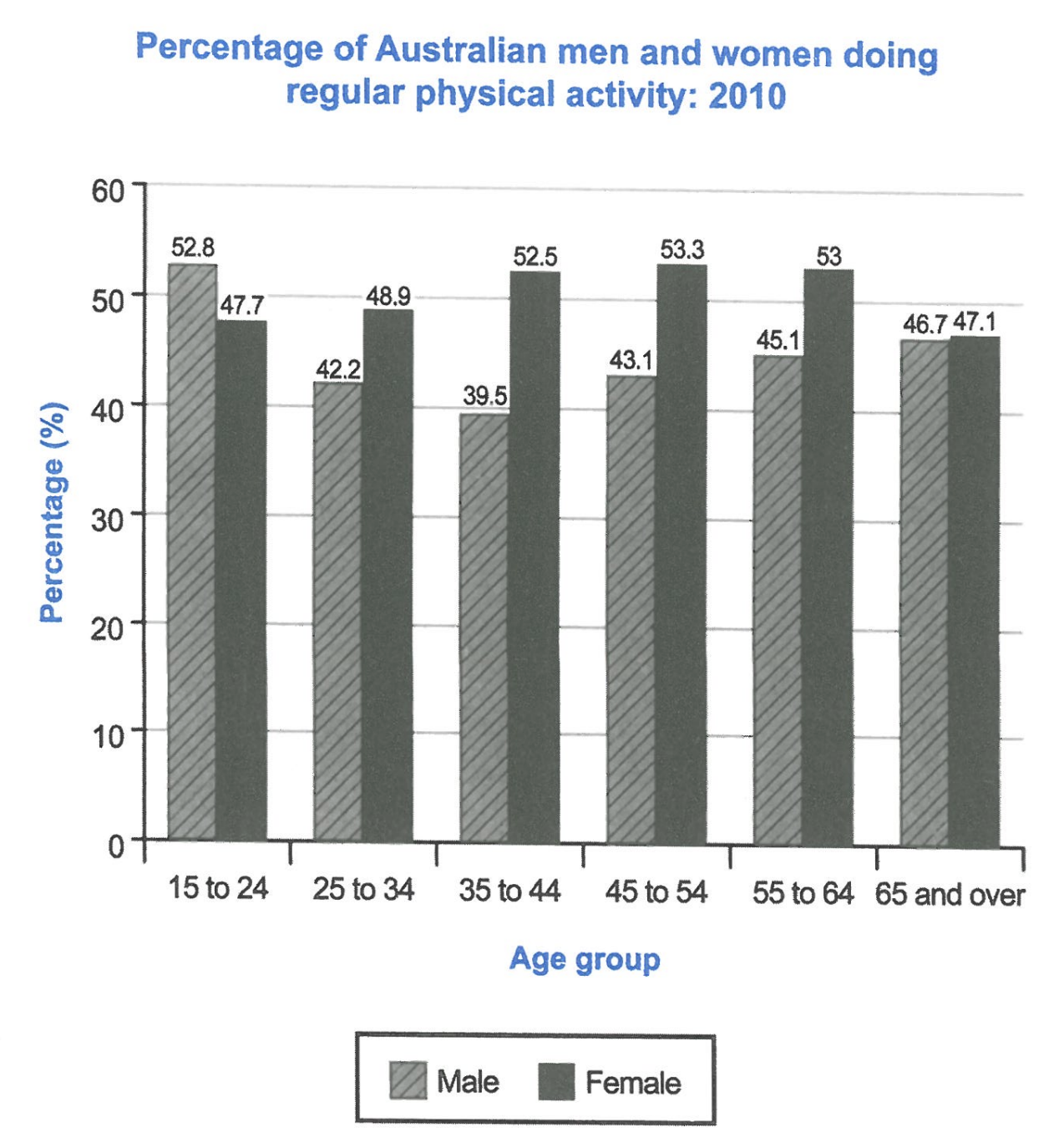
The bar chart below shows the percentage of Australian men and women in different age groups who did regular physical activity in 2010.
Summarise the information by selecting and reporting the main features, and make comparisons where relevant.
Student answer (Band 5.0)
This bar graph illustrates the percentage of Australian men and women in different age groups who did regular physical activity in 2010.
Overall, it can be seen that the chart chart experienced fluctuating trend.
The percentage of men at the age of 15 to 24 was recorded 52.8% which was the highest in men's percentage while women were found as 47.7% in that age. Similarly, the male was found 42.2% and female can be seen 48.9% in the adult age (25-34). Moreover, the percentage of the masculine was dropped into 39.5%, on the other hand 52.2% was found for women in the age of 35 to 44. In this way the percentage steadily increased and decreased at different ages but the percentage of the overaged ( over 65) was recorded as 46.7% for the men and 47.1% percent for the female who did physical activity in Australia in the year of 2010
AI examiner evaluation
| Criterion | Band |
|---|---|
| Task Achievement / Task Response | 4.5 |
| Coherence and Cohesion | 5.0 |
| Lexical Resource | 5.0 |
| Grammatical Range and Accuracy | 5.0 |
| Overall | 5.0 |
Task Achievement / Task Response: Band 4.5
You identify the chart’s subject and include several relevant figures, including the male peak of 52.8% among 15–24-year-olds and the near-equal rates for people aged 65 and over. However, the response is under the required 150 words, containing 134 words, and this limits how fully you can summarise the data. The overview, “the chart chart experienced fluctuating trend,” is unclear and does not identify the main pattern: women were more active than men in every age group except 15–24. There is also a factual error: women aged 35–44 recorded 52.5%, not 52.2%. Important comparisons and the female peak are omitted. Give a clear overview, report the main contrasts accurately, and include a few key figures.
Coherence and Cohesion: Band 5.0
The response follows a basic order, moving from the youngest age group through to the oldest, and uses linking expressions such as “Moreover” and “on the other hand.” This gives the reader some sense of progression. However, the ideas are crowded into one long body paragraph after a brief introduction and overview, so the comparisons are difficult to follow. Several transitions do not clearly show how the figures relate, and “In this way” introduces a general statement rather than a specific comparison. The overview sentence is also too vague to guide the reader. Separate the overview from the detailed comparisons, group related age groups, and use clear links such as “whereas” to contrast the sexes.
Lexical Resource: Band 5.0
You use some relevant chart vocabulary, including “percentage,” “age groups,” and “increased and decreased,” so the topic is generally recognisable. However, the range is limited and several choices are unnatural or imprecise. “The masculine” and “the female” are awkward labels for the data, while “overaged” is not an appropriate term for people aged 65 and over. “Dropped into” also does not collocate naturally with a percentage. Repetition of “percentage” and “found” makes the description less precise, and “chart chart” is an editing slip. Use standard terms such as “men,” “women,” and “older adults,” and vary reporting verbs with accurate phrases such as “stood at” or “fell to.”
Grammatical Range and Accuracy: Band 5.0
You attempt both simple and more complex sentences, including a contrast joined by “on the other hand,” and most of the intended meaning can be understood. However, the range is limited, and errors recur in sentence construction and grammatical patterns. For example, “was recorded 52.8%” is missing “at,” while “the percentage of the masculine was dropped” has an incorrect passive construction. The long final sentence joins several ideas without clear punctuation, making its structure difficult to follow. There are also inconsistent forms such as “female can be seen” alongside past-tense reporting. Practise concise comparison sentences, maintain past tense consistently, and check articles, prepositions, and clause boundaries.
See this exact question answered at other band scores. The same prompt compared across bands.
Browse more IELTS Writing model answers or get your own writing scored by the same AI examiner.