Band 5.5 IELTS Writing Task 1 Model Answer
Overall Band Score: 5.5 · Cambridge IELTS 12 · 2026-11-16
IELTS Writing Task 1 question
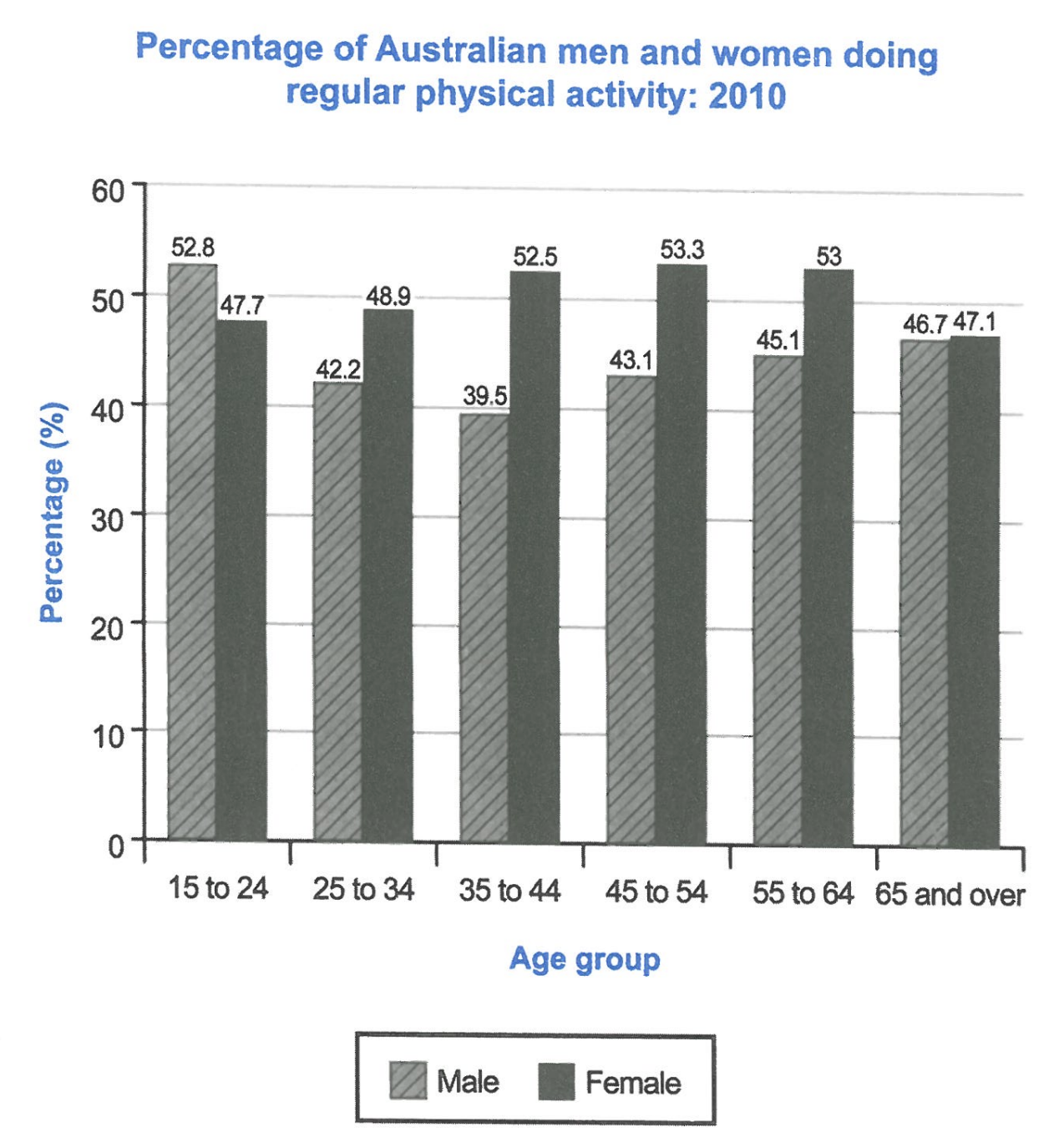
The bar chart below shows the percentage of Australian men and women in different age groups who did regular physical activity in 2010.
Summarise the information by selecting and reporting the main features, and make comparisons where relevant.
Student answer (Band 5.5)
The bar graph illustrates the percentage of female and male in Australia according to various age categories who do sport regularly in 2010.
Overall, after analyzing the bar graph, it is observed the awerness to sport importance increased for male in age (14-25), whereas female became more physical active specially in age (45-54). In age 65 and over females and males were almost identical percentage.
In the beginning, spore was important for male, which males age between (15-24) were more active than female in the same age range, by 52.8%, and 47.7%, respectively, while females in age (25-34) were more physical active than males in the same age by 6.7%.
In age (35-44), (45-54), and (55-64), Females were advanced than males by around 53%, while the percentages of male did not exceed 50%. In age 65 and over, each of females and males were almost identically, at 46.7, and 47.1 ,respectively.
AI examiner evaluation
| Criterion | Band |
|---|---|
| Task Achievement / Task Response | 5.5 |
| Coherence and Cohesion | 5.5 |
| Lexical Resource | 5.0 |
| Grammatical Range and Accuracy | 5.0 |
| Overall | 5.5 |
Task Achievement / Task Response: Band 5.5
You identify relevant comparisons, including the male lead among 15–24-year-olds and the near-equal figures for people aged 65 and over. However, the overview is unclear and partly inaccurate: the chart shows activity rates, not an increase in “awareness” or the “importance” of sport, and male activity did not rise in the 14–25 age group. The main pattern—that women had higher rates in most age groups, while men led only among the youngest—is not stated clearly. Some figures are also misreported: the female advantage at 25–34 is 6.7 percentage points, but the male figure is 42.2% and the female figure 48.9%; the final comparison is given in reverse order. Select and accurately summarise the main trends before adding supporting figures.
Coherence and Cohesion: Band 5.5
The response has a recognisable structure: an introduction, an overview, and two paragraphs of comparisons. This gives the reader some organisation, and phrases such as “while” help signal contrasts. However, progression is weakened by an unclear overview and by grouping several age bands together without explaining their pattern precisely. “In the beginning” is an imprecise transition, and repeated openings such as “In age” make the account feel list-like. The final paragraph also repeats the near-equality point already mentioned in the overview. Use a clearer overview, then organise the details by meaningful contrasts—for example, the youngest group, the middle groups where women lead, and the oldest group—and use accurate linking phrases to guide the reader.
Lexical Resource: Band 5.0
You use some task-relevant vocabulary, including “percentage,” “age categories,” “more active,” and “almost identical,” so the topic is generally understandable. However, the range is limited and several word choices or collocations are inaccurate or unclear, such as “awerness to sport importance,” “sport was important,” and “females were advanced than males.” These expressions do not describe the chart’s measured activity rates naturally and can make the intended comparison difficult to follow. Spelling errors such as “awerness” and “spore” also reduce control. Aim for precise, repeated chart language rather than abstract claims: describe participation or activity rates, and use “higher than,” “lower than,” or “exceeded” for comparisons.
Grammatical Range and Accuracy: Band 5.0
The response attempts both simple and more extended sentences, including comparisons joined with “while,” but control is inconsistent. Errors in sentence structure and agreement appear in phrases such as “it is observed the awerness … increased,” “which males age between,” and “each of females and males were almost identically.” Articles and plural forms are also unreliable, as in “the percentage of female and male,” while punctuation around age ranges and figures is inconsistent. These problems sometimes make relationships between ideas difficult to interpret. Practise building accurate comparison sentences with a clear subject and verb—for example, “Women’s rate was higher than men’s in the 25–34 group”—and check agreement, articles, and punctuation when editing.
See this exact question answered at other band scores. The same prompt compared across bands.
Browse more IELTS Writing model answers or get your own writing scored by the same AI examiner.