Band 6.0 IELTS Writing Task 1 Model Answer
Overall Band Score: 6.0 · Cambridge IELTS 12 · 2026-11-16
IELTS Writing Task 1 question
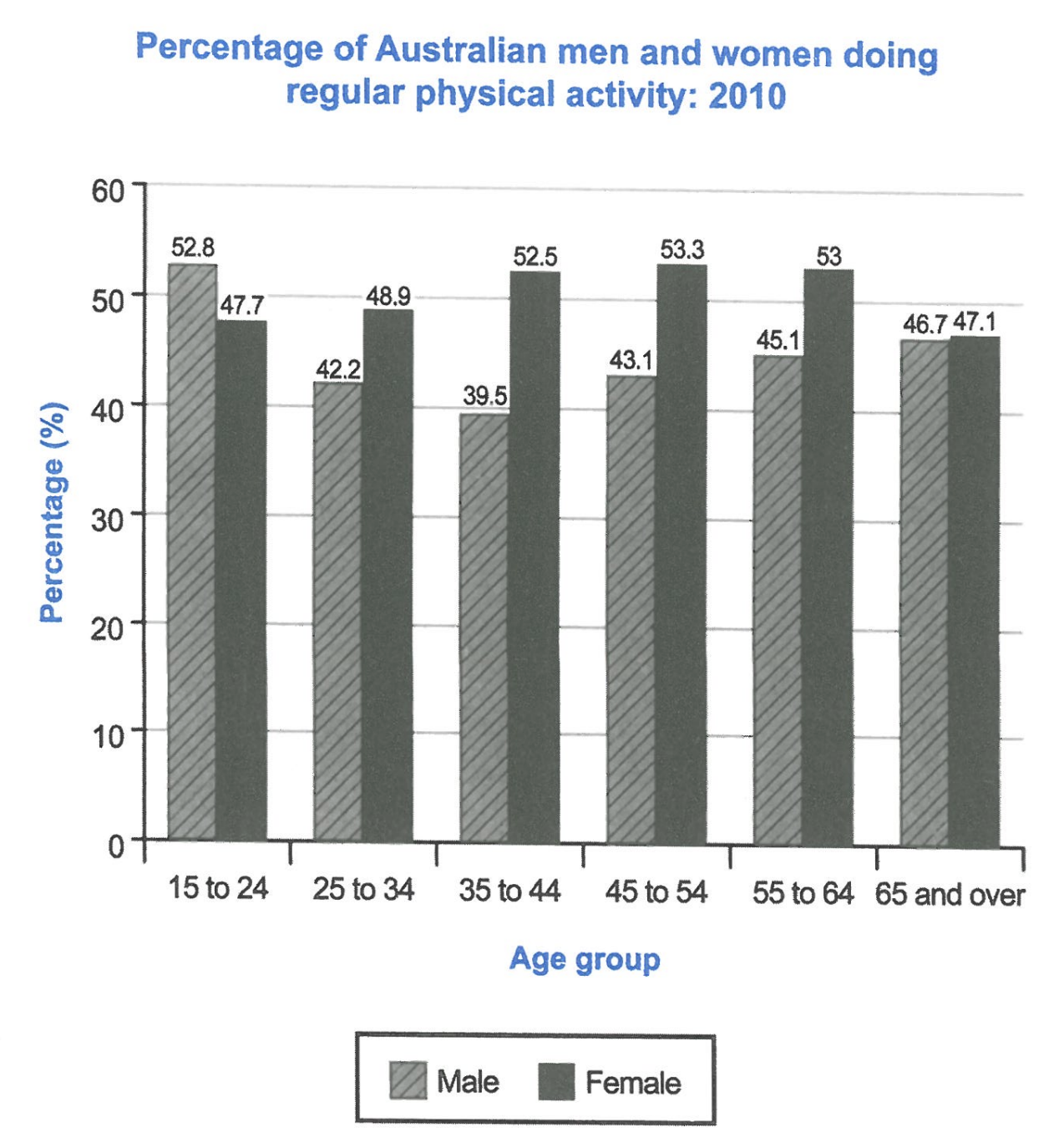
The bar chart below shows the percentage of Australian men and women in different age groups who did regular physical activity in 2010.
Summarise the information by selecting and reporting the main features, and make comparisons where relevant.
Student answer (Band 6.0)
The bar chart illustrates the proportion of Australian men and women doing regular physical activitie in different age group in 2010.
Overall, the largest share of men who doing regular physical activity is between 15 to 24, whereas female highest share is between 45 to 54 . However both are doing physical activities equally in the age group between 65 and over.
Looking at the details, men's are accounted for the highest proportion 52.8% in the age group between 15 to 24, whereas the lowest shared proportion is 39.5% between the age groups of 35 to 44. After that they started slightly increasing between age group of 45 to 54 and 54 to 65 and represent 43.1% and 45.1% respectively.
While the female made up 52.5% between age group of 45 to 54, as compared to men female dominated top the chart , however both maintain the same level between age group of 65 to more.
AI examiner evaluation
| Criterion | Band |
|---|---|
| Task Achievement / Task Response | 6.0 |
| Coherence and Cohesion | 6.0 |
| Lexical Resource | 6.0 |
| Grammatical Range and Accuracy | 5.5 |
| Overall | 6.0 |
Task Achievement / Task Response: Band 6.0
You identify the chart’s subject and provide an overview of the contrasting peaks: men are highest among 15–24-year-olds, while women peak in the middle age groups. You also correctly report several male figures and note that the sexes are close among those aged 65 and over. However, some key details are incomplete or inaccurate: women peak at 53.3% for ages 45–54, not 52.5% (that figure is for ages 35–44), and the two oldest-group figures are 46.7% and 47.1%, rather than equal. The female figures are also not reported across the age groups. More precise comparisons and a fuller account of the main trends would make the summary more complete and better supported.
Coherence and Cohesion: Band 6.0
The response has a clear overall shape: an introduction, an overview, and separate discussion of male and female data. This makes the main subject and broad comparison easy to follow. Linking expressions such as “Overall,” “Looking at the details,” and “Whereas” help signal the stages of the report. However, the final paragraph combines several ideas in a confusing way, particularly “as compared to men female dominated top the chart, however both maintain the same level.” The reference to equality is also unclear because the figures are close but not identical. Develop the female details in a more orderly sequence and use pronouns such as “they” only when their reference is unmistakable. This would strengthen progression and cohesion.
Lexical Resource: Band 6.0
You use an adequate range of task-related vocabulary, including “proportion,” “highest,” “lowest,” “increasing,” and “dominated,” and the meaning is generally understandable. There are, however, several inaccurate or unnatural choices that reduce precision. “The lowest shared proportion” is not an appropriate way to describe the male low point, while “dominated top the chart” is an awkward combination. “Physical activitie” and “age group” also show errors in spelling or number form. Aim for natural chart-reporting collocations and use “percentage” or “figure” consistently when describing values. More precise vocabulary would help distinguish a peak, a low point, a rise, and a close comparison without relying on vague phrases such as “same level.”
Grammatical Range and Accuracy: Band 5.5
You attempt both simple and more complex sentence forms, including comparisons with “whereas” and a sentence beginning “While.” The overall meaning can usually be followed, but some grammatical errors remain. For example, “men who doing” needs a finite verb form, and “men’s are accounted” has an incorrect possessive construction and verb pattern. In “the female made up 52.5% between age group,” the article, number, and preposition pattern are not controlled. The final sentence also joins contrasting ideas with “however” in a way that makes the structure difficult to follow. Practise accurate subject–verb patterns and build comparisons as complete clauses; this will let you retain complex structures while improving clarity.
See this exact question answered at other band scores. The same prompt compared across bands.
Browse more IELTS Writing model answers or get your own writing scored by the same AI examiner.