Band 6.0 IELTS Writing Task 1 Model Answer
Overall Band Score: 6.0 · Cambridge IELTS 12 · 2026-11-17
IELTS Writing Task 1 question
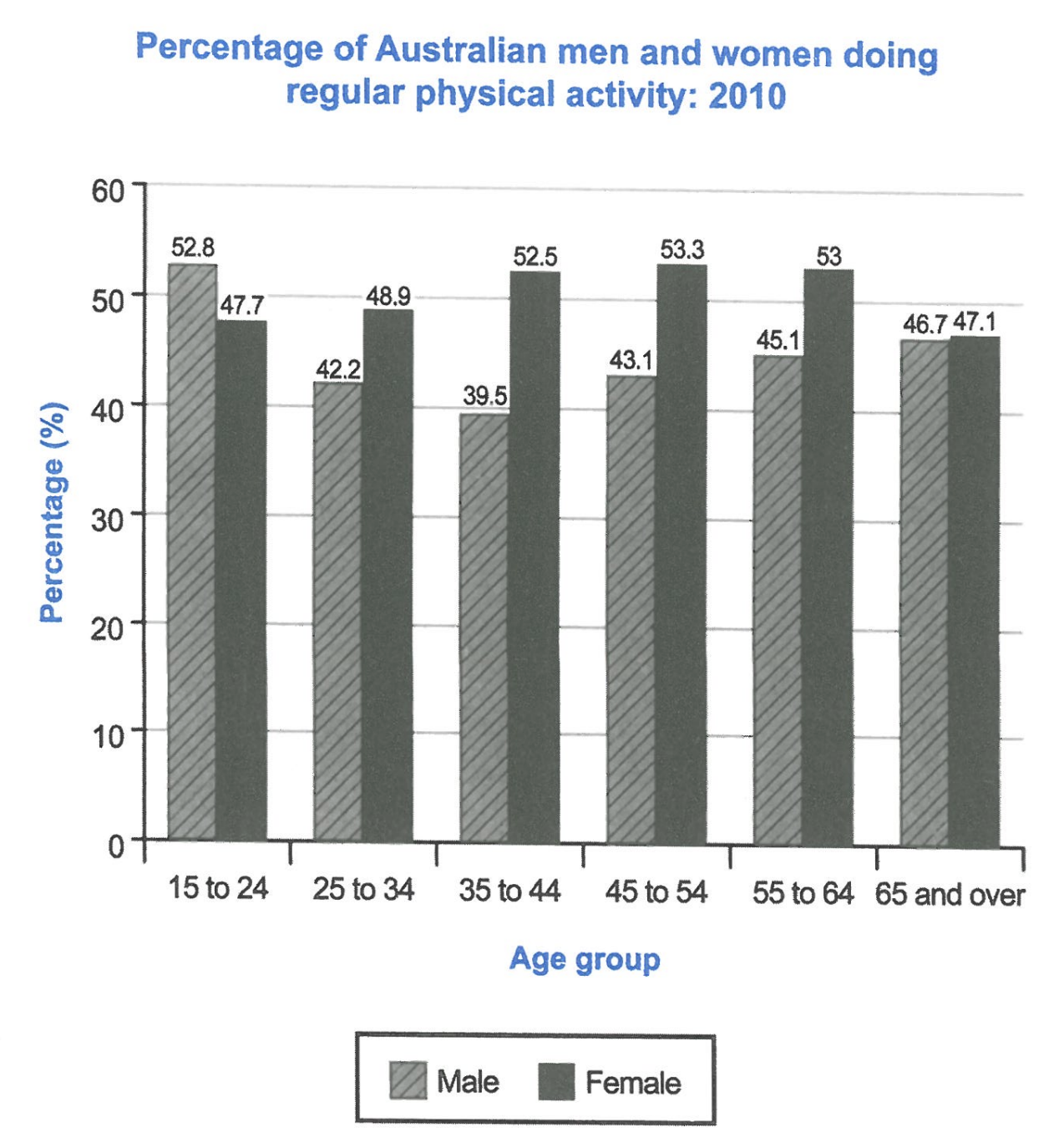
The bar chart below shows the percentage of Australian men and women in different age groups who did regular physical activity in 2010.
Summarise the information by selecting and reporting the main features, and make comparisons where relevant.
Student answer (Band 6.0)
The presented bar graph illustrates the different data about the men and women who did physical activity in 2010, in Australia.
As it is presented, the highest physical activity in men is in age group of 15 to 24, the lowest were observed in 35 to 44 years. Whereas, 45 to 54 years old women did regular physical activity and the age group of 65 and over performed the least.
Looking closely at the younger and middle-aged groups, 52.8% of men aged 15 to 24 engaged in physical activity in 2010, which was slightly higher than the women of the same group at 47.7%. However, this pattern changed in the next age two groups. In the age group of 25 to 34, women were more active at 48.9% as compared to the men at the rate of 42.2%. The similar trends occurred in 35 to 44 age groups.
On the other hand, women remained more active in the group of 45 to 54 years comparatively to the men. The biggest gap was in 55 to 64 age group, where women activity hits its highest point at 53% while men dropped at 45.1%. In the age group of 65 and over, the rates were really close, women at 47.1% and men at 46.7%.
AI examiner evaluation
| Criterion | Band |
|---|---|
| Task Achievement / Task Response | 5.5 |
| Coherence and Cohesion | 6.0 |
| Lexical Resource | 6.0 |
| Grammatical Range and Accuracy | 5.5 |
| Overall | 6.0 |
Task Achievement / Task Response: Band 5.5
You identify several important features, including the male peak among 15–24-year-olds, the male low among 35–44-year-olds, and women’s higher participation in most older groups. The figures you give for the first two age groups and the final group are accurate. However, the overview is incomplete and partly misleading: women’s highest rate was among 45–54-year-olds (53.3%), not 55–64-year-olds (53%), and their lowest rate was among 15–24-year-olds (47.7%), not those aged 65 and over. You also say the “similar trends” occurred at 35–44 without reporting the figures or clearly explaining the comparison. A more complete overview and accurate coverage of the middle-age data would make the key features clearer.
Coherence and Cohesion: Band 6.0
The response has a clear overall arrangement: an introduction, a summary of extremes, and paragraphs comparing younger and older groups. Linking expressions such as “However” and “On the other hand” help signal contrasts, and the reader can generally follow the age-group comparisons. Some connections are less clear or mechanical, though. “The similar trends occurred in 35 to 44 age groups” does not specify the figures or explain the trend, while “Looking closely at the younger and middle-aged groups” is followed by only limited coverage of the middle-aged data. The overview also places the women’s peak and low inaccurately, which weakens the progression of the summary. Grouping the data more consistently and using clearer references would improve cohesion.
Lexical Resource: Band 6.0
You use an adequate range of task-related vocabulary, including “engaged in physical activity,” “highest point,” “biggest gap,” and “rates,” so the comparisons are usually understandable. There are also attempts at varied phrasing, such as “Looking closely” and “On the other hand.” However, several expressions are imprecise or unnatural for describing chart data: “different data about,” “the highest physical activity,” “women activity hits its highest point,” and “dropped at 45.1%.” These choices sometimes make the intended comparison less precise. Prefer standard reporting collocations such as “the proportion who exercised,” “reached a peak,” and “stood at.” More consistent use of precise terms for percentages and participation would strengthen the report.
Grammatical Range and Accuracy: Band 5.5
You use a mix of simple and complex sentence forms, including a relative clause in “which was slightly higher than the women of the same group” and contrast structures beginning with “However” and “Whereas.” Most of the meaning remains clear, but some grammatical errors occur. For example, “the lowest were observed” has faulty agreement, and “in age group of 15 to 24” is missing an article. The phrase “the next age two groups” has an incorrect word order, while “women activity hits its highest point” has a problematic possessive construction and tense choice. There are also awkward sentence fragments or incomplete comparisons, particularly the sentence beginning “Whereas.” Check articles, agreement, and complete sentence structure, while keeping the useful range of clauses you already attempt.
See this exact question answered at other band scores. The same prompt compared across bands.
Browse more IELTS Writing model answers or get your own writing scored by the same AI examiner.