Band 6.5 IELTS Writing Task 1 Model Answer
Overall Band Score: 6.5 · Cambridge IELTS 12 · 2026-11-17
IELTS Writing Task 1 question
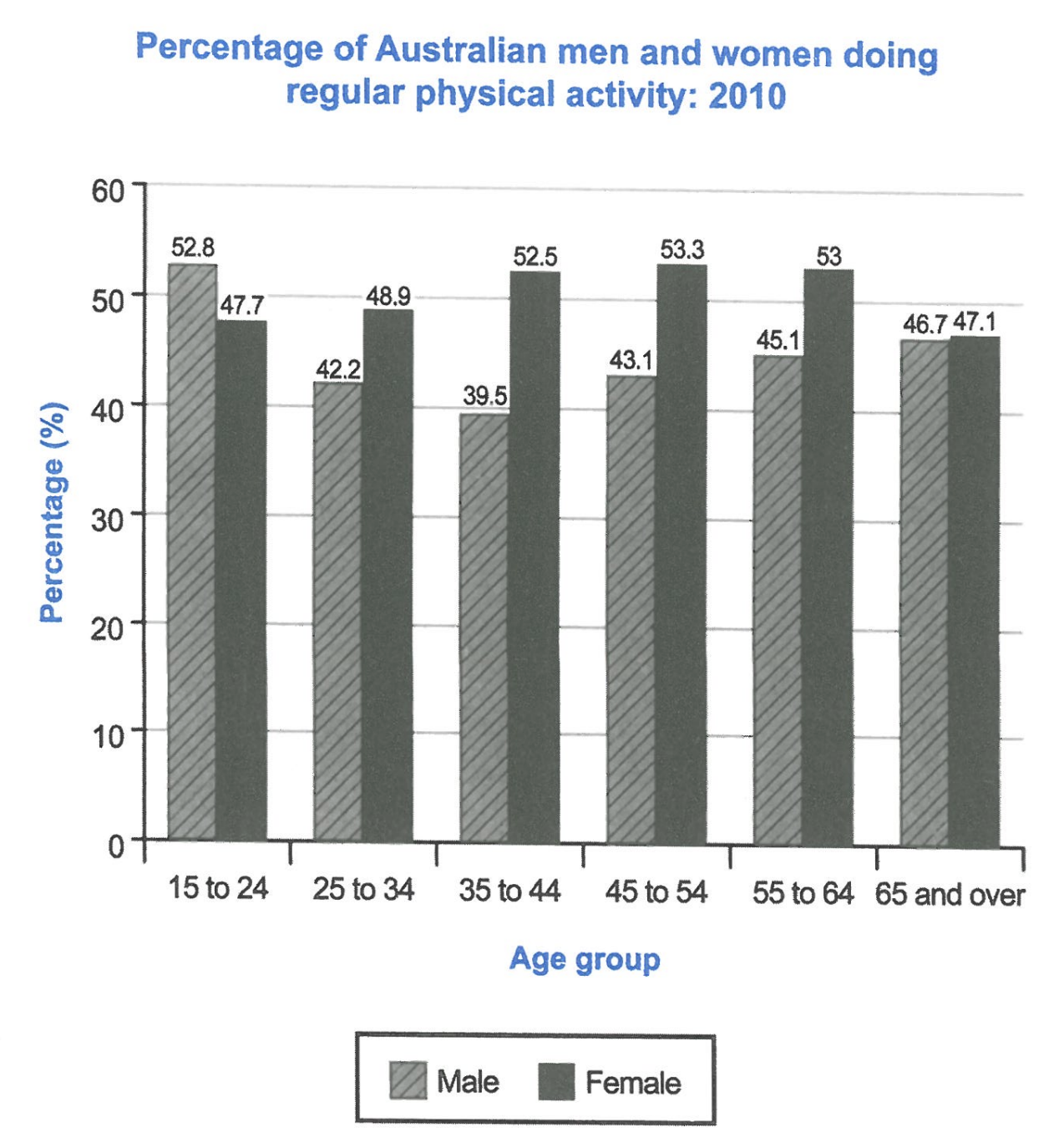
The bar chart below shows the percentage of Australian men and women in different age groups who did regular physical activity in 2010.
Summarise the information by selecting and reporting the main features, and make comparisons where relevant.
Student answer (Band 6.5)
The bar chart compares the proportion of regular physical activities of Australian people categorized by gender in the year 2010.
Overall, younger male has the highest proportion while older female reported as more active in physical activities and older male are less active.
Younger male of age group 15 to 24 reported as 52.8% and younger females as 47.7%, however male of age group 25 to 34 fell sharply to 42.2% but females gradually increased to 48.9% . In the age group 35 to 44, male declined to 39.5% while female rose to 52.5%.
Older females of age 45 to 54 reported as the highest proportion at 53.3% and male at 43.1% increased slightly from previous age group. The age group of 55 to 64, the female accounted for 53% and male accounted for 45.1% , however in the age of 65 and over both male and female recorded as almost at same proportion at 46.7% for male and 47.1% for females, showed a decline in female proportion.
AI examiner evaluation
| Criterion | Band |
|---|---|
| Task Achievement / Task Response | 7.0 |
| Coherence and Cohesion | 6.5 |
| Lexical Resource | 6.0 |
| Grammatical Range and Accuracy | 5.5 |
| Overall | 6.5 |
Task Achievement / Task Response: Band 7.0
The response selects the main comparisons and reports the figures accurately, including the male peak of 52.8% among 15–24-year-olds, the female high of 53.3% among 45–54-year-olds, and the near-equal rates in the oldest group. It also identifies the broad pattern that women were more active in most age groups, while men led among the youngest. The overview is useful, but “older male are less active” is too broad: the male rate rises after its low point at 35–44, and the oldest men are not the least active group overall. Make the overview more precise by describing the gender crossover and the contrasting trends across age groups.
Coherence and Cohesion: Band 6.5
The response has a clear overall structure: an introduction, an overview, and two paragraphs that move through the age groups in order. This chronological progression makes the comparisons easy to follow, and linking words such as “while,” “however,” and “in the age group” help connect the data. However, some transitions are mechanical or awkward, and the final sentence combines several comparisons and a trend in a way that makes the relationship less clear. For example, separate the oldest-group figures from the comment that female participation declined. More varied, precise referencing and cleaner sentence boundaries would make the progression smoother.
Lexical Resource: Band 6.0
There is adequate vocabulary for describing the chart, including “proportion,” “declined,” “increased,” and “accounted for,” and the reader can understand the comparisons. However, several choices are imprecise or unnatural: “proportion of regular physical activities” refers to activities rather than participation, and “reported as” is not a natural way to describe chart data. Repetition of “age group,” “proportion,” and “male/female” also limits flexibility. Use concise chart language such as “participation rate” and “stood at,” and vary descriptions of increases and decreases. These improvements would make the wording more accurate and natural without requiring unnecessarily complex vocabulary.
Grammatical Range and Accuracy: Band 5.5
The response attempts a mixture of simple and complex sentences, using contrast clauses with “while” and “however,” and most of the data remains understandable. Some grammatical errors recur, though. In “younger male has the highest proportion,” the plural subject needs an article or plural form; “older male are less active” has an agreement error; and “both male and female recorded as” is missing a suitable verb construction. Several sentences also lack clear punctuation, particularly the long final sentence, where the comma before “showed” leaves the clause incomplete. Practise accurate plural subjects, articles, and complete clause structures, then divide long comparisons into shorter sentences.
See this exact question answered at other band scores. The same prompt compared across bands.
Browse more IELTS Writing model answers or get your own writing scored by the same AI examiner.