Band 5.0 IELTS Writing Task 1 Model Answer
Overall Band Score: 5.0 · Cambridge IELTS 12 · 2026-11-17
IELTS Writing Task 1 question
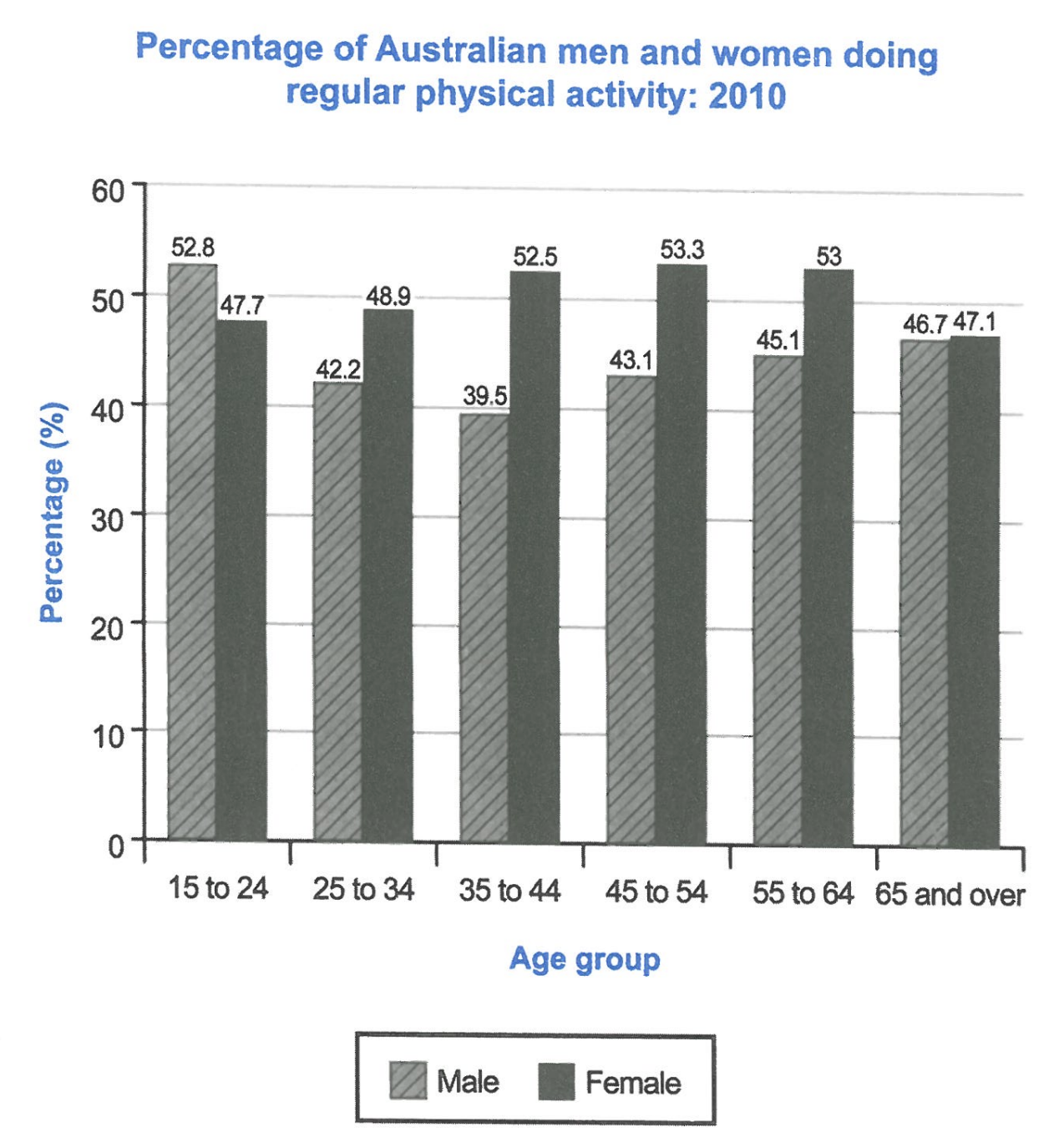
The bar chart below shows the percentage of Australian men and women in different age groups who did regular physical activity in 2010.
Summarise the information by selecting and reporting the main features, and make comparisons where relevant.
Student answer (Band 5.0)
The bar chart illustrate the different age groups of men and women of Australia do physical activities in 2010.
Looking deep into the figuers the teenagers are doing more exercise then any other age of men do, whereas, young adults of females age 45 to 54 are ahead in doing activities then of other age of women. Moreover, age 65 or above and women aged 15 to 24 are likely similar in physical activities.
secondly, the age 35 to 44 are the least to involve in physical exercise then the other aged men. And 25 to 34 and 45 to 54 age men are more common to do th activity are around 43%
AI examiner evaluation
| Criterion | Band |
|---|---|
| Task Achievement / Task Response | 4.0 |
| Coherence and Cohesion | 5.0 |
| Lexical Resource | 5.0 |
| Grammatical Range and Accuracy | 5.0 |
| Overall | 5.0 |
Task Achievement / Task Response: Band 4.0
You identify some relevant features, including the male peak among 15–24-year-olds and the low male figure for ages 35–44. However, the response only minimally summarises the chart: it gives almost no accurate numerical comparisons and omits the central overall pattern that women were more active than men in every age group except 15–24. The claim that women aged 45–54 were ahead of all other female groups is also inaccurate; their figure was marginally higher than the other groups, but this should be supported with data. The comparison between women aged 65+ and 15–24 is broadly valid. The response is 37 words below the required minimum, leaving too little space to report the main features adequately. Add a clear overview and several precise comparisons.
Coherence and Cohesion: Band 5.0
There is a basic attempt to organise the response: an opening sentence is followed by observations about the age groups, and linking expressions such as “whereas,” “Moreover,” and “secondly” signal relationships. However, the ideas do not progress in a clear, planned sequence. The second paragraph begins with “secondly” without a corresponding first point, and several observations are crowded into long, unclear sentences. The response also ends abruptly, with no concluding overview or complete summary of the chart. Grouping the information into an overview and a paragraph comparing male and female patterns would make the progression easier to follow. Use linking words only where the relationship between the figures is clear.
Lexical Resource: Band 5.0
The response uses a small set of relevant terms, including “age groups,” “physical activities,” “exercise,” and “around 43%,” so the topic is generally recognisable. However, vocabulary is limited and several choices or spellings make the meaning less clear: “figuers,” “then” for “than,” “young adults of females age,” and “more common to do th activity” are awkward or inaccurate. Repetition of “age” and “activities” also limits precision. For chart descriptions, use standard terms such as “percentage,” “participation,” “highest,” “lowest,” and “compared with,” and describe the figures directly—for example, “the proportion of men aged 35–44 was the lowest.” Check spelling and collocations carefully.
Grammatical Range and Accuracy: Band 5.0
You attempt some complex sentence forms, particularly the comparison beginning “whereas” and the sentence starting “Moreover,” but control is inconsistent. The opening has subject–verb disagreement (“The bar chart illustrate”), and “men and women of Australia do physical activities” does not form a clear grammatical description. Other problems include missing or misplaced articles and prepositions, as in “age 65 or above,” and an incomplete final construction: “25 to 34 and 45 to 54 age men are more common to do th activity are around 43%.” Sentence boundaries and punctuation also need attention, especially where several ideas are joined together. Practise accurate simple comparison sentences first, then combine them with clauses such as “while” or “whereas.”
See this exact question answered at other band scores. The same prompt compared across bands.
Browse more IELTS Writing model answers or get your own writing scored by the same AI examiner.