Band 5.5 IELTS Writing Task 1 Model Answer
Overall Band Score: 5.5 · Cambridge IELTS 12 · 2026-11-17
IELTS Writing Task 1 question
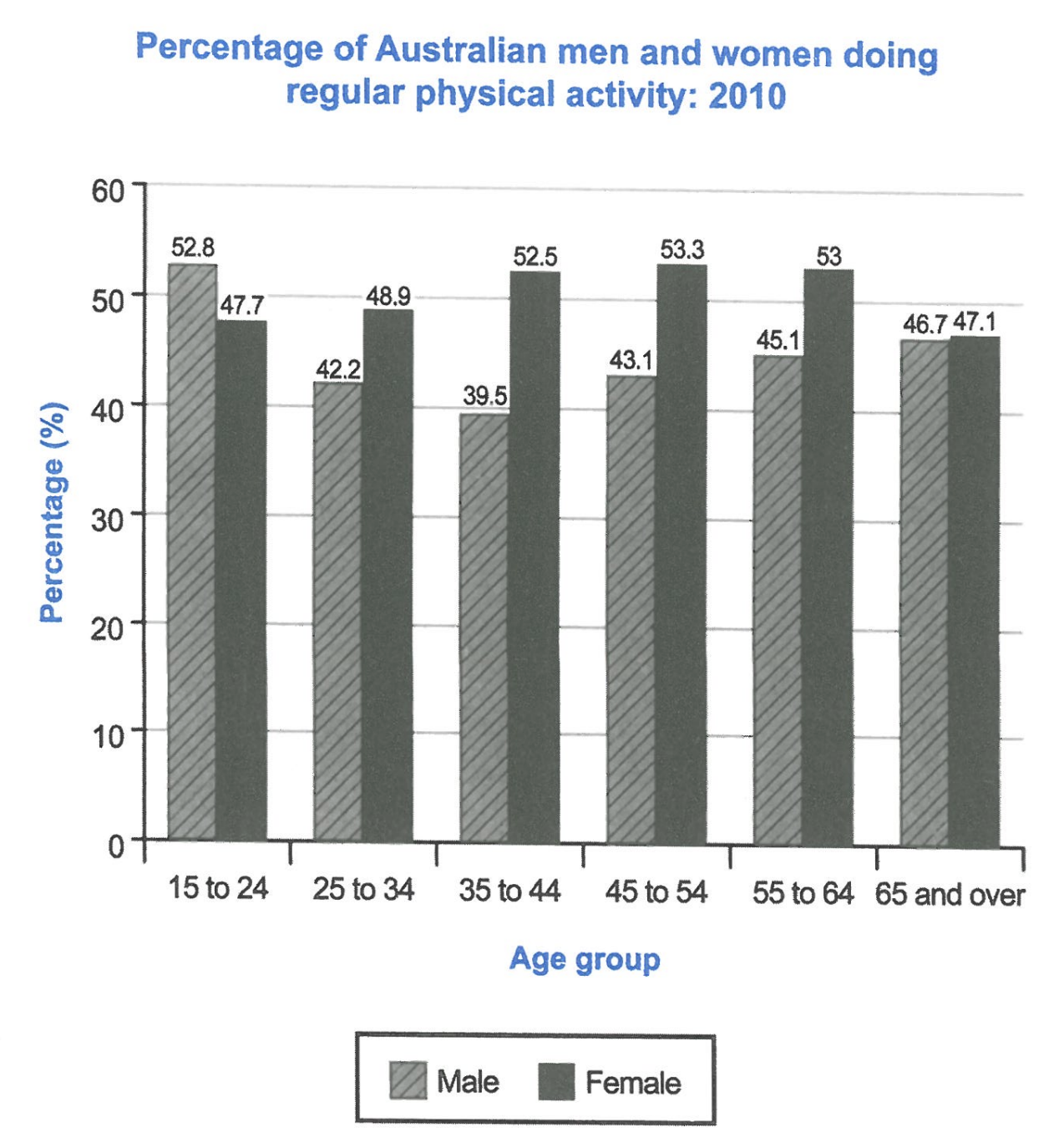
The bar chart below shows the percentage of Australian men and women in different age groups who did regular physical activity in 2010.
Summarise the information by selecting and reporting the main features, and make comparisons where relevant.
Student answer (Band 5.5)
The bar chart illustrates the percentage of daily physical activity done by the Australians in different ages in the year 2010.
Overall, the percentage of females doing physical activity in the year 2010 outnumbered the males in Austraila.
According to the data given the age group between 15 to 24 shows the only time males outnumbered in percentage than the women making it 52.8 percent and 47.7 percent respectively. The age group 25 to 34 the percentage of males doing physical activity decreased to 42.2 percent and the females experienced a slight incline making it 48.9 percent. The age group of 65 and over records almost the same percentage of men and women doing physical activity(46.7 percent and 47.1 percent respectively).
The age group 25 to 34 records incline in women doing physical activity making it 48.9 percent and experincing upward trajectory by the age group 35 to 44 making it 52.5 percent. The age group of 45 to 54 the percentage of daily females doig physical activity increased upto 53.3 percent and it remained almost similar for the age bracket 55 to 64 at 53 percent.
AI examiner evaluation
| Criterion | Band |
|---|---|
| Task Achievement / Task Response | 5.5 |
| Coherence and Cohesion | 5.5 |
| Lexical Resource | 6.0 |
| Grammatical Range and Accuracy | 5.5 |
| Overall | 5.5 |
Task Achievement / Task Response: Band 5.5
You identify the broad pattern that women were more active overall and correctly note that men led only among 15–24-year-olds. Several figures are also accurate, including the 15–24 and 65-and-over comparisons and the female peak of 53.3% at ages 45–54. However, the overview is too general: women did not lead in every age group, and the important male trend—falling from 52.8% to 39.5% before rising to 46.7%—is not summarised. The 35–44 and 45–54 male figures are omitted, and the repeated discussion of women aged 25–34 adds little. A clearer overview of both series and more balanced selection of key comparisons would make the report more complete.
Coherence and Cohesion: Band 5.5
The response has a recognisable introduction, overview and two detail paragraphs, and it generally moves through the age groups in a sensible order. However, progression is weakened by repetition: the 25–34 female figure of 48.9% is reported in both detail paragraphs, while the male figures for several later groups are not integrated into the account. Linking phrases such as “According to the data given” and repeated openings with “The age group” make the writing feel mechanical. The relationship between the overview and details could also be clearer, since the overview says women outnumbered men overall but does not explain the exception. Organise the body by comparing both sexes within each age range, and use concise transitions to show contrasts and trends.
Lexical Resource: Band 6.0
You use an adequate range of task-related vocabulary, including “percentage,” “decreased,” “slight incline,” “upward trajectory” and “records.” These choices help communicate changes and comparisons, and the meaning is generally clear. However, some expressions are imprecise or unnatural for describing chart data: “daily physical activity done by” and “outnumbered the males” do not fit the intended meaning, while “records incline” is an awkward collocation. There are also spelling errors, including “Austraila” and “experincing,” and “doig.” Aim for precise reporting language such as “the proportion who exercised regularly” and “the figure rose.” Check spelling carefully and avoid using several different trend expressions when a simpler, accurate verb is available.
Grammatical Range and Accuracy: Band 5.5
You attempt both simple and more extended sentence forms, and most comparisons remain understandable. However, some sentence structures are incomplete or awkwardly joined. For example, “The age group 25 to 34 the percentage of males…” lacks a clear grammatical link, and “The age group of 45 to 54 the percentage…” has the same problem. In “the percentage of females … outnumbered the males,” the subject and verb do not agree in meaning; it is the percentage or proportion that was higher. Articles and prepositions are also inconsistent, as in “in different ages” and “by the age group 35 to 44.” Use complete clauses with clear subjects and verbs, and vary sentence patterns while checking agreement, articles and punctuation.
See this exact question answered at other band scores. The same prompt compared across bands.
Browse more IELTS Writing model answers or get your own writing scored by the same AI examiner.