Band 6.5 IELTS Writing Task 1 Model Answer
Overall Band Score: 6.5 · Cambridge IELTS 12 · 2026-11-17
IELTS Writing Task 1 question
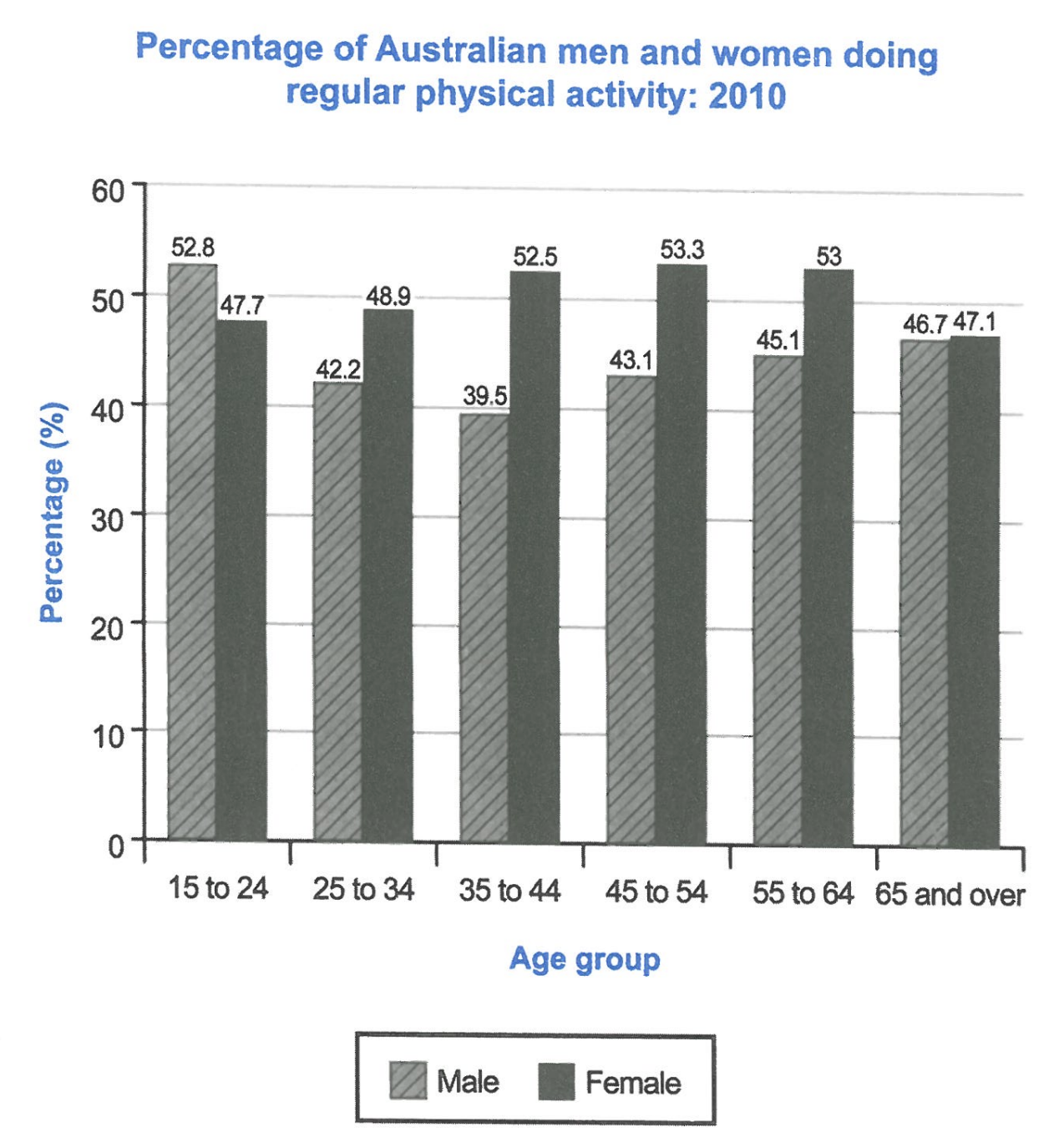
The bar chart below shows the percentage of Australian men and women in different age groups who did regular physical activity in 2010.
Summarise the information by selecting and reporting the main features, and make comparisons where relevant.
Student answer (Band 6.5)
The bar chart illustrates the proportion of Australian men and women in six different age groups who workout everyday in 2010.
The men in the age group of 15 to 24 accounted for the largest proportion at about 53% who excercise regularly, while this number reduced to 39.5% to the age group of 35 to 44 years. The percentage of men increased dramtically in the following age groups and reached to 46.7% for men over 65 years.
The proportion of women who excercise daily in the age of 15 to 24 years was at 47.7% which increased gradually and reached its peak at 53.3% among the age group of 45 to 54. A slight decline can be seen in the next age group, while this number reduced to 47.1% in women who are above 65 years.
Overall, the percentage of men who do regular physical activity was at its peak in their early age, while not many women involved in physical activities at that age. With the age group the proportion for men decreased and for women this percentage increased dramatically, while both the categories ended up having almost the same percentage in the age of 65 and over.
AI examiner evaluation
| Criterion | Band |
|---|---|
| Task Achievement / Task Response | 7.0 |
| Coherence and Cohesion | 7.0 |
| Lexical Resource | 6.5 |
| Grammatical Range and Accuracy | 6.0 |
| Overall | 6.5 |
Task Achievement / Task Response: Band 7.0
You select the main patterns and support them with relevant figures: men peak at about 53% among 15–24-year-olds, fall to 39.5% at 35–44, then rise, while women reach 53.3% at 45–54 before declining. The overview also identifies the near-equal figures for the oldest group. This gives a clear account of the chart’s key comparisons. However, the overview overgeneralises when it says men’s activity “decreased” with age and women’s increased “dramatically”: both trends reverse partway through, and the female rise is modest. Also, “workout everyday” and “excercise daily” imply daily exercise, whereas the chart reports regular physical activity. A more precise overview would describe the fluctuations and the age groups where the gender pattern changes.
Coherence and Cohesion: Band 7.0
The response is organised into a clear introduction, separate paragraphs for men and women, and a concluding overview. This creates a logical progression and makes the two series easy to follow. Linking phrases such as “while,” “in the following age groups,” and “Overall” help connect comparisons and signal the summary. Some connections are less precise, however: “while this number reduced” in the women’s paragraph does not clearly identify the age group or figure being contrasted, and the final overview repeats trends already described rather than synthesising them accurately. Use explicit references such as “the female figure then fell” and make the overview a concise comparison of the overall patterns. This would make cohesion more flexible and less repetitive.
Lexical Resource: Band 6.5
You use an adequate range of chart-reporting vocabulary, including “proportion,” “accounted for,” “reached its peak,” and “slight decline.” These choices generally communicate the data clearly, and terms such as “dramatically” show an attempt to vary your language. Some word choices and collocations are imprecise for this task: “workout everyday” and “excercise daily” suggest a daily frequency not stated in the chart, while “reduced to 39.5% to the age group” is not a natural way to express the comparison. There are also spelling errors in “excercise” and “dramtically.” To move beyond adequate range, use accurate, natural reporting phrases consistently, such as “engaged in regular physical activity” and “fell to 39.5% among men aged 35–44.”
Grammatical Range and Accuracy: Band 6.0
You use a mix of simple and more complex sentence forms, including clauses linked with “while” and “which,” and most of the meaning remains clear. Some grammatical errors persist. For example, “reduced to 39.5% to the age group” has an incorrect preposition and an unclear construction; “in the age of 15 to 24 years” is also an inaccurate age-group pattern. In “the proportion for men decreased and for women this percentage increased,” the parallel structure is awkward, and “both the categories ended up having” is less controlled than a direct comparison. Practise standard constructions such as “among those aged 15–24” and “the male figure fell, whereas the female figure rose.” More consistent control of these patterns would improve accuracy while retaining your sentence variety.
See this exact question answered at other band scores. The same prompt compared across bands.
Browse more IELTS Writing model answers or get your own writing scored by the same AI examiner.