Band 6.5 IELTS Writing Task 1 Model Answer
Overall Band Score: 6.5 · Cambridge IELTS 12 · 2026-11-17
IELTS Writing Task 1 question
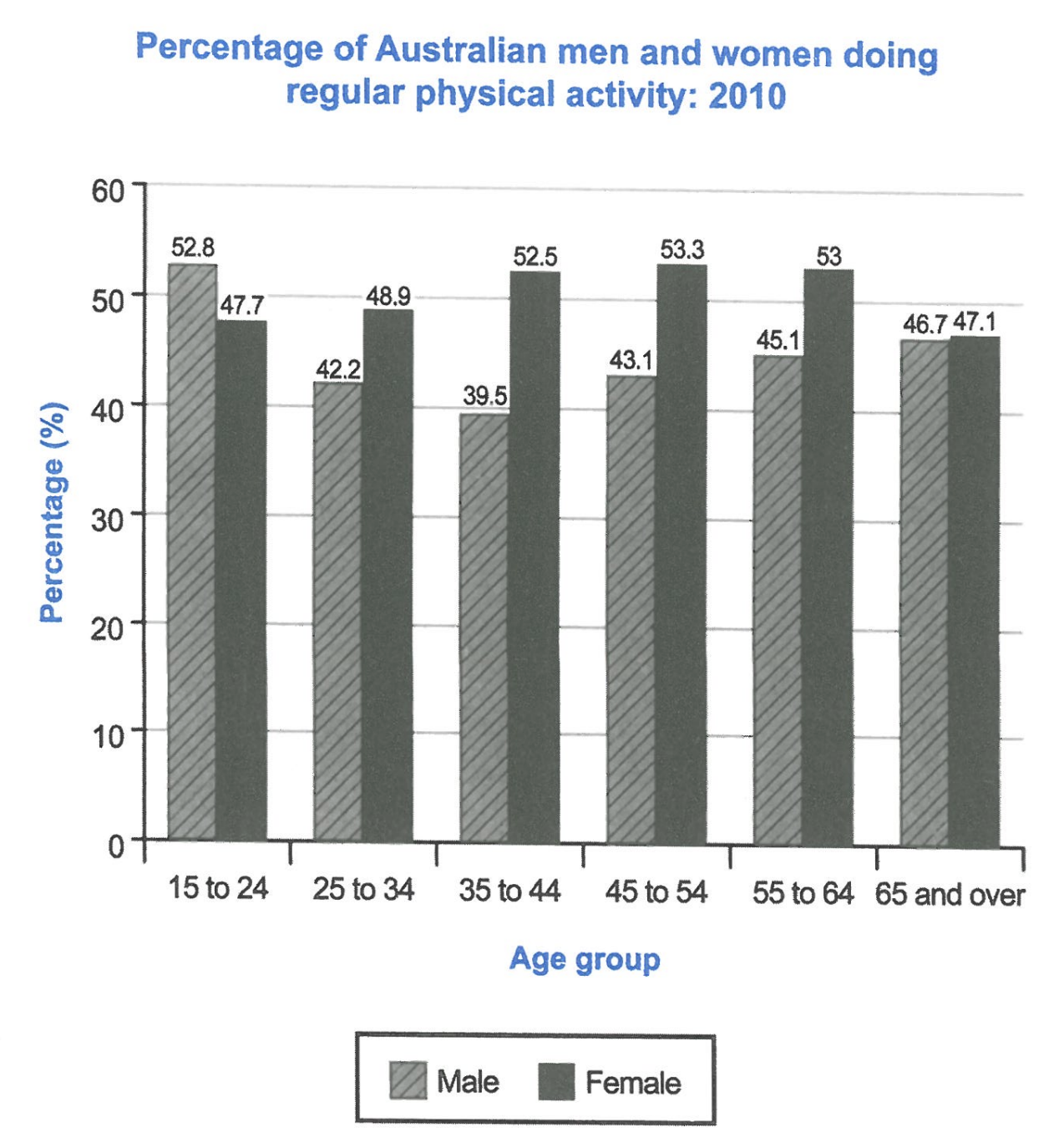
The bar chart below shows the percentage of Australian men and women in different age groups who did regular physical activity in 2010.
Summarise the information by selecting and reporting the main features, and make comparisons where relevant.
Student answer (Band 6.5)
The bar graph illustrates the proportion of Australian people of each gender (men and women) in several age groups doing regular physical activity in the year 2010.
Overall, women did more regular physical activity on average among all age groups than men, except the 15 to 24 years age group where men ranked first.
From the chart, men in the 15 to 24 years age group, who did regular physical activity, accounted for 52.8% of the total and ranked first among men in all the groups and women in this group (15 to 24 years) represented 47.7% of the total. Subsequently, 42.2% men in the 25 to 44 years age group did regular physical activity, while women constituted 48.9% of the total.
As for other groups, 35 to 44 years, 45 to 54 years, 55 to 64 years and 65+ accounted for 39.5% (men) of the total and 52.5% (women) of the total, 43.1% (men) of the total and 53.3% (women) of the total, 45.1% (men) of the total and 53% (women) of the total and 46.7% (men) of the total and 47.1% (women) of the total, respectively.
Noteworthy, women in the group of 55 to 64 years ranked first among all the age groups of both men and women, while men in the group of 35 to 44 ranked last not only in the men groups but in the women groups.
AI examiner evaluation
| Criterion | Band |
|---|---|
| Task Achievement / Task Response | 6.5 |
| Coherence and Cohesion | 6.5 |
| Lexical Resource | 6.5 |
| Grammatical Range and Accuracy | 6.0 |
| Overall | 6.5 |
Task Achievement / Task Response: Band 6.5
You identify the main contrast accurately: women recorded higher participation in every age group except 15–24, and you report the key figures correctly. The overview also notes the male peak among the youngest group and the female peak at 45–54, although the latter is only made clear in the final paragraph. Some comparisons are less fully developed: for example, the overall rise and fall in women’s figures and the recovery in men’s participation after their low at 35–44 could be summarised more clearly. There is also a factual imprecision in saying men aged 25–44 had 42.2%, since that figure applies only to ages 25–34. A sharper overview and more precise grouping would strengthen the report.
Coherence and Cohesion: Band 6.5
The response has a recognisable structure, moving from an introduction and overview to details for younger and older groups. The final paragraph also highlights the highest female figure and the lowest male figure, giving the report a useful concluding comparison. However, progression is sometimes mechanical: “From the chart,” “Subsequently,” and “As for other groups” do not always make the relationships between figures clear. The long sentence listing four age groups is difficult to follow, especially with repeated parenthetical labels and “respectively.” The reference to “25 to 44 years” also disrupts the sequence because the chart separates 25–34 and 35–44. Grouping the figures into clearer comparisons would make cohesion more flexible and the information easier to process.
Lexical Resource: Band 6.5
You use an adequate range of task-related vocabulary, including “proportion,” “accounted for,” “ranked first,” and “represented,” and the meaning is generally clear. There are also attempts at more formal reporting language. However, some choices are imprecise or unnatural for describing chart data. “Women did more regular physical activity on average” suggests an amount of activity rather than a higher participation rate, while “ranked first” is less natural than saying a figure was the highest. Repeated use of “of the total” is also unnecessary and can imply that the percentages are shares of a total rather than rates within each group. More precise terms such as “participation rate” and “recorded” would improve accuracy and flexibility.
Grammatical Range and Accuracy: Band 6.0
You use a mix of simple and complex forms, including the relative clause “who did regular physical activity” and the contrast introduced by “while.” Most sentences remain understandable, but some grammatical choices reduce precision. In “42.2% men,” the noun phrase needs a determiner or possessive construction, and “women in this group … represented 47.7%” would be clearer with a subject such as “the figure for women.” The long sentence beginning “As for other groups” has a difficult structure, with repeated figures and labels that make the relationship between clauses hard to track. There are also punctuation and spacing inconsistencies around parentheses. Aim for shorter, parallel comparison sentences and check noun phrases and clause structure.
See this exact question answered at other band scores. The same prompt compared across bands.
Browse more IELTS Writing model answers or get your own writing scored by the same AI examiner.