Band 6.0 IELTS Writing Task 1 Model Answer
Overall Band Score: 6.0 · Cambridge IELTS 12 · 2026-11-18
IELTS Writing Task 1 question
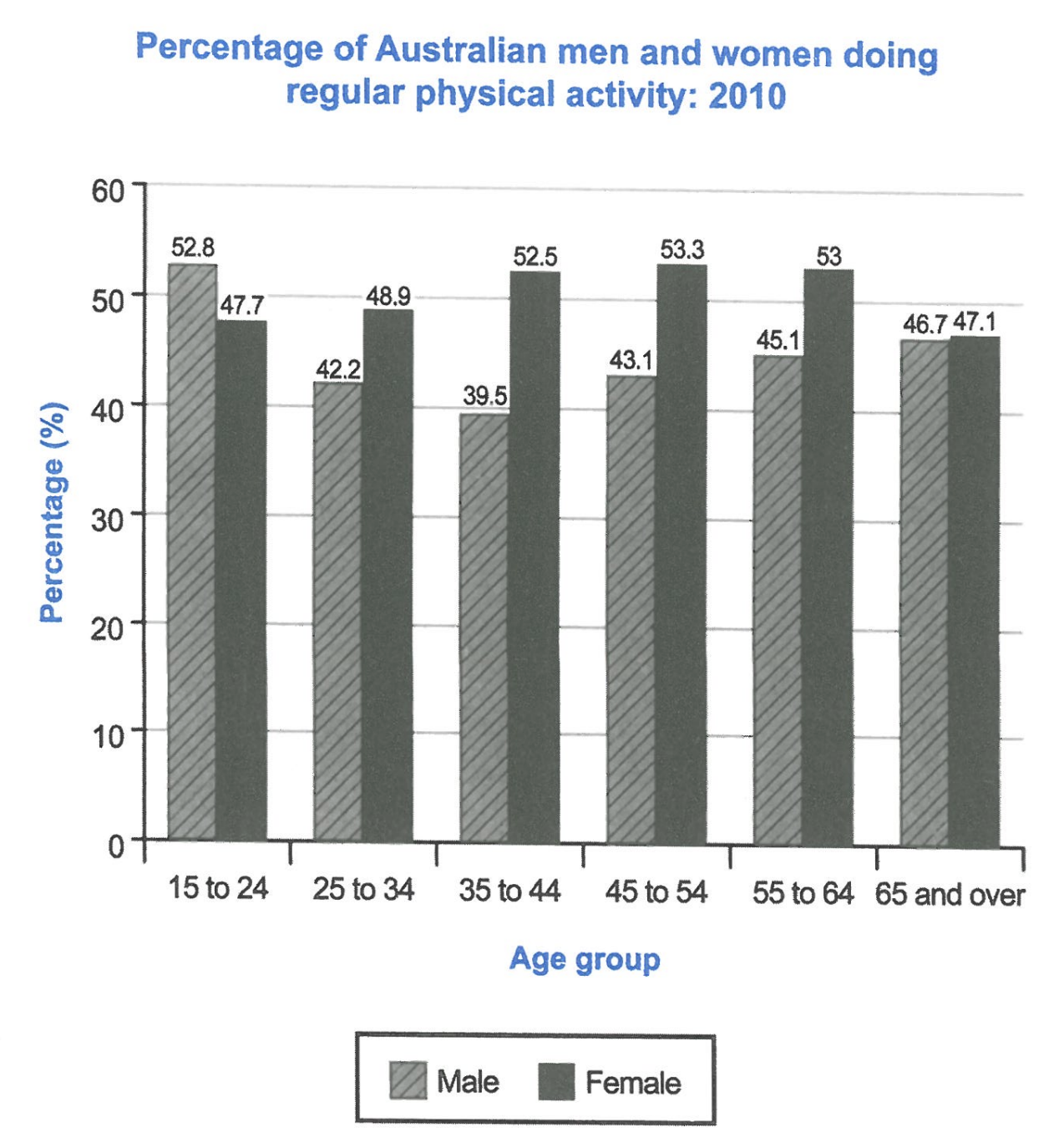
The bar chart below shows the percentage of Australian men and women in different age groups who did regular physical activity in 2010.
Summarise the information by selecting and reporting the main features, and make comparisons where relevant.
Student answer (Band 6.0)
The bar graph illustrates the proportion of Australian men and women in different age groups doing daily physical excercise in 2010.
Overall, Australian women between 25 to 64 age groups do more physical acitivity than men in the year 2010. Meanwhile, 15 to 24 age group women do less physcial excercise than men. Moreover, the age group between 65 and over is almost identical in doing physical activity.
To be more specific, there is a significant difference in men and women doing physical activity daily in 35 to 44 age group, Only 39.5% men do physical excercise where the number for women is 52.5%. This three age groups 25 to 34, 45 to 54, and 55 to 64 has 42.2%, 43.1%, and 45.1% men do daily excercise respectively, where women is 48.9%, 53.3%, and 53% respectively. Highest number of women is in 45 to 54 age group.
65 and over age group men and women has almost same percentage with 46.7% for men and 47.1% for women. And, 15 to 24, women do less excercise regualr
AI examiner evaluation
| Criterion | Band |
|---|---|
| Task Achievement / Task Response | 6.5 |
| Coherence and Cohesion | 6.0 |
| Lexical Resource | 5.5 |
| Grammatical Range and Accuracy | 5.5 |
| Overall | 6.0 |
Task Achievement / Task Response: Band 6.5
The response identifies the main pattern accurately: women exceed men in the 25–64 groups, men lead among 15–24-year-olds, and the oldest group is nearly equal. It also supports these points with several correct figures, including 39.5% versus 52.5% for ages 35–44 and 46.7% versus 47.1% for those 65 and over. This gives the overview a sound basis and covers the key comparisons. To make the report more complete, describe the overall trends across the age groups: male participation falls to a low at 35–44 before rising, while female participation generally rises to a peak at 45–54 and then declines. The final comparison is cut off, and the description of the 15–24 figures is not completed, so some features are less fully reported than others.
Coherence and Cohesion: Band 6.0
The response has a recognisable structure, moving from an introduction and overview to specific comparisons, and the age-group figures are generally presented in a sensible order. Linking expressions such as “Overall,” “Meanwhile,” and “To be more specific” help signal the purpose of each paragraph. However, some connections are mechanical or unclear. For example, “This three age groups” introduces a list awkwardly, and the final sentence ends before completing the comparison, interrupting the progression. The overview also repeats the contrast between women and men without clearly linking it to the broader trends. Grouping the figures into a clear sequence—male pattern, female pattern, then notable comparisons—and completing each point would make cohesion more consistent.
Lexical Resource: Band 5.5
The response uses relevant task vocabulary, including “proportion,” “age groups,” “significant difference,” and “percentage,” so the meaning is generally clear. However, the range is limited by repeated use of “physical exercise” and “do,” and several expressions are not natural for describing chart data, such as “Highest number of women” and “the number for women.” Spelling errors—including “excercise,” “acitivity,” “physcial,” and “regualr”—also reduce accuracy. Use more precise reporting language and check spelling carefully; for example, describe a figure as a “participation rate” and say that it “stood at” a particular percentage. These improvements would make the vocabulary more varied and appropriately formal.
Grammatical Range and Accuracy: Band 5.5
The response attempts both simple and more extended sentence forms, and most comparisons remain understandable. Some grammatical errors, however, recur in agreement, articles, and sentence construction. Examples include “This three age groups … has,” where the plural subject requires a plural verb, and “65 and over age group men and women has,” which needs a clearer subject and agreement. The phrase “Only 39.5% men do” is missing “of,” while “where women is” has incorrect agreement. The final sentence is incomplete, and the comma splice in “..., Only 39.5%...” should be corrected with a full stop or conjunction. Practise accurate comparison patterns such as “the figure for men was …, compared with … for women.”
See this exact question answered at other band scores. The same prompt compared across bands.
Browse more IELTS Writing model answers or get your own writing scored by the same AI examiner.