Band 6.0 IELTS Writing Task 1 Model Answer
Overall Band Score: 6.0 · Cambridge IELTS 12 · 2026-11-19
IELTS Writing Task 1 question
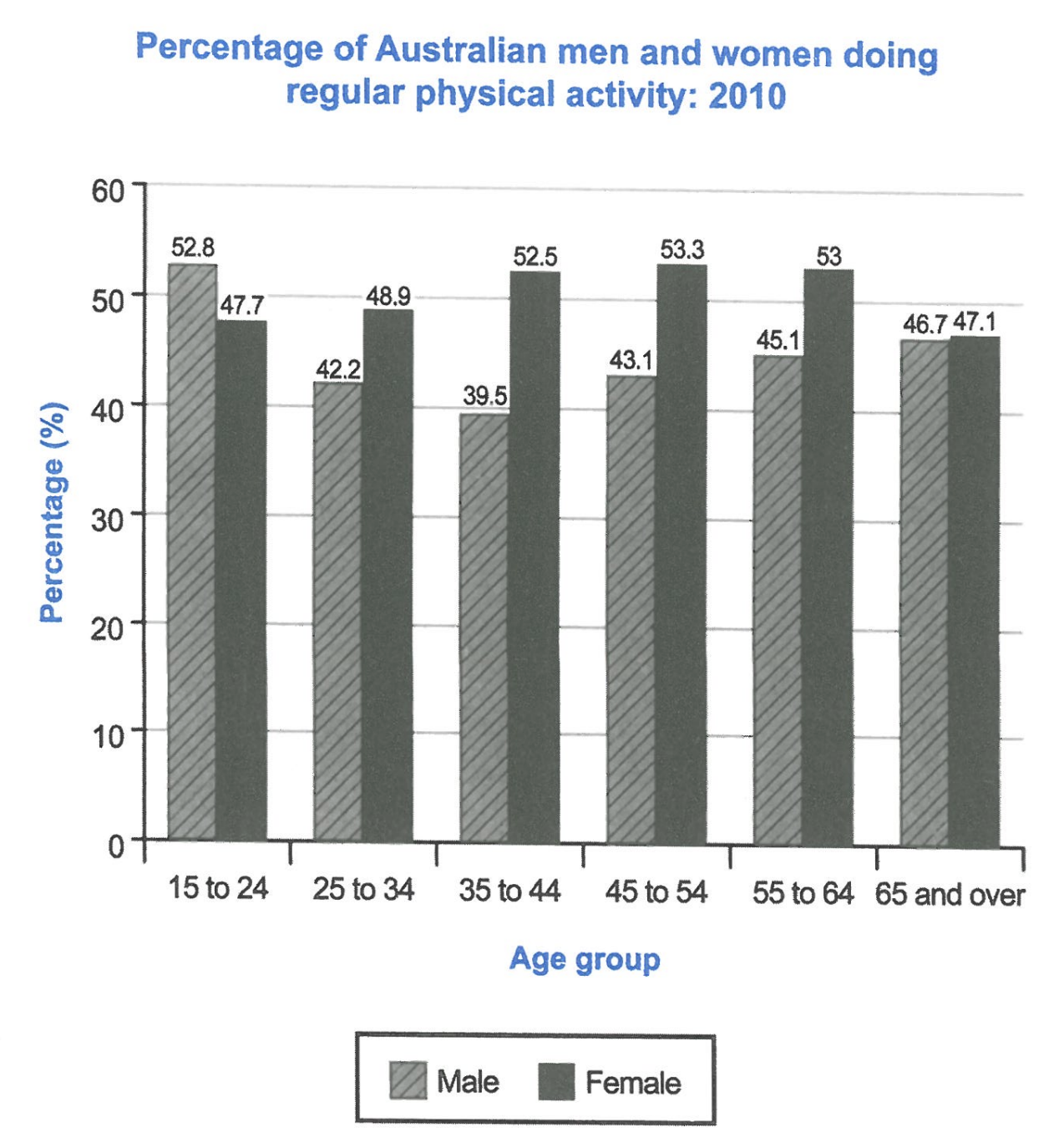
The bar chart below shows the percentage of Australian men and women in different age groups who did regular physical activity in 2010.
Summarise the information by selecting and reporting the main features, and make comparisons where relevant.
Student answer (Band 6.0)
The bar chart illustrates the proportion of Australian men and women in six age group who participated in regular physical activity in 2010.
Overall, women were more active in physical activity compare to men except the younger age group. Surprisingly, the only time men and women had a close proportion with each other was in the oldest age group.
Men from age range 15 to 24 had a proportion of 52.8 while women were at 47.7%. The highest difference between men and women in physical activity were in the age group of 35 to 44. Only 39.5% of men did physcial activity whereas women had a proportion of 52.5. Around 13% higher than men.
Men and women who were in age group of 65 and above had a similar percentage. Approximately 46.7% of the men and 47.1% of the women took part in the physical activity. A pattern can be seen in the age group from 25 to 64. Men barely reached 45% while women had 53% of them doing the activity. Men were less active compare to women.
AI examiner evaluation
| Criterion | Band |
|---|---|
| Task Achievement / Task Response | 6.5 |
| Coherence and Cohesion | 6.0 |
| Lexical Resource | 6.0 |
| Grammatical Range and Accuracy | 5.5 |
| Overall | 6.0 |
Task Achievement / Task Response: Band 6.5
The response identifies the main overall contrast accurately: women recorded higher participation in every age group except 15–24, and the figures for the oldest group were close. It also selects useful details, including the 35–44 gap and the similar rates among people aged 65 and over. This meets the task well, with some features reported precisely. However, the overview could capture the full pattern more clearly: male participation falls to its low point at 35–44 and then rises, while female participation peaks at 45–54 before declining. The statement that men “barely reached 45%” across ages 25–64 is a little broad, since the 55–64 figure is 45.1%. A fuller account of these trends would make the summary more complete.
Coherence and Cohesion: Band 6.0
The response has a clear overall arrangement: an introduction, an overview, and paragraphs giving comparisons and figures. The reader can follow the main contrast, and phrases such as “Overall” and “A pattern can be seen” help signal the direction of the discussion. However, the progression within the detail paragraphs is not always smooth. The response moves from the youngest group to the largest gap, then to the oldest group and a broad summary of ages 25–64, rather than grouping the age trends consistently. Some linking is also repetitive, particularly the repeated contrast that men were less active than women. Organising the figures by a clear pattern—such as the male trend followed by the female trend—would improve cohesion and make comparisons easier to track.
Lexical Resource: Band 6.0
Vocabulary is adequate for describing the chart, with relevant terms such as “proportion,” “age range,” “highest difference,” and “participated in regular physical activity.” The writer also uses percentage language to report comparisons, so the meaning is generally clear. However, some word choices and collocations are awkward or repetitive: “more active in physical activity compare to men,” “had a proportion,” and “took part in the physical activity” could be expressed more naturally. “Surprisingly” adds an unsupported reaction rather than an objective chart description, and “barely reached” is imprecise for a figure just above 45%. Use concise reporting language such as “the participation rate was” and “exceeded,” and vary terms for rates and activity while keeping the tone factual.
Grammatical Range and Accuracy: Band 5.5
The response uses a mix of simple statements and more developed structures, including “whereas” and the sentence beginning “A pattern can be seen…”. Most of the comparisons remain understandable, but some grammatical errors recur. For example, “six age group” needs a plural noun, and “women were more active… compare to men” has an incorrect verb form and comparison structure. In “The highest difference… were,” the subject and verb do not agree; “Around 13% higher than men” is also a sentence fragment. Articles and phrasing are sometimes awkward in “in the age group from 25 to 64.” Improving agreement, comparative constructions, and complete sentence formation would make the writing more accurate while preserving its range.
See this exact question answered at other band scores. The same prompt compared across bands.
Browse more IELTS Writing model answers or get your own writing scored by the same AI examiner.