Band 6.5 IELTS Writing Task 1 Model Answer
Overall Band Score: 6.5 · Cambridge IELTS 12 · 2026-11-19
IELTS Writing Task 1 question
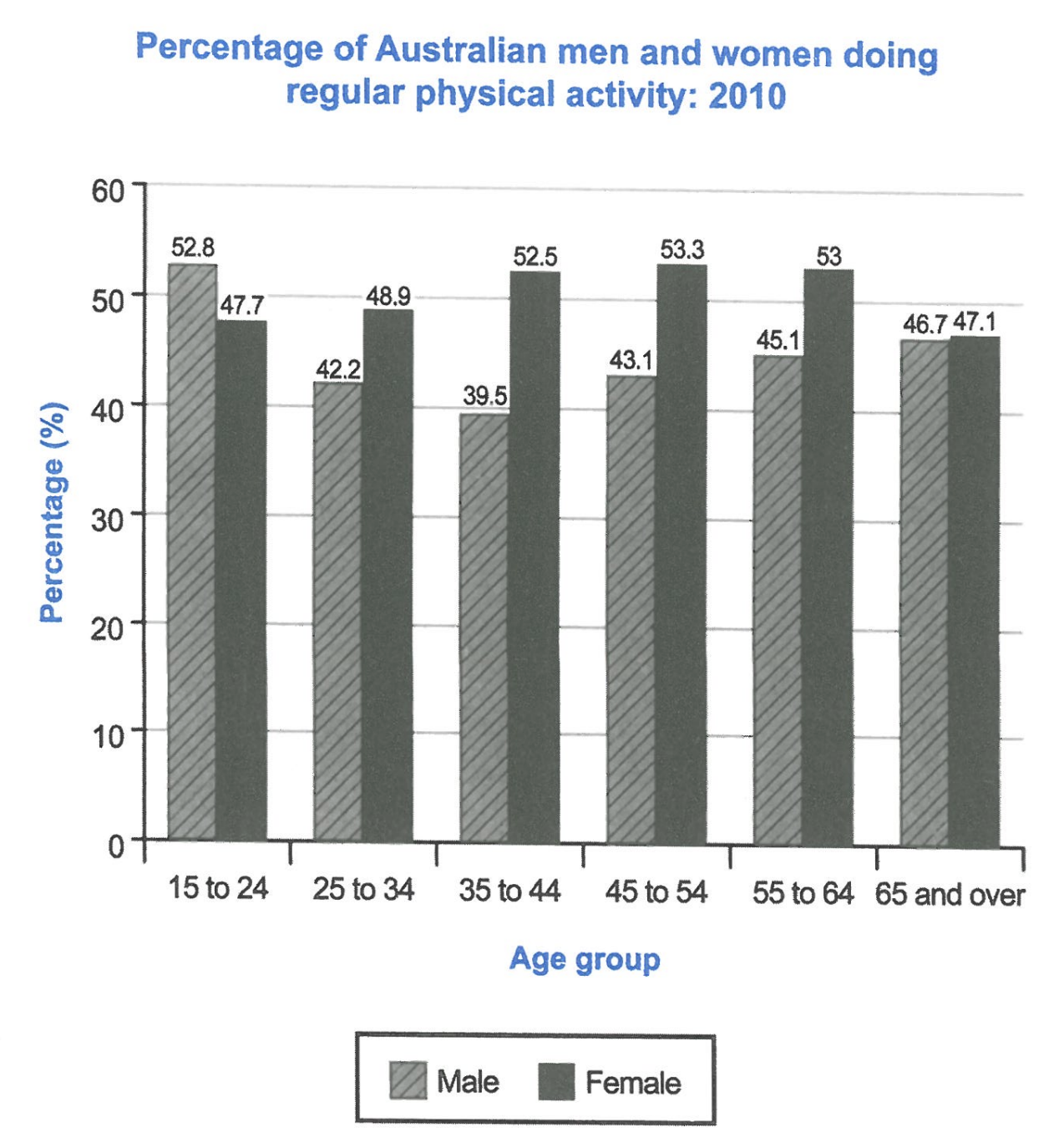
The bar chart below shows the percentage of Australian men and women in different age groups who did regular physical activity in 2010.
Summarise the information by selecting and reporting the main features, and make comparisons where relevant.
Student answer (Band 6.5)
The bar graph illustrates the percentage of male and female with different age group who do physical activity in Australia in 2010.
Overall, the proportion of men in physical activity had decreased until the age group 35 to 44 after that start increasing to 65 and over age group, while in women the activity rose by increasing age group 55 to 64 and dropped in age 65 and over.
In Australia the most of the young male showed interest in physical activity of age group 15 to 24 at 52.8%, whereas it keep declining to 39.5% at age group 35 to 44. After that it showed opposite trend and start increasing by growing age 65 and over at 46.7.
Moving towards female physical activity, 47.7 % of women like to do physical activity at the age group of 15 to 24. The percentage was keep increasing before reaching to its peak at 53% of age group 55 to 64. However, this declined to 47.1 % of 65 and over age group of women.
AI examiner evaluation
| Criterion | Band |
|---|---|
| Task Achievement / Task Response | 6.5 |
| Coherence and Cohesion | 7.0 |
| Lexical Resource | 6.0 |
| Grammatical Range and Accuracy | 5.5 |
| Overall | 6.5 |
Task Achievement / Task Response: Band 6.5
You identify the main patterns accurately: male participation falls to a low of 39.5% among 35–44-year-olds before rising, while the female figure climbs to a peak in the 55–64 group and then drops. The overview and selected figures are relevant, and the male and female trends are reported clearly enough to address the task. However, some comparisons are less fully developed: the response does not explicitly highlight that women exceed men in every age group except 15–24, nor compare the figures directly across groups. Also, the female peak is given as 53% rather than the chart’s 53.0% for ages 55–64; this is a reasonable rounding, but the 53.3% value for ages 45–54 is omitted. More direct comparisons would strengthen the summary.
Coherence and Cohesion: Band 7.0
The response has a clear four-part structure: an introduction, an overview, and separate paragraphs for male and female data. Its progression is easy to follow, and linking expressions such as “Overall,” “After that,” and “However” help signal the trends. The division by gender also makes the information straightforward to locate. To make the organisation more effective, connect the two series through direct comparisons rather than treating them almost entirely separately; for example, note that women’s rates are higher from ages 25–34 onward. Some transitions, such as “Moving towards female physical activity,” feel formulaic, and clearer referencing would help avoid repeated phrases like “age group.”
Lexical Resource: Band 6.0
You use an adequate range of task-related vocabulary, including “percentage,” “proportion,” “declining,” “increasing,” “peak,” and “opposite trend.” These choices make the main movements understandable, and the chart topic is consistently expressed. However, several word combinations are unnatural or imprecise, such as “showed interest in physical activity,” “the activity rose by increasing age group,” and “the most of the young male.” The response also repeats “physical activity” and “age group” frequently, limiting flexibility. Prefer neutral chart language such as “participation rate,” “rose with age,” and “the highest proportion.” More precise collocations would make the description sound more natural without changing its meaning.
Grammatical Range and Accuracy: Band 5.5
You attempt a mix of simple and complex forms, including a contrast with “whereas” and a time sequence using “after that.” The overall meaning remains clear, and the overview communicates both trends. Some grammatical errors nevertheless recur. For example, “male and female with different age group” has problems with number and sentence structure; “it keep declining” and “the percentage was keep increasing” use incorrect verb forms; and “before reaching to its peak” has an unnecessary preposition. Articles and agreement also need attention in phrases such as “the most of the young male.” Build accuracy by checking subject–verb agreement, plural forms, and verb patterns, and use a wider range of controlled complex sentences. Punctuation around the overview’s contrasting clauses could also be clearer.
See this exact question answered at other band scores. The same prompt compared across bands.
Browse more IELTS Writing model answers or get your own writing scored by the same AI examiner.